Read our Google Birdeye Reviews
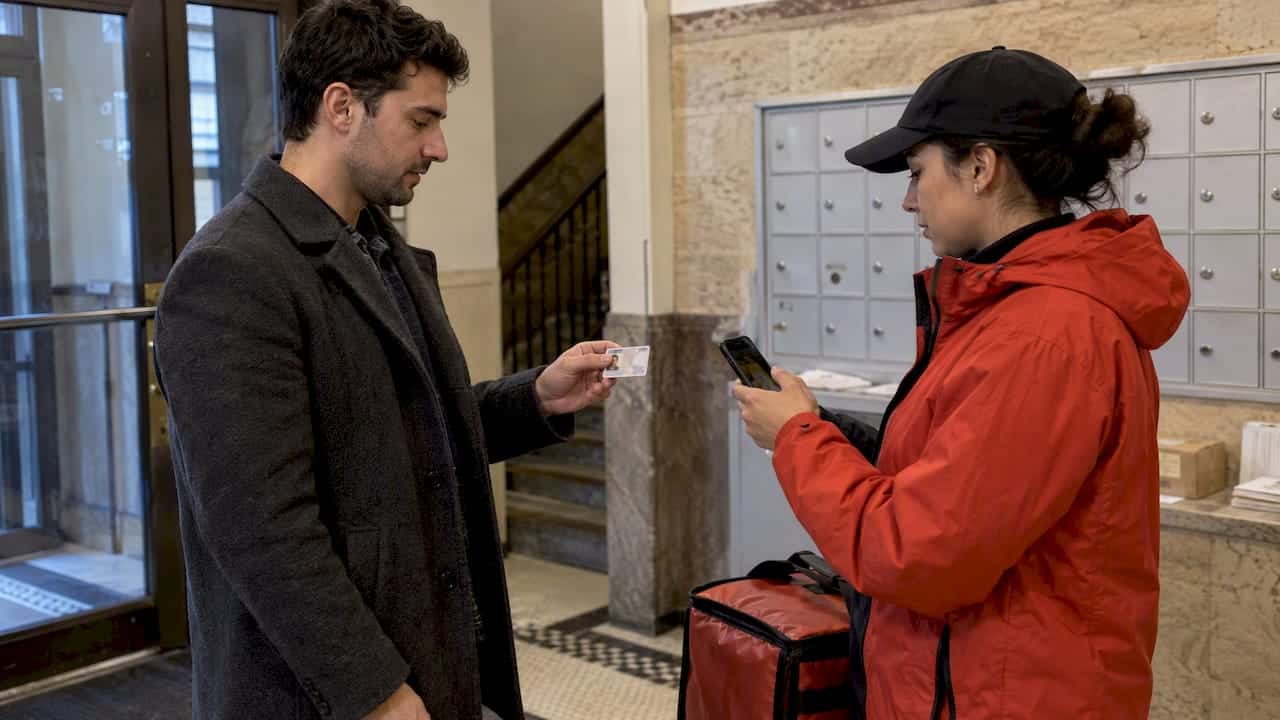
Yes, adult-use cannabis delivery is legal in New York when it comes from a licensed dispensary or delivery licensee. You must be 21 or older, show government-issued photo ID at the door, and prepay, because cash at delivery is not allowed. Deliveries go only to private residences and private businesses inside New York State. That covers NYC weed delivery laws in one breath, and the rest of this guide shows how each rule works at your door.
TL;DR:
- At handoff, recipients must be 21 or older and show government issued photo ID; an uploaded image does not replace the physical card.
- Drivers can deliver only to private residences or private businesses within New York; parks, schools, houses of worship, public spaces, and vehicles are prohibited.
- Confirm the retailer in New York’s state dispensary locator before ordering; licensed deliveries are prepaid, and cash requested at the door signals an unlicensed sale.
- Adults may possess up to 3 ounces of cannabis flower and 24 grams of concentrated cannabis, counting what they already hold at home.
- Drivers must refuse delivery if recipients cannot prove their age, appear visibly intoxicated, or request a handoff in a park or motor vehicle.
Table of Contents
- How the law makes cannabis delivery legal in New York
- Who can order and who can receive a delivery
- How a lawful delivery must be conducted
- Where deliveries may and may not be made
- What to expect when your delivery arrives
- How to verify a retailer and avoid unlicensed deliveries
- Possession limits and penalties for delivery receivers
- How we follow these rules at High Fashion Smokes & Prints
- What I’d prioritize when ordering delivery in NYC
- Get same-day delivery from a compliant NYC retailer
- FAQ
- Sources
How the law makes cannabis delivery legal in New York
New York’s adult-use market runs on the Marihuana Regulation and Taxation Act, and the Office of Cannabis Management (OCM) turns that statute into licenses, guidance and enforcement. Delivery is not a gray area. It is a regulated activity that only licensed businesses may perform, under rules written into the state’s cannabis regulations.
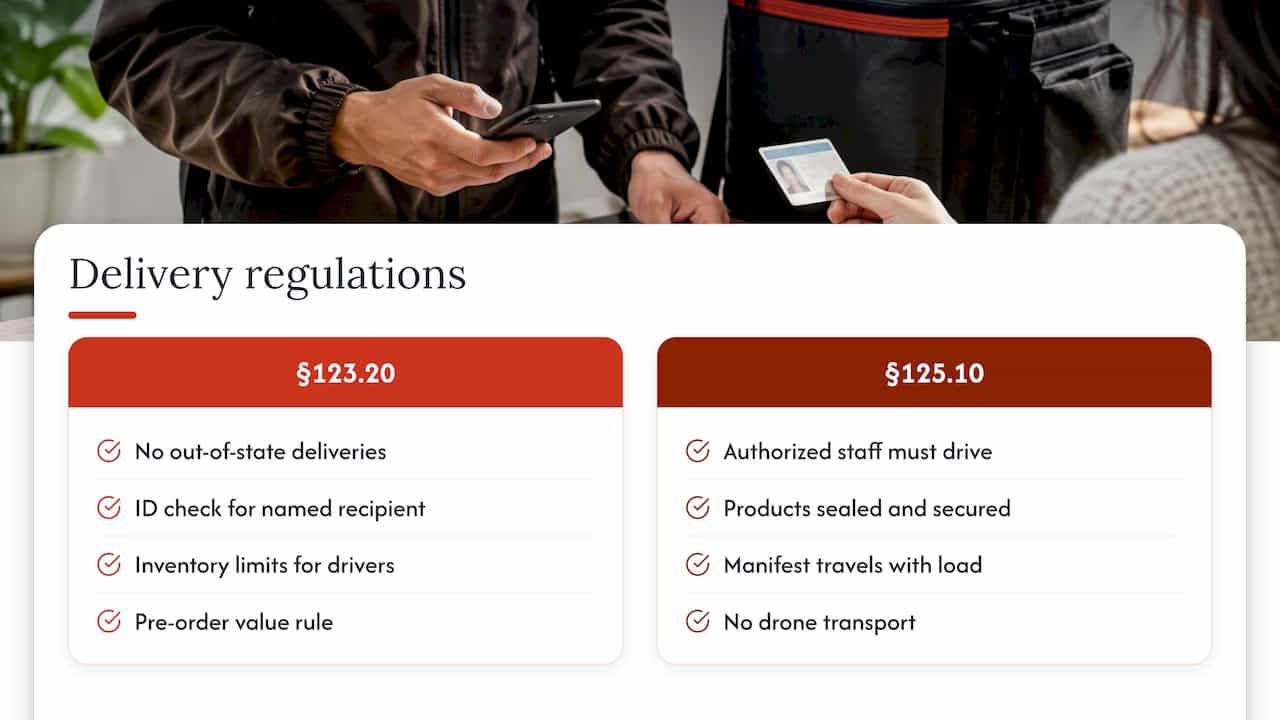
Two regulatory sections do most of the work for delivery. 9 NYCRR § 123.20 covers delivery operations: no deliveries outside New York State, no sales to someone sitting in a motor vehicle, delivery only to the person named in the order after an ID check, inventory limits for delivery employees, manifests, the pre-ordered value rule and staffing limits. Section 125.10 governs transport. It requires that licensees or authorized employees do the driving, that products are sealed and moved securely, that a shipping manifest travels with the load, and that drones are off the table. It also treats the vehicle as an extension of the licensed premises, which means inspectors can examine it.
OCM’s early delivery guidance shaped how the market launched. OCM allowed CAURD licensees to use approved warehouses to fill delivery orders while their permanent storefronts were being built. It required online prepayment only and allowed bicycle and scooter delivery alongside motor vehicles. Retail dispensary rules in 9 NYCRR § 123.10 add that a dispensary must be a physical brick-and-mortar store with posted hours before it can sell or deliver, and that it needs a written delivery plan.
Why does this matter to you as a customer? Licensed delivery means the product went through state testing, was tracked on a manifest, and sits under state oversight. The NYC Department of Health warns that buying from unlicensed stores bypasses state testing and quality controls, and it points consumers toward retailers that display the official New York State Licensed Cannabis Dispensary decal.
Local enforcement follows the same logic. A delivery from a licensed operator is part of the regulated system. A delivery from anyone else is an unlicensed sale, no matter how professional the website looks or how friendly the text thread feels.
Who can order and who can receive a delivery
Only adults 21 and older may order or accept an adult-use delivery. That age line applies to the person who places the order and to the person who ends up holding the bag at the door. The state’s age verification rules in the Cannabis Law require retailers to use valid government-issued photo ID, and the information scanned must match the physical ID presented at delivery. Those details are recorded in the retailer’s point-of-sale system.
Online orders carry an age attestation, a checkbox or prompt where the buyer confirms they are 21 or older. That attestation is only the first step. The OCM consumer delivery FAQ is explicit that delivery employees must verify government-issued ID at delivery even if you uploaded ID during checkout. The upload gets your order approved. The physical card gets your order handed over.
Here is what to have ready and what to expect:
- Acceptable ID: a driver’s license, passport or military ID, the standard government-issued photo documents.
- Same person orders and receives: the driver checks your ID against the order and records it.
- Different person receives: both the orderer and the recipient must be 21 or older, and both identities must be recorded in the retailer’s point-of-sale system.
- Physical ID in hand: a screenshot or a photo of a card on your phone is a poor substitute for the real thing, so keep the card where you can grab it quickly.
- Name match: the name on the ID should match the name on the order, because the delivery goes to the individual detailed in the order.
The different-person case trips people up most often. Say you order for a friend who is visiting from out of town and they sign for it. That can work, but only if your friend is 21 or older and the retailer logs both of you. If either of you is under 21, or if the recipient cannot produce ID, the driver has to turn around with the order.
Doormen and building staff are a related wrinkle. A lobby handoff only works when the person receiving the order is the person named on it and can prove their age. If you live in a building with a front desk, plan to meet the driver downstairs or arrange the handoff ahead of time. Our guide on two step age verification for NYC deliveries walks through how to keep that process clean, and our page on ID requirements for NYC weed delivery covers checks that can help prevent an order from being refused.
How a lawful delivery must be conducted
Knowing the operational rules lets you spot a legitimate delivery at a glance. Every step below is something the licensed operator is required to do, not a courtesy.
- The order starts at a licensed source. All deliveries must originate from a licensed retail dispensary or from an OCM-approved warehouse operating under a written delivery plan.
- You prepay. Every legal delivery is paid for online or by phone before the driver leaves. If a service asks for cash on arrival, it is operating outside the licensed system.
- The driver travels by ground. Permitted modes are car, van, bicycle, scooter or on foot. Drones are not permitted.
- The handoff never happens in a vehicle. The sale cannot be completed while you are inside a motor vehicle, so meeting a driver at your car window is out.
- Paperwork rides along. A shipping manifest and invoice must accompany the products and be available for inspection.
- Inventory stays inside the limits. Delivery employees carry capped amounts of product, and a share of what they carry must already be spoken for by pre-paid orders.
That last point has numbers behind it. Under the delivery rules, a delivery employee may carry up to $20,000 in retail value when the products are in an enclosed, locked compartment and $5,000 when they are not. Separately, the pre-ordered value rule means that after January 1, 2025, a minimum share of what the driver holds must be pre-paid.
Per 9 NYCRR 123.20, starting after January 1, 2025, at least 30% of the retail value of the products in a delivery employee’s possession must be pre-ordered and paid for before they depart the licensed premises. In plain terms, drivers cannot roam the city with a trunk of unclaimed product waiting for walk-up buyers. Most of what they carry has an order attached.
A licensed driver is delivering orders that already exist. Someone who texts you “I’m nearby with a full bag, want anything?” is describing exactly the model the rule was written to stop.
Staffing is regulated too. Transport employees must meet age and ID requirements of their own, and the regulations limit how many delivery staff can be working under a license. As a customer you will not see those limits directly, but you will see their effect: a driver who can show who they work for, carries a manifest and does not rush the ID check.
Prepayment also protects you. Because the money moves before the product does, there is no cash on a doorstep, no change-making and no reason for the handoff to take more than a minute or two. Our same-day compliance checklist follows these same steps from the ordering side.
Where deliveries may and may not be made
Delivery addresses are limited on purpose. Knowing the map of allowed and prohibited drop-offs saves you a refused order.
Allowed delivery locations:
- Private residences, whether you live there year-round or are staying short term
- Private businesses within New York State
Prohibited delivery locations:
- Public buildings and public spaces such as sidewalks, plazas and parks
- School grounds and day-care centers
- Houses of worship
- Any handoff to a person inside a motor vehicle
Those prohibitions come straight from the OCM consumer FAQ, which tells drivers to refuse such requests. If you ask a driver to meet you at a park entrance or a corner by a school, expect a polite no. They are following the law, not being difficult.
The New York State line matters as well. Under § 123.20, deliveries outside the state are illegal, and a driver who cannot complete a lawful delivery must return the undelivered product to the licensed premises. So an order to a New Jersey address from a New York license will not be fulfilled, no matter how close the address is to the city.
Short-term stays raise the most questions. Whether a hotel room or short-term rental qualifies as a private residence is not established here, so check with the retailer before placing an order. A hotel lobby, a hostel common room or a rooftop open to the public is different. When in doubt, give the driver a specific private address and a unit number rather than a landmark.
Consumption is a separate question from delivery. Getting an order to a private address does not establish where cannabis may be consumed, and our breakdown of NYC park smoking rules discusses the issue.
What to expect when your delivery arrives
A lawful delivery is short and predictable. Here is how it usually unfolds so nothing catches you off guard:
- Be reachable. Watch for the call or text that says the driver is close, and plan to be at the door or lobby.
- Show your physical ID. Hand over the actual card. The driver compares it to the name and details on the order and logs the check.
- Confirm the order. The driver completes the handoff according to the retailer’s process.
- Receive the invoice or receipt. Ask the retailer what purchase documentation it provides, and keep it for your records.
- Skip the cash. The order is already paid, so nothing changes hands but the product and the paperwork.
Drivers will refuse delivery in a few predictable situations. They cannot hand over an order if the recipient cannot prove age, if the recipient appears visibly intoxicated, or if the recipient asks to move the handoff to a prohibited place such as a park or a car. Those refusals are not personal. The driver’s license, and the retailer’s, depend on getting those calls right.
When a delivery is refused, the paper trail matters. The manifest and invoice document the attempt, which protects the driver, the retailer and you. If you believe a refusal was a mistake, contact the retailer’s support and have the order details handy. Our guide to signature and retailer rules explains how to avoid the most common refusals, and our delivery checklist covers ID, no cash and doorman rules in a format you can skim before the driver arrives.
Pro Tip: Put your ID somewhere you can reach quickly, and tell your doorman or front desk who is coming and for which unit, so the lobby handoff does not stall.
Timing helps too. Evening hours are busy, and a driver running behind has less patience for a missed call. If your schedule is tight, check how delivery times vary by city and schedule your window before the evening rush, or consider scheduled delivery for apartments so someone is ready at the door.
How to verify a retailer and avoid unlicensed deliveries
Anyone can build a polished website. What separates a licensed business from an impostor is a record in the state’s own system, and you can check it quickly.
The OCM requires regulated dispensaries to appear in the state’s Dispensary Location Verification tool, so consumers can confirm licensing and status. Retailers are also expected to post the verification tool near their entrance and keep their locator listing accurate. Before your first order from any retailer, run this quick check:
- Search the state dispensary locator for the business name and address, and confirm it shows as licensed.
- Look for the state decal. The NYC Health Department points consumers to the official New York State Licensed Cannabis Dispensary decal as a sign you are in the regulated market.
- Ask for lab results. A certificate of analysis (COA) for the products you want is a good sign when the retailer offers it.
- Read the website for license information. A legitimate operator is not shy about it.
Red flags are just as useful. Walk away if a seller asks for cash, offers to meet you in a public space, can’t be found in the state locator, or runs a website that never mentions a license.
The NYC Department of Health reports 729 adult-use cannabis dispensaries licensed statewide, so there is no shortage of licensed options to choose from.
With that many licensed businesses available, there is little reason to gamble on a stranger’s text message.
Possession limits and penalties for delivery receivers
Receiving a lawful delivery does not change the possession rules. Adults 21 and older in New York may legally purchase and possess up to 3 ounces of cannabis flower and 24 grams of concentrated cannabis. Those limits are the ceiling for what you may hold, however you came by it.
Going above the allowed amounts can be unlawful. Check the applicable law for the consequences of possessing more than the allowed amounts. If you are stocking up, keep your total inside the line, and remember that the limits apply to what you have on you and at home combined with what is delivered.
The bigger risk for most receivers is not quantity but source. Cannabis from an unlicensed seller skips state testing, tracking and quality controls, which is the health concern the NYC Department of Health raises about unlicensed stores. The law also limits distribution to licensed actors, so an unlicensed seller is breaking the rules even if you are only the customer. Staying with licensed retailers keeps you on the safe side of both the law and your own health.
How we follow these rules at High Fashion Smokes & Prints
We built our delivery process around the same rules covered above. Our same-day delivery service runs with age verification, so the legal steps are part of ordering, not an afterthought.
Here is the short checklist we hand every customer:
- Verify the retailer’s license in the state locator.
- Prepay online, with no cash at the door.
- Keep your physical ID ready.
- Choose a private address, never a public space or a vehicle.
- Confirm the invoice when the order arrives.
For step by step ordering guidance, see our same-day compliance checklist, which walks through those points from checkout to doorstep.
What I’d prioritize when ordering delivery in NYC
If I could give one piece of advice, it would be to treat verification as part of the purchase, not a hurdle before it. Most refused deliveries and most bad experiences trace back to two things: a retailer that was never licensed, and a customer who was not ready at the door.
Pick a licensed retailer and walk away from any offer that involves cash on arrival. Keep your ID where you can find it, and send the driver to a private address with clear directions, which removes most handoff problems before they start. A quick, friendly text about the building entrance or the doorman goes a long way, and a tip for a driver who made your night easy is a practical way to build trust and keep future deliveries smooth.
— Jake
Get same-day delivery from a compliant NYC retailer
If you want to follow the legal steps, we offer same-day delivery across NYC with age verification built in. You can read our compliance checklist, pick a delivery window and place your order in one sitting. Delivery fees are listed by borough, starting at $8 for Queens and $12 for Manhattan or $12 for the Bronx.

- Same-day delivery across NYC, with ID verified at the door
- Prepaid checkout, so no cash is ever exchanged
- Delivery windows you can schedule online
Browse the menu and book your delivery at High Fashion Smokes & Prints and have your ID ready when we arrive.
This article is general information, not a substitute for advice from a qualified lawyer. Consult a qualified legal professional about your own circumstances before acting on anything here.
FAQ
Is weed delivery legal in New York City?
Yes, when the order comes from a licensed dispensary or delivery licensee. You must be 21 or older, show government-issued photo ID, and prepay, because cash at delivery is not allowed. Deliveries from unlicensed sellers fall outside the regulated system.
Do I have to pay in advance for a weed delivery?
Yes. Every legal delivery in New York is prepaid online or by phone. If a delivery service asks for cash when it arrives, it is operating outside the licensed system.
Where can a cannabis delivery be dropped off?
Only at private residences and private businesses within New York State. Public spaces, parks, schools, day-care centers, houses of worship and motor vehicles are off limits, and drivers must refuse those requests.
How can I tell if a delivery service is licensed?
Search for the business in the state’s Dispensary Location Verification tool and look for the official state decal. A seller that is missing from the locator or asks for cash is a red flag.
Sources
- Cannabis (Marijuana) – NYC Health
- N.Y. Comp. Codes R. & Regs. Tit. 9 § 123.20 – Delivery Operations | State Regulations | US Law | LII / Legal Information Institute