Read our Google Birdeye Reviews
Most weed delivery arrives within 30 to 90 minutes, with same-day orders stretching to two hours during evening peaks or landing next-day near closing time. A scheduled time slot is the more reliable choice once demand picks up, while an ASAP order works fine midday. Licensed delivery also runs inside set operating hours, so timing your order around those windows matters as much as picking ASAP versus scheduled.
TL;DR:
- Choose scheduled slots on evenings and weekends, when batching makes arrival times less predictable; use ASAP midday, when demand is lighter.
- Pickup lasting over 10 minutes or transport exceeding 17 minutes raises delay risk, while lobby handoffs and clear entry details reduce avoidable access delays.
- California permits delivery from 6 AM to 10 PM, while New York hours vary by municipality; orders near closing may move to the next day.
- Keep valid ID ready because every licensed handoff requires identity and age checks, and confirm your phone number and entry instructions to avoid missed deliveries.
Table of Contents
- Typical Delivery Times and City Examples
- How Scheduled Slots, ASAP Orders, and Batching Shape Your Arrival Time
- Main Factors That Lengthen or Shorten Delivery Time
- Legal and Operational Hour Constraints on Delivery Windows
- How to Speed Up Your Delivery and Avoid Missed Handoffs
- How High Fashion Smokes & Prints Keeps NYC Deliveries on Time
- Rescheduling, ID Checks, and No-Contact Handoff Rules
- How Dispensaries Manage Inventory for Prompt Same-Day Delivery
- How Order Size and Product Availability Affect Delivery Time
- Flower vs. Edibles vs. Vapes: Does Product Type Change Delivery Speed
- Jake’s Quick Take: Simple Rules That Actually Hold Up
- Ready for Reliable Same-Day Delivery in NYC
- FAQ
- Sources
Typical Delivery Times and City Examples
Delivery speed depends heavily on where you live, what time you order, and how your building is set up. A ground-floor walkup in a quiet neighborhood gets a driver to the door faster than a doorman building on a packed Friday night.
Across major markets, the ranges tend to cluster predictably:
- New York City: 30 to 90 or more minutes, depending on the borough and whether the building requires lobby check-in or elevator access.
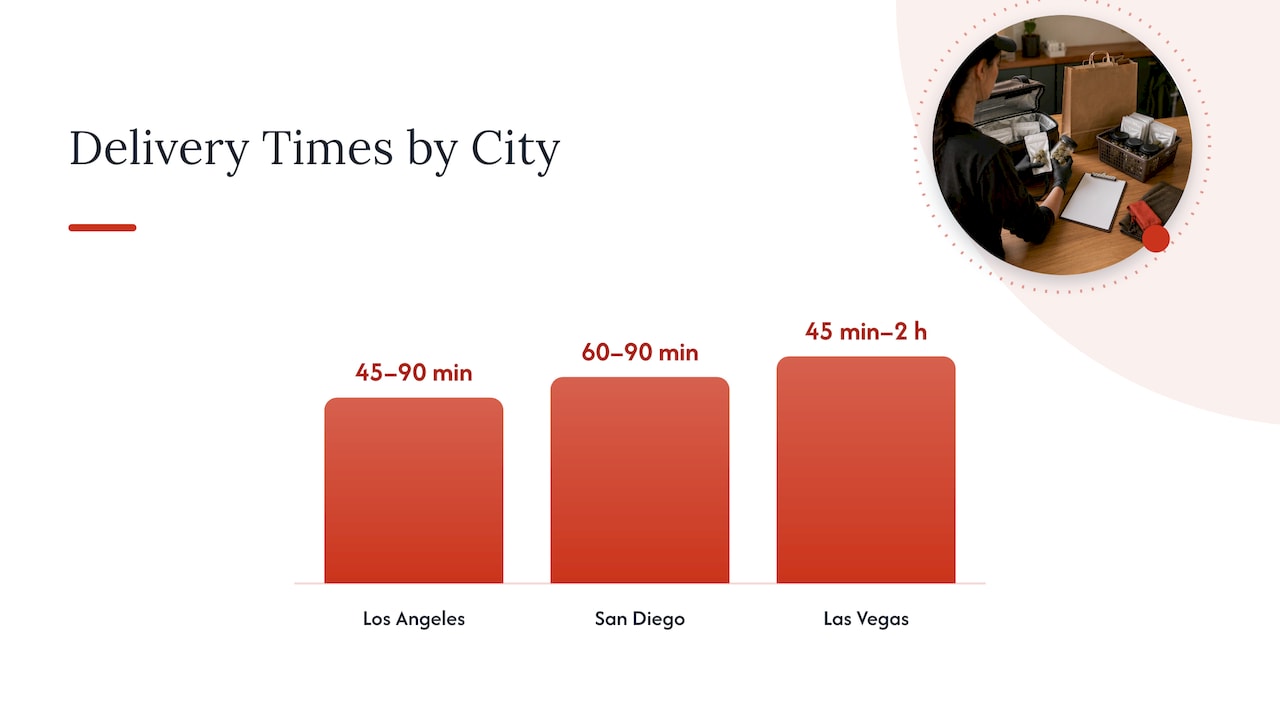
- Los Angeles: 45 to 90 minutes is common for most zip codes during regular hours.
- San Diego (92101): roughly 60 to 90 minutes is typical for downtown orders.
- Las Vegas: 45 minutes to 2 hours, with the wider range tied to how close the order falls to opening or closing.
- Philadelphia: many retailers use fixed windows instead of live ETAs, such as 1 to 3 PM, 4 to 6 PM, or 7 to 9 PM slots.
Orders placed close to closing time, or in areas near the edge of a delivery zone, sometimes shift to next-day fulfillment instead of same-day. That’s not a failure on the retailer’s part. It’s a function of operating hours and route coverage, which we cover in more detail below.
Look for a retailer that offers live tracking or text updates on your ETA. Those signals tell you whether a driver is genuinely en route or whether your order is still queued for dispatch, which matters more than the raw time estimate on the checkout page.
How Scheduled Slots, ASAP Orders, and Batching Shape Your Arrival Time
A scheduled slot reserves a spot on a driver’s route ahead of time, which means dispatch already knows when and where that stop happens. An ASAP order instead drops into a live queue, where it often gets grouped with other nearby orders to cut down on total driving time.
That grouping, known as batching, is efficient for the business but adds variability for you. A single driver might carry three or four orders at once, so your spot in that sequence determines whether you get the 30 minute end of the range or the 90 minute end.
A general guideline for choosing between ASAP and scheduled delivery is:
- Use ASAP orders during less busy times, such as mid-morning to early afternoon, when there is lighter demand.
- Opt for scheduled slots during evenings and weekends when demand increases and batching can cause more variability.
- If you need your order by a specific time, scheduling is generally more reliable than ASAP, as it reserves your spot instead of depending on the queue at the order time.
Pro Tip: Book the earliest available scheduled slot you can rather than gambling on an ASAP order once evening demand ramps up.
Main Factors That Lengthen or Shorten Delivery Time
Delivery times follow a predictable daily pattern: slower in the evening rush, faster in the quieter midday stretch. Demand tends to hump upward through the afternoon and peak right around dinnertime, which is exactly when batching gets heaviest.
A few specific factors do most of the work in determining your actual wait:
- Pickup and prep time at the dispensary. Orders that take more than 10 minutes to prepare and hand to a driver carry meaningfully higher delay risk.
- Route batching. When one order in a driver’s queue runs late, every stop after it tends to run late too, a pattern researchers call delay propagation.
- Building access. Doorman buildings, gated complexes, and limited parking all add dwell time at the door, even after the driver has arrived on your block.
A causal study of on-demand delivery delays found that transport and pickup durations are the largest contributors to delivery lateness. Transport accounts for just over half of total delivery time, and pickup a significant portion as well. The study found that a notable share of orders experience delays, and that pickup times exceeding 10 minutes or transport times exceeding 17 minutes significantly increase delay risk.
Minimizing your own building’s friction, like meeting a driver in the lobby instead of asking them to find your unit, is one of the few delay factors you actually control.
Legal and Operational Hour Constraints on Delivery Windows
Licensed cannabis delivery doesn’t run around the clock, and understanding the CBD legal in Deutschland framework can provide additional context on varying international regulations. Most states set operating windows, and local governments can tighten them further.
- California generally allows licensed delivery between 6 AM and 10 PM, based on Los Angeles delivery inspection guidance, and delivering outside that window counts as a major violation. Individual cities can set stricter limits on top of the state rule.
- New York leaves dispensary hours largely up to municipalities, and state guidance confirms that a dispensary can accept an order outside its hours but can’t complete the delivery until it reopens.
- Some New York municipalities bar cannabis operations between midnight and 8 AM entirely, unless a local law specifically allows it.
That’s why an order placed 20 minutes before closing often gets bumped to the next available slot rather than rushed out the door. The retailer isn’t stalling. It’s working inside a legal window that doesn’t bend for a late-night order.
How to Speed Up Your Delivery and Avoid Missed Handoffs
A few habits on your end can shave real minutes off your wait and prevent a missed handoff entirely.
- Choose a scheduled slot for evenings and weekends, and switch to ASAP only when you’re ordering midday.
- Give exact entry instructions, buzzer number, floor, or a specific curbside spot, so the driver isn’t searching for your door once they’ve already arrived.
- Keep a valid ID ready, confirm the phone number on your account is current, and use contactless verification where the retailer offers it.
- If a delivery runs late, note the time and check the retailer’s reschedule or refund policy instead of guessing at what you’re owed.
Checking your retailer’s live tracking link before you call or text support also saves time. Most delay questions get answered by the map, not by a phone call.
Pro Tip: A clear “meet in lobby” note in your delivery instructions can turn a multi-minute doorman delay into a handoff that takes under a minute.
How High Fashion Smokes & Prints Keeps NYC Deliveries on Time
We built our ordering flow around the same scheduling logic covered above. Customers can pick same-day delivery or reserve a specific window through our scheduled delivery option, and our day and night menus let you browse and check out whenever it’s convenient, with age verification and delivery tracking built into checkout.
For NYC apartment buildings specifically, we outline lobby and doorman handoff steps so a driver isn’t guessing at building access:
- Our delivery hours guide explains what same-day actually means depending on when you order.
- Our handoff etiquette checklist covers ID, payment, and doorman rules in under 90 seconds of reading.
- Our delay troubleshooting guide walks through the most common reasons for a late order and how to fix them.
Rescheduling, ID Checks, and No-Contact Handoff Rules
Every licensed delivery requires age and identity verification at the door, which means a driver checks a valid ID before handing over your order, regardless of how you paid. This isn’t optional paperwork. It’s part of the compliance record-keeping that regulators require for every completed trip.
Signature requirements vary by retailer, but most ask for some form of acknowledgment that the order was received by the person named on the account, not a roommate or neighbor. No-contact handoff options exist at many retailers, letting you specify a lobby drop, a doorman handoff, or a curbside meeting point instead of a door-to-door exchange, though ID verification still happens before the order changes hands.
If your schedule shifts, most retailers allow a reschedule rather than a cancellation, often with a window of notice required to avoid a fee. Checking the specific rescheduling policy before your delivery window opens is faster than trying to redirect a driver who’s already en route. Giving accurate building instructions upfront, floor number, buzzer code, or a named curb location, cuts down on the back-and-forth that turns a routine handoff into a delay for you and for the next customer on that driver’s route.
How Dispensaries Manage Inventory for Prompt Same-Day Delivery
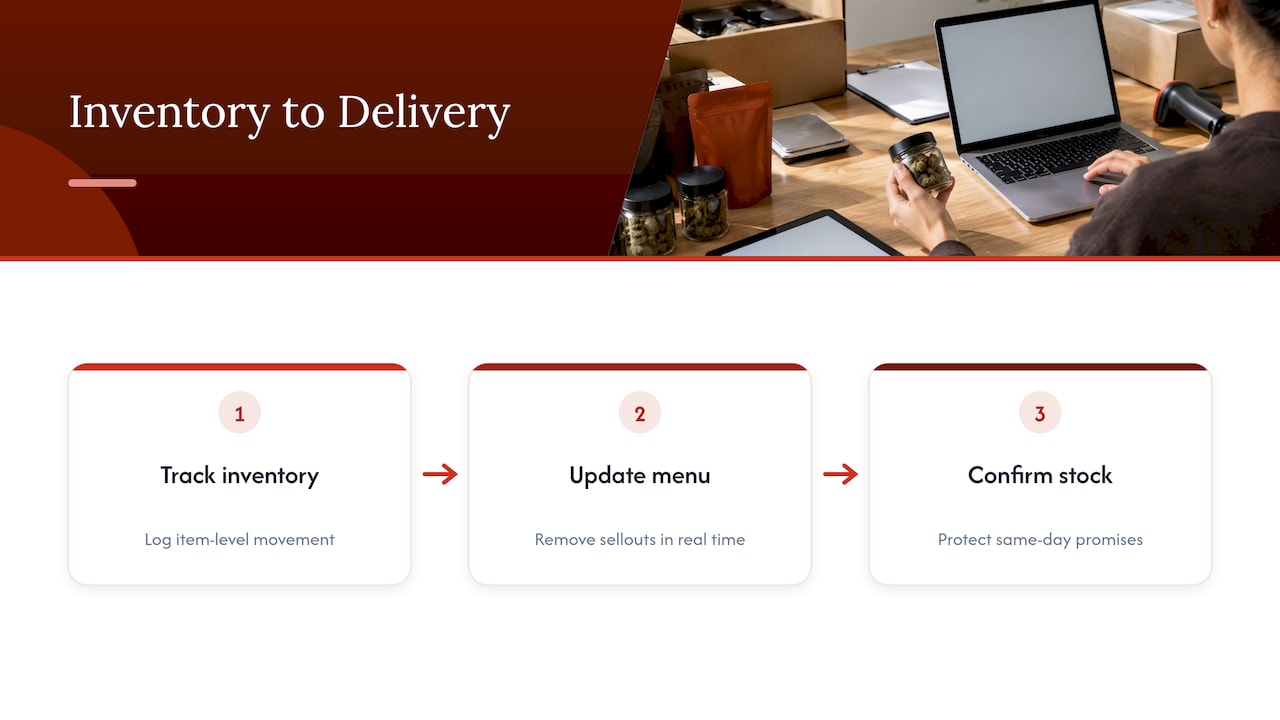
Same-day delivery depends on a retailer knowing exactly what’s in stock before an order ever reaches a driver. Retailers operating under California’s track-and-trace requirements maintain a delivery inventory ledger that records what left the building, what time it departed, and what was actually delivered, down to the item level. That ledger isn’t just a compliance box to check. It’s also what keeps a menu accurate, so a customer doesn’t order a product that’s already out of stock.
Real-time inventory tracking means a dispensary can update its online menu the moment a product sells out rather than waiting for a daily recount, which directly protects same-day promises. A menu that lags behind actual stock creates the single most frustrating kind of delay: the order that gets confirmed, then canceled an hour later because the item never existed to deliver.
Day and night menu structures, like the ones we run, also help by splitting inventory visibility into two distinct windows, so what’s available at 2 PM doesn’t get confused with what’s been restocked for the evening rush. Keeping that separation accurate is less about generating options and more about making sure the thing you click “buy” on is still sitting in a driver’s bag an hour later.
How Order Size and Product Availability Affect Delivery Time
A small order of one or two items, especially something already sitting in a prepped bin, moves through pickup faster than a large multi-category order that requires someone to walk the floor and pull five different products. That extra prep time matters because pickup durations longer than 10 minutes measurably raise delay risk for the rest of the trip.
Product availability plays an equally large role. An item that’s in stock and sitting at the front counter gets bagged and handed off in minutes. An item that’s low in stock, stored in a back room, or needs a manual count takes longer to prep, and that extra prep time pushes back everything downstream, including the driver’s next three stops if your order is part of a batch.
If you’re ordering something unusual or in bulk, placing that order earlier in the day, or scheduling a slot instead of going ASAP, gives the dispensary time to prep accurately without rushing. A rushed large order is also more likely to arrive with a substitution or a missing item, which creates its own follow-up delay while a replacement gets arranged.
Flower vs. Edibles vs. Vapes: Does Product Type Change Delivery Speed
The product category itself rarely changes how fast a driver can drive to your address, but it does change how long prep takes before the driver ever leaves the building. Flower and pre-rolls are usually pre-packaged and ready to grab, which keeps pickup time short. Edibles, concentrates, and THC beverages sometimes require more careful handling, temperature consideration, or double-checking dosage labeling before they go into a delivery bag.
Vapes and accessories tend to move at the same pace as flower since they’re typically shelf-stable and pre-packaged. Multi-category orders, say flower plus edibles plus a vape, take a bit longer to assemble than a single-category order, simply because more hands and more checks are involved before the bag is sealed.
None of this changes the drive time once a driver leaves, but it does affect that 10 minute pickup threshold mentioned earlier. An order built entirely from fast-pick categories is less likely to tip into the slower side of your ETA range than one that mixes several product types together.
Jake’s Quick Take: Simple Rules That Actually Hold Up
Schedule for evenings and weekends, go ASAP midday, and build in extra time for anything ordered close to closing. Those three habits cover most of what causes a late delivery. Research on delivery patience even suggests that accepting just 5 to 10 extra minutes of flexibility can noticeably improve reliability across a whole fleet of drivers, and that small trade-off tends to pay off for you too.
— Jake
Ready for Reliable Same-Day Delivery in NYC
We’ve built our ordering process around the scheduling logic in this guide: pick a time that fits your evening, or let us route you through ASAP when demand is light. Our same-day delivery page covers day and night menus, age verification, and tracking from checkout to your door.
- Book a reliable arrival window through our scheduled delivery page.
- Living in a doorman building? Our lobby handoff guide shows what to expect at the door.
- New to ordering online? Start with our step-by-step compliance checklist.
FAQ
Will DoorDash Ever Deliver Weed?
Major third-party delivery apps currently don’t carry licensed cannabis orders because of federal restrictions on interstate platforms handling a federally illegal substance. Licensed cannabis delivery instead runs through dispensary-operated fleets or cannabis-specific delivery platforms, not general delivery apps.
Where Can I Get 24-Hour Weed Delivery in San Diego?
True around-the-clock cannabis delivery is uncommon because most jurisdictions set operating hours for licensed retailers rather than allowing round-the-clock service. In San Diego, typical delivery windows run during standard daytime and evening hours, with ETAs commonly falling in the 60 to 90 minute range for downtown addresses.
Why Do Weed Delivery Drivers Take So Long?
Delays usually trace back to pickup prep time, route batching with other orders, or building access issues like doorman check-in. A causal delivery delay study found pickup and transport time are the two biggest contributors, and that one late order can push back every stop that follows it.
Is Weed Delivery Legal in NYC?
Licensed cannabis delivery is legal in New York, subject to state and municipal rules on operating hours. Some municipalities restrict delivery between midnight and 8 AM unless specifically authorized, so hours can vary by location even within the state.
How Fast Is Weed Delivery Compared to Food Delivery?
Weed delivery ETAs land in a similar range to food delivery, typically 30 to 90 minutes, though cannabis orders carry extra steps like ID verification that food orders don’t require. Scheduled slots tend to be more common for cannabis delivery than for food delivery, since the ID check and signature requirement reward a reserved window over a live queue.
Sources
- A causal discovery and inference framework for on-demand food delivery delays | npj Sustainable Mobility and Transport
- Record-keeping/track-and-trace requirements for deliveries – Department of Cannabis Control
- Delivery Inspection Webinar_new
- The Value of Patience in Online Grocery Shopping