Read our Google Birdeye Reviews
Scheduled weed delivery beats ASAP ordering when what you actually want is certainty: a known window, a driver who shows up when they said they would, and no missed handoff with your building’s front desk. The system runs on inventory checks at checkout, dispatch planning that groups nearby orders, and cutoff rules that lock in your slot. For anyone who orders regularly, setting up a recurring delivery removes the guesswork entirely.
TL;DR:
- Scheduling your weed delivery ensures you get a known window, timely handoff, and better coordination with building access, especially for apartments and gated communities.
- Orders placed early in the day or during off-peak hours typically have tighter timing and lower fees, with early slots offering the best chance for on-time delivery.
- Recurring scheduled deliveries are ideal for frequent users, as they automate repeat orders, reduce checkout friction, and help meet free delivery thresholds.
- Delivery fees are lower for standard scheduled windows, while express or priority requests during peak times carry higher surcharges and tipping norms remain around 10 to 20 percent.
- Proper preparation, such as providing detailed instructions and booking early slots, significantly increases the chances of a smooth, on-time delivery experience.
Table of Contents
- Why Scheduled Weed Delivery Benefits Regular Customers
- How Scheduled Cannabis Delivery Actually Works
- Scheduled Delivery vs. ASAP: How to Choose
- Tips for On-Time Scheduled Deliveries
- Recurring Scheduled Delivery for Regular Users
- What Scheduled Delivery Costs: Fees, Tipping, and Taxes
- How High Fashion Smokes and Prints Delivers on These Benefits
- A Straight Answer on Scheduled Delivery
- Ready to Schedule Your Next Order?
- Sources
- FAQ
Why Scheduled Weed Delivery Benefits Regular Customers
Ordering weed shouldn’t feel like a coin flip on whether someone’s home to buzz the driver in. Here’s what scheduled delivery actually gets you, ranked by what matters most to people who order more than once.
- You save real time. Skipping the trip to a physical shop, the parking, the line, the small talk, adds up to hours saved over a month of regular orders.
- Windows are predictable. A defined one- to two-hour block means you’re not guessing whether “today” means noon or 9 PM, which matters if you have a shift, a meeting, or a kid to pick up.
- Apartment and gated handoffs go smoother. When you know your slot in advance, you can tell the doorman or leave a gate code ahead of time instead of scrambling when a driver texts from the lobby.
- You can plan around inventory. High-demand batches sell out. Scheduling ahead, rather than hoping ASAP inventory holds, gives you a better shot at the exact product you want.
- Discretion improves. Packaging arrives plain, and a scheduled slot means you control exactly when a delivery shows up at your door instead of it arriving at a random, possibly inconvenient, moment.
- ID and age verification happen properly. Legal delivery requires checking that the person receiving the order is 21+, and a planned handoff makes that check quick instead of awkward.
- Routes run more efficiently. Dispatchers can group nearby scheduled orders into one loop, which cuts driving time and fuel use compared to scattered on-demand runs.
- Subscriptions remove the busywork. If you order the same thing weekly, a standing scheduled delivery means you stop re-shopping and re-checking out every single time.
For apartment dwellers specifically, scheduling solves a problem ASAP orders create by design: you can’t coordinate building access for a driver whose arrival time is a moving target. Knowing your window in advance means you can loop in building staff or set up entry instructions well before the driver is anywhere near your block.
How Scheduled Cannabis Delivery Actually Works
Delivery windows typically run for a moderate duration, though some zones have wider windows depending on how spread out the addresses are and how many drivers cover that route. WebJoint’s operational breakdown of scheduled delivery shows the system leaning on four moving parts:
- Cutoff times. Orders need to be placed by a set point before a window opens, giving dispatch enough runway to plan routes.
- Slot caps. Each window only holds so many orders before it fills, which is why early slots often disappear first on busy days.
- Inventory checks at two stages. Availability gets verified once at checkout and again right before dispatch, since a product can sell out between the time you order and the time your delivery gets packed.
- Route optimization. Dispatchers batch nearby scheduled orders into efficient loops rather than sending a driver criss crossing the map for one-off ASAP requests.
Pro Tip: Booking the first slot of the day tends to work in your favor twice over. The queue is empty, and the driver hasn’t spent hours navigating traffic and backed-up orders yet, so timing tends to run tighter.
That two-stage inventory check matters more than it sounds. A product can look available when you check out in the morning and be gone by the afternoon if enough other customers wanted the same thing. Scheduled orders that get locked in early avoid that scramble.
Scheduled Delivery vs. ASAP: How to Choose
Both modes have a place. The right call depends on your address, your timing, and how much you’re willing to pay to skip the line.
- Pick scheduled when you need a guaranteed window, you’re coordinating apartment or gate access, or you’re planning your week ahead and don’t want to think about it again.
- Pick ASAP during off-peak stretches, weekday mid-mornings or early afternoons, when order volume is low and a same-day request can move almost as fast as a scheduled one.
- Pick express or priority when you’re ordering during a Friday or Saturday night rush and need to jump the queue; expect to pay a surcharge for that priority placement.
Same-day local delivery generally wins on speed and product freshness, while planning further ahead pays off for bulk or specific-strain purchases where you don’t want to gamble on stock. Address type matters too: a house with easy street access has more flexibility than a high-rise needing lobby coordination, where scheduling removes almost all the risk of a missed handoff.
Tips for On-Time Scheduled Deliveries
A few small habits push your on-time odds up noticeably.
- Add buzzer codes, gate codes, or apartment numbers directly in the delivery notes, not just in a text you send later.
- Give your concierge or doorman a heads up about the expected window so they’re not caught off guard.
- Book early morning or midday slots when you have the choice. Fewer orders ahead of yours means tighter timing.
- Avoid unlocked-in Friday and Saturday evening slots unless you’re prepared to pay for express.
- Set up recurring scheduling if you order weekly or biweekly, so you’re not rebuilding the same order from scratch.
- Have your ID ready at the door. A refusal at handoff over missing verification is the most avoidable failed delivery there is.
Pro Tip: If you live in a walk-up or a building with a finicky buzzer, note the specific floor and unit quirks, “buzzer is broken, call on arrival”, right in your delivery instructions. Drivers read those notes before they’re standing outside guessing.
Recurring Scheduled Delivery for Regular Users
If you order the same products on a rhythm, weekly flower, a biweekly vape restock, a standing scheduled delivery does the shopping for you. The system generates the order against your preferred window automatically, which cuts checkout friction to almost nothing and can put you over free-delivery thresholds you’d otherwise miss on smaller one-off orders.
This setup benefits medical cannabis patients and daily or near-daily users most, since their ordering pattern is already predictable. Before locking in a recurring order, confirm three things:
- How rescheduling or canceling a single upcoming delivery works.
- Whether you get a confirmation notice before each automatic order fires.
- What payment method is charged and when.
What Scheduled Delivery Costs: Fees, Tipping, and Taxes
Delivery fees generally run lower for standard scheduled windows than for express or ASAP requests, since staffing and route planning are easier to manage ahead of time. Express or priority slots during peak hours carry a surcharge because they require pulling a driver out of an already-planned route.
- Tipping follows familiar service norms. Many customers tip in the 10 to 20 percent range, similar to food delivery, with more for tricky handoffs like walk-ups or bad weather.
- Taxes vary by jurisdiction and change how your final total looks compared to the sticker price on the menu. NYC-specific rules are worth checking directly rather than assuming a flat national rate.
- Fees can shift with slot demand. A wide-open Tuesday afternoon window usually costs less to book than a packed Saturday night slot with limited driver capacity.
Cannabis affects reaction time and judgment, so plan deliveries around when you’re not driving anywhere yourself; the CDC’s guidance on cannabis and driving is worth a quick read if you’re new to using at home before heading out later.
How High Fashion Smokes and Prints Delivers on These Benefits
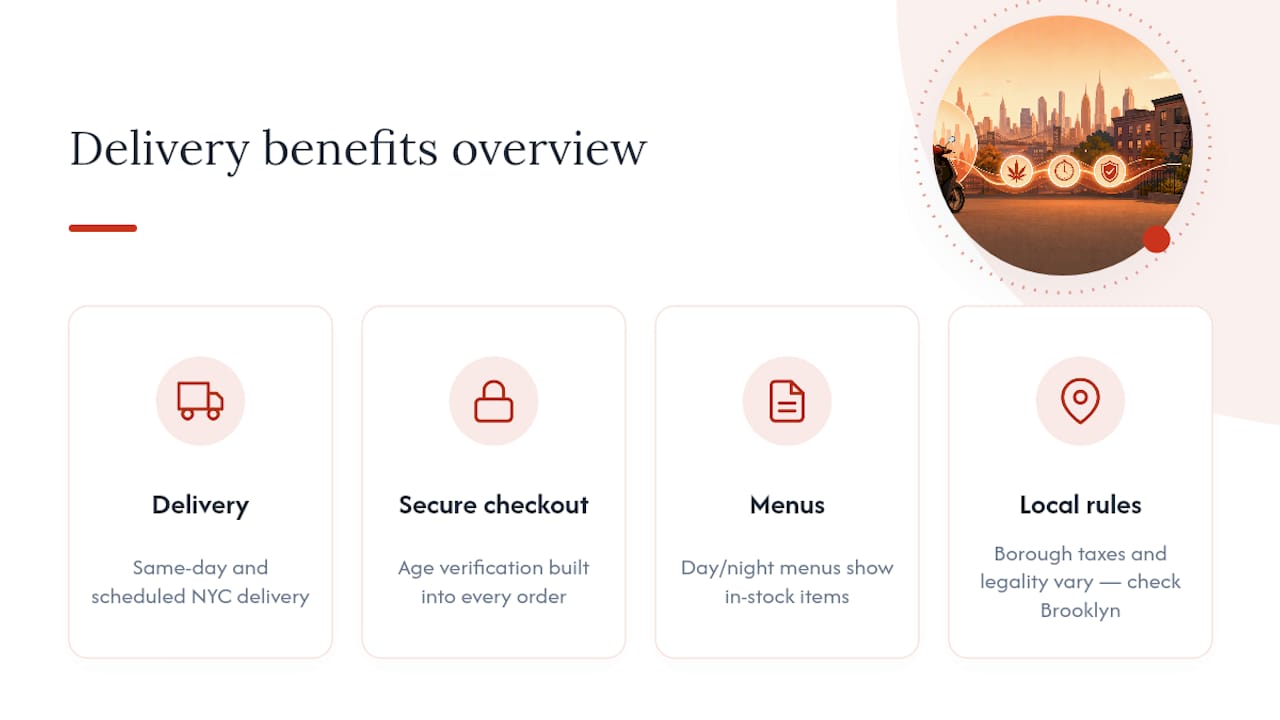
An online cannabis dispensary runs both same-day and scheduled delivery across a NYC service area, with secure checkout and age verification built into every order. Its day and night menus give you visibility into what’s actually in stock before you commit to a window, which supports the predictability and privacy this whole approach is built around. Local rules and tax details differ by borough, so it’s worth checking Brooklyn-specific delivery legality before your first order.
A Straight Answer on Scheduled Delivery
If you order more than once a month, scheduling beats ASAP almost every time, especially in apartments where a missed buzzer means a missed delivery. The single best move: book your next order as a recurring scheduled delivery instead of re-ordering from scratch each time.
— Jake
Ready to Schedule Your Next Order?
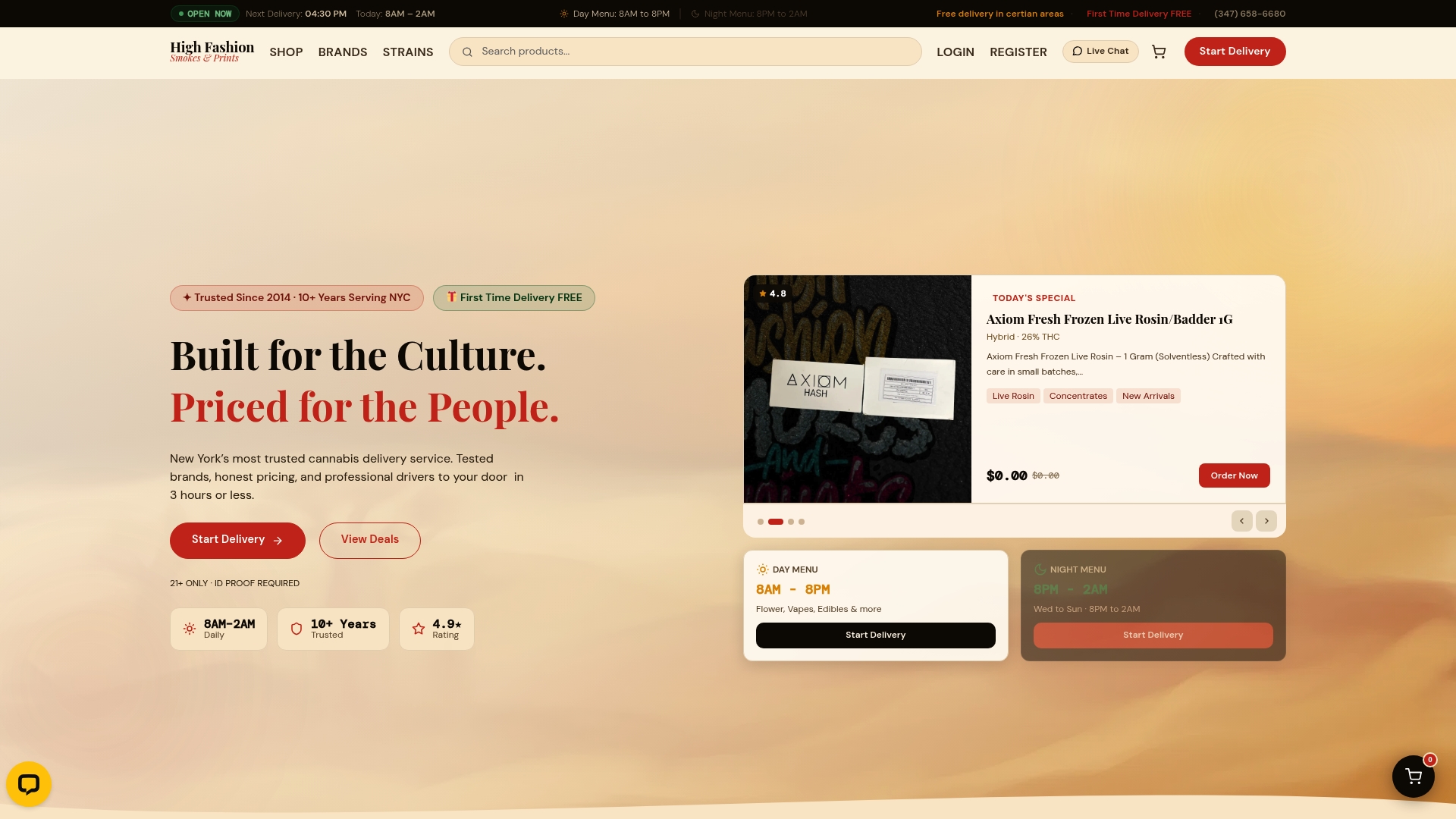
A New York City dispensary service offers customers the choice competitors force you to pick between: fast when you need it, exact when you plan ahead. Same-day and scheduled windows run side by side on the same menu, with lab-tested products, secure checkout, and delivery tracking so you’re never guessing where your order stands.
If you’re new to ordering or just want to understand what you’re buying before you commit, start with the pros and cons of cannabis breakdown, then head to the menu and lock in a delivery window that actually fits your day.
Sources
- WebJoint — Scheduled delivery
- CDC — Cannabis and driving
- Illinois Department of Public Health — Medical Cannabis
FAQ
Is Weed Delivery Worth It Compared to Pickup?
For most regular customers, yes. Scheduled delivery saves the trip, gives you a predictable window, and lets you plan around inventory availability instead of hoping a shop has what you want when you walk in.
What Is $40 Worth of Weed Called?
There’s no single official term, but among consumers it’s commonly called a “forty” or a “forty sack,” referring to a smaller flower purchase priced around that amount rather than a specific standardized weight.
How Does Scheduled Cannabis Delivery Work?
Orders get locked in by a cutoff time, checked against live inventory at checkout and again before dispatch, then batched into optimized routes so drivers cover nearby scheduled deliveries in one efficient loop.
Should I Tip My Weed Delivery Driver?
Tipping is standard practice and generally falls in the 10 to 20 percent range, similar to food delivery norms, with more for difficult handoffs like walk-up apartments or bad weather.
Does this dispensary offer scheduled delivery in NYC?
Yes, Highfashionsmokesandprints offers both same-day and scheduled delivery windows across its NYC service area, with secure checkout and age verification on every order.