Read our Google Birdeye Reviews
 Distillate is a purified cannabinoid oil stripped of most terpenes and minor compounds; full spectrum keeps the plant’s native mix of THC, minor cannabinoids, and terpenes intact. Pick distillate when you want predictable milligram dosing and a neutral taste. Pick full spectrum when flavor, aroma, and a broader chemical profile matter more than precision. Either way, the certificate of analysis (COA) tells you what you’re actually buying.
TL;DR:
- Distillate offers higher potency purity, often exceeding 80%, with volatile terpenes evaporated off and usually reintroduced through added flavoring.
- Full-spectrum extracts preserve the plant’s natural terpene and cannabinoid ratios, but their chemical profiles vary significantly based on starting material and extraction methods.
- Terpene data in the certificate of analysis is crucial to verify true full-spectrum products; missing panels suggest no real terpene preservation.
- For vapes, distillate’s thin consistency is hardware-friendly, while full-spectrum extracts excel in flavor and aroma but may clog cheaper devices.
- When dosing for edibles or avoiding drug-test surprises, start low, verify the COA for THC levels, terpene content, and contaminants, and prefer products with recent, transparent lab data.
Table of Contents
- Full Spectrum vs Distillate: The Extraction Basics
- What Is Full-Spectrum Extract Made Of?
- What Is Distillate and How Is It Made?
- Does the Entourage Effect Actually Hold Up?
- Full Spectrum vs Distillate: Which One Should You Buy?
- How Does the Choice Change by Product Type?
- How Do You Dose Safely and Avoid Drug-Test Surprises?
- Why Processing Quality Matters More Than the Label
- Ready to Shop Full Spectrum or Distillate in NYC?
- Sources
- FAQ
Full Spectrum vs Distillate: The Extraction Basics
A cannabis extract is anything pulled from the plant using solvents (butane, ethanol) or CO2 to separate cannabinoids and terpenes from raw plant material. What happens after that separation determines everything about the final product.
Two separate questions define any extract, and mixing them up is the most common mistake buyers make:
- Material state: crude oil, distillate, or isolate describe how refined the extract is.
- Composition: full spectrum, broad spectrum, or isolate describe what compounds remain after refinement.
- These are independent axes. A “full-spectrum distillate” is a real category. So is a “broad-spectrum” product with THC removed but terpenes reintroduced. Read the Terpenes Explained guide before you assume a label tells you the whole story.
What Is Full-Spectrum Extract Made Of?
Full-spectrum extract typically preserves THC, CBD, minor cannabinoids like CBG and CBN, terpenes, and flavonoids in ratios close to the original plant. Researchers studying extract chemical complexity note that full-spectrum products generally retain more of the source plant’s chemical profile than distillate, which concentrates one target cannabinoid at the expense of nearly everything else.
What changes the final result:
- Starting material matters. Fresh-frozen (“live”) biomass locks in volatile terpenes that dried flower loses during curing.
- Extraction method matters. Gentler methods like CO2 or cold ethanol preserve more delicate compounds than aggressive solvent runs.
- Terpene levels shift with processing. A comparative study of flower versus supercritical CO2 extracts found terpene and cannabinoid ratios can diverge significantly from the original flower, even in “full spectrum” labeled products.
This is why two full-spectrum carts from different brands can taste completely different despite similar THC numbers. The strain character, that skunky or citrusy signature, comes from native terpenes, not the cannabinoid count on the label.
Pro Tip: If a full-spectrum product tastes flat or generic, check whether the COA lists a terpene panel at all. No terpene data usually means no real terpene preservation happened.
What Is Distillate and How Is It Made?
Distillate is made through short-path or wiped-film vacuum distillation, a process that heats crude oil under low pressure to separate compounds by boiling point. The result is a viscous, often amber-to-clear oil that can reach cannabinoid purity in the 80% to 90%+ range, depending on the starting material and run quality.
What gets left behind:
- Terpenes evaporate off during distillation because they’re highly volatile.
- Plant pigments, waxes, and chlorophyll get separated out as well.
- Producers can reintroduce terpenes afterward, either botanical or cannabis-derived, to rebuild flavor and aroma.
Why does anyone choose this over full spectrum? Consistency is the big one. Distillate lets a producer hit the same potency batch after batch, which matters for edibles and vape carts where dosing accuracy is the whole point. The neutral flavor also makes it easier to formulate gummies or beverages without a hemp aftertaste fighting the fruit flavoring. If you’re weighing a cart purchase, the Live Resin vs Distillate comparison breaks down the flavor tradeoff in more depth.
Pro Tip: Distillate carts with strong flavor almost always have added terpenes. That’s not a flaw, but check the COA to see if they’re labeled as “cannabis-derived” or “botanical.”
Does the Entourage Effect Actually Hold Up?
The entourage effect describes the theory that cannabinoids and terpenes work better together than any single compound alone, through synergy or additive effects rather than one dominant molecule doing all the work. It’s one of the most repeated claims in cannabis marketing, and the science behind it is thinner than most product labels suggest.
A review decoding the postulated entourage effect found the evidence limited and often contradictory, arguing the concept is better described using established pharmacological terms like synergy and bioenhancement rather than a catch-all marketing phrase. That doesn’t mean nothing is happening. A 2024 controlled human study found vaporized d-limonene reduced acute THC-related anxiety under the specific conditions tested, but the researchers flagged that the THC-to-limonene ratio they used may not match what’s actually in retail products.
What this means for you:
- Some terpene-cannabinoid interactions probably exist, at least for specific compounds and ratios.
- Results are batch-specific and don’t automatically transfer from a lab study to a random cart off a shelf.
- The entourage effect deep dive covers this in more detail if you want the full research breakdown.
One study finding a real effect at a specific dose isn’t the same as every full-spectrum product delivering that effect. Treat entourage claims on packaging as a hypothesis, not a guarantee.
Full Spectrum vs Distillate: Which One Should You Buy?
Neither format wins outright. The right pick depends entirely on what you’re optimizing for.
- Choose distillate if you want predictable dosing, a neutral taste, or you’re buying edibles/beverages where flavor masking matters.
- Choose full spectrum if you want strain-specific flavor, a broader compound profile, or you believe terpene interactions matter for your experience.
- Check the COA either way. A 2025 GMP-grade purification study found that careful processing can preserve measured cannabinoid and terpene markers even through purification, showing that processing quality matters more than the format label alone.
A quick comparison across the factors that actually affect your purchase:
| Factor | Full spectrum | Distillate |
|---|---|---|
| Best for | Flavor, aroma, broader profile | Precise dosing, neutral taste |
| Potency measure | Variable, multi-compound | High single-cannabinoid purity |
| Terpene/flavor | Native, strain-specific | Minimal unless reintroduced |
| Dosing precision | Moderate | High |
| Stability/shelf life | Shorter, terpenes degrade | Generally longer |
| Testing transparency | Look for full terpene panel | Look for purity + reintroduction source |
Red flags on any COA: a missing terpene panel, cannabinoid totals that don’t add up, or no listing for pesticides, solvents, heavy metals, and microbials. If a brand can’t produce that panel on request, that’s a reason to walk away, not a technicality to overlook.
How Does the Choice Change by Product Type?
The full spectrum versus distillate decision doesn’t apply the same way to every product category.
Vapes depend heavily on hardware compatibility and viscosity. Distillate’s thinner consistency works well in most cartridge hardware, while live resin carts (a full-spectrum subtype) can clog cheaper atomizers if viscosity isn’t managed correctly. Check the Flower vs Vapes guide if you’re deciding on a delivery method first.
Edibles and beverages almost always favor distillate. Neutral flavor and even dosing matter more here than terpene nuance, and onset/duration depends more on your metabolism than extract type.
Concentrates and dabbing are where full spectrum, especially live resin, earns its reputation. Texture and terpene-driven flavor are the entire appeal for dab enthusiasts, and this is one category where sensory value clearly outweighs dosing precision.
How Do You Dose Safely and Avoid Drug-Test Surprises?
Start low regardless of format, then wait before redosing. Distillate’s concentrated potency makes overshooting your dose easier, especially with edibles where effects take longer to kick in.
Drug-test risk deserves a specific warning. A full-spectrum CBD product can legally contain trace THC, and mislabeling on this front is a documented problem across the industry. If you’re subject to testing, that trace amount can matter more than the label suggests.
Read your COA in three layers:
- Cannabinoid totals first. Confirm identity and concentration match the label.
- Terpene panel second. This tells you whether flavor claims are backed by actual data.
- Contaminant screens last. Pesticides, residual solvents, heavy metals, and microbial testing should all be present and passing.
Pro Tip: If a product’s COA is more than a year old or doesn’t match the batch number on your packaging, ask for a current one before you buy. Old COAs tell you nothing about what’s in your hand. For a deeper look at how THC and CBD interact with safety and testing concerns, see THC vs CBD.
Why Processing Quality Matters More Than the Label
Most of the debate around full spectrum versus distillate treats them like a quality hierarchy, full spectrum “natural,” distillate “processed.” That framing misses the point. A sloppy full-spectrum extraction with unlisted contaminants beats nothing over a clean, well-tested distillate, and vice versa. The GMP-grade purification research makes this concrete: careful processing preserved cannabinoid and terpene markers while removing what needed to go, regardless of what you’d call the final format.
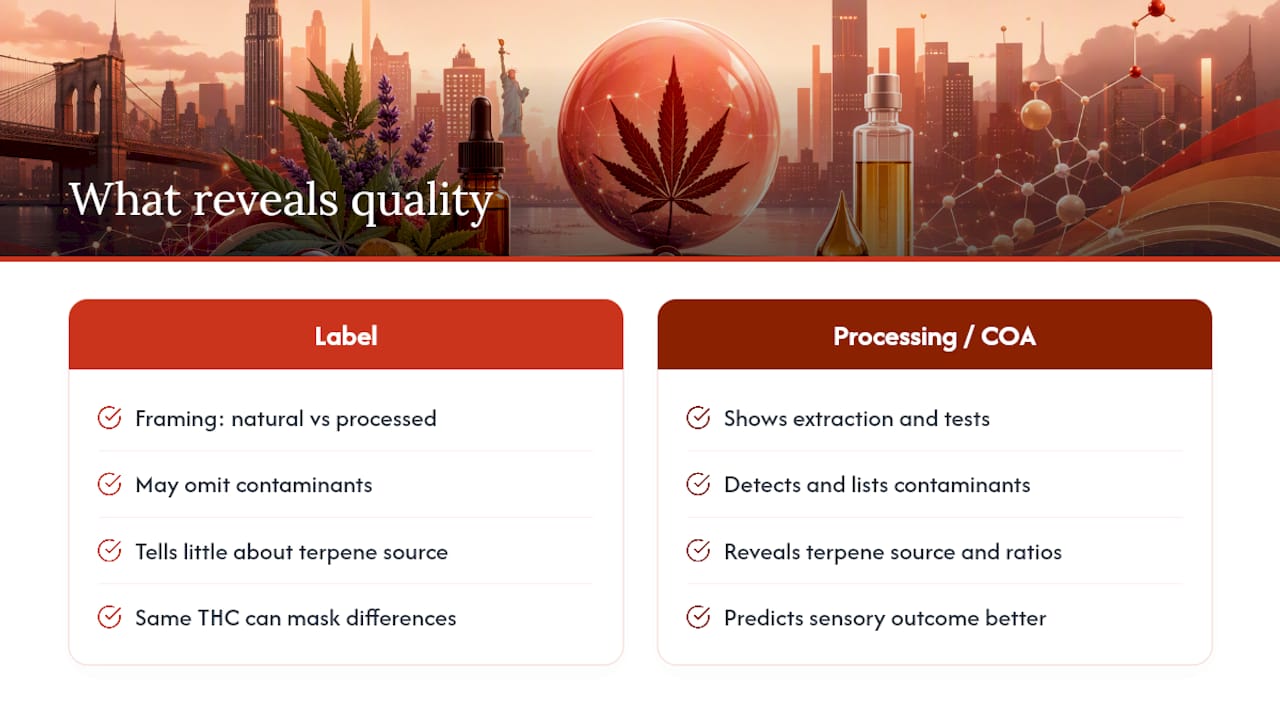
What buyers underestimate is how much terpene source affects their experience even when the THC percentage on two products is identical. A distillate cart with reintroduced cannabis-derived terpenes and a full-spectrum live resin cart can land in completely different places sensorially, and neither label alone tells you which you’re getting. The entourage effect gets cited constantly in marketing, but the actual research supports something narrower: specific compounds, in specific ratios, doing specific things. That’s a much less exciting sentence than what’s printed on most packaging, but it’s the honest one.
If there’s one habit worth building, it’s treating the COA as the actual product description and the marketing copy as a rough sketch.
— Jake
Ready to Shop Full Spectrum or Distillate in NYC?
The dispensary stocks both formats across vapes, concentrates, and edibles, and products come with lab testing you can verify before ordering. That’s the real advantage over guessing based on packaging alone: same-day delivery allows faster receipt of products compared to other methods.

Browsing carts? Compare formats using the Cart vs. Disposable guide before you order. Curious how live resin stacks up against distillate for flavor specifically? The Live Resin vs Distillate breakdown covers that head to head. Whichever format fits your goals, browse the full menu and check delivery windows for your borough before you place an order.
Sources
- Researchers: chemical complexity and extract profiles (PMC9608144)
- 2025 GMP full-extract purification study (PubMed 40733057)
FAQ
Does a Full-Spectrum Cart Get You High?
Yes, if it contains meaningful THC. Full-spectrum THC products are intoxicating, while full-spectrum CBD products may only cause mild effects but can still carry trace THC that shows up on drug tests.
Is Full Spectrum Better Than Distillate?
Neither is objectively better. Full spectrum offers a broader compound profile and stronger flavor, while distillate offers more precise dosing and consistency, so the right choice depends on whether you’re prioritizing experience or predictability.
Are Distillate Vapes Better Than Full-Spectrum Vapes?
“Better” depends on your goal. Distillate vapes give you consistent potency and a cleaner hardware experience, while full-spectrum vapes, especially live resin, deliver stronger native flavor and aroma at some cost to dosing precision.
Is Full-Spectrum Extract the Same as Distillate?
No. They describe different things entirely. Full spectrum refers to composition (what compounds remain), while distillate refers to material state (how refined the oil is), and a product can technically be both a full-spectrum distillate at once.
How Do I Know if a Product’s Terpenes Are Real or Added?
Check the COA for a terpene panel and look for wording like “cannabis-derived” versus “botanical” terpenes. Distillate almost always needs reintroduced terpenes since the distillation process removes them during purification.