Read our Google Birdeye Reviews
Edibles deliver a slower, longer, often stronger high and demand strict wait-and-dose discipline; smoking gives faster, easier-to-titrate effects but exposes your lungs to combusted plant matter. If you want quick relief you can control puff by puff, smoking wins on predictability. If you want smoke-free, longer-lasting effects and don’t mind waiting, edibles work, but only if you respect the dose.
TL;DR:
- Edibles can produce effects that last up to 12 hours, requiring careful dosing and waiting at least two hours before re-dose to avoid overdose.
- Smoking provides faster effects within minutes and easier dose control but exposes lungs to irritants and potential long-term airway inflammation.
- The strength of edibles depends heavily on metabolism, with the conversion of THC to 11-hydroxy-THC making highs more sedating and body-heavy than inhalation.
- Chronic cannabis use, regardless of method, can impair vascular function and increase cardiovascular risks similarly to tobacco smoking.
- Starting with no more than 2.5 mg of THC and avoiding mixing with alcohol or sedatives reduces overdose risk, especially for first-time or infrequent users.
Table of Contents
- Edibles vs. Smoking: Onset, Peak, and How Long Effects Last
- Why Edibles Hit Differently: The Liver, Metabolism, and 11-Hydroxy-THC
- The Real Health Risks: Lungs, Heart, and Acute Overdose Events
- Dosing and Harm Reduction: What Actually Keeps You Safe
- Choosing Between Edibles and Smoking: A Quick Decision Guide
- How We Think About Evidence When We Guide Customers
- Get Lab-Tested Edibles and Smoke-Free Options Delivered Same Day
- Sources
- FAQ
Edibles vs. Smoking: Onset, Peak, and How Long Effects Last
The core difference between these two methods comes down to timing, and the gap is bigger than most people expect. Inhaled cannabis, whether smoked or vaped, reaches your bloodstream through the lungs almost instantly. Edibles have to survive your stomach and liver before anything reaches your brain.
That detour changes everything about how you plan your day, your dose, and your risk.
Inhalation (smoking or vaping) produces effects within seconds to a few minutes. Peak intensity usually lands around 20 to 30 minutes after your last inhale, and most of the psychoactive effect fades within two to six hours. Because you feel it almost right away, you can stop after a puff or two, gauge how you feel, and decide whether you want more. That real-time feedback loop is the single biggest safety advantage smoking has over edibles.
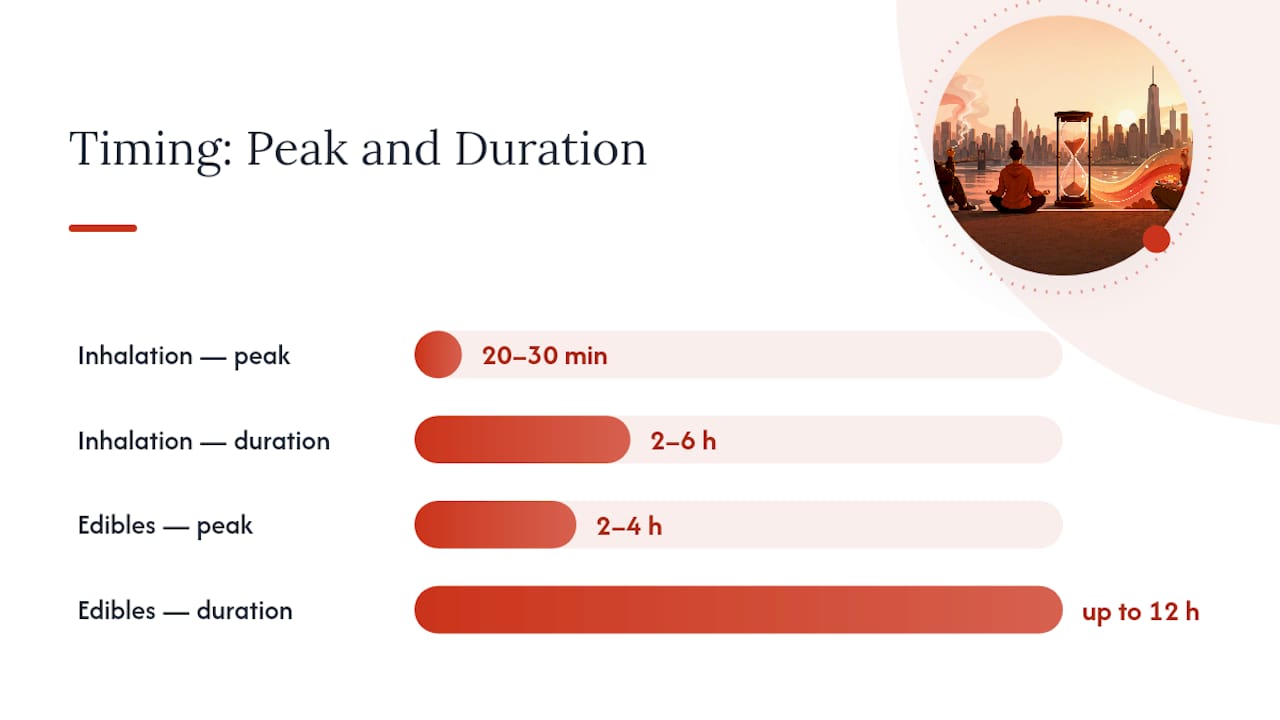
Edibles work on a completely different clock. Onset typically takes 30 minutes to two hours, peak effects hit around the two to four hour mark, and the high itself can run as long as 12 hours, with some residual grogginess lingering up to 24 hours. That delay is exactly why so many first timers overshoot their dose. They eat a gummy, feel nothing after 30 minutes, eat another, and then get hit with both doses at once right as the first one finally kicks in.
Here’s how the two methods stack up on the factors that actually matter day to day:
- Onset speed: Inhalation, seconds to minutes. Edibles, 30 minutes to two hours.
- Peak intensity: Inhalation, 20 to 30 minutes in. Edibles, two to four hours in.
- Total duration: Inhalation, up to six hours. Edibles, up to 12 hours (sometimes longer).
- Dose control: Inhalation lets you stop mid-session. Edibles commit you to whatever you already swallowed.
- Best for: Inhalation suits short-term relief or social settings where you want to gauge effects in real time. Edibles suit overnight symptom relief or situations where smoke isn’t an option.
Predictability is where experienced users notice the biggest divide. Someone who smokes regularly usually knows within a puff or two how a particular strain or product will hit. Edibles resist that kind of intuition, even for veteran users, because absorption depends heavily on what’s in your stomach, your metabolism, and the specific product’s formulation. A THC gummy eaten on an empty stomach can hit faster and harder than the same dose eaten after a full meal. That variability is a big reason public health guidance leans so hard on strict waiting periods before any edible re-dose, a rule we’ll get into in the safety section below.
If you’re deciding between a THC beverage and a traditional edible, know that drinks often sit closer to the faster end of the edible range, since liquid THC is generally absorbed a bit quicker than a solid gummy or baked good, but it still runs through the same liver pathway and carries the same delayed-onset risk.
Why Edibles Hit Differently: The Liver, Metabolism, and 11-Hydroxy-THC
The reason a 10 mg edible can feel stronger than a 10 mg puff of flower isn’t marketing. It’s biochemistry. Route of administration changes what your body actually does with the THC, and that changes the experience almost as much as the dose itself.
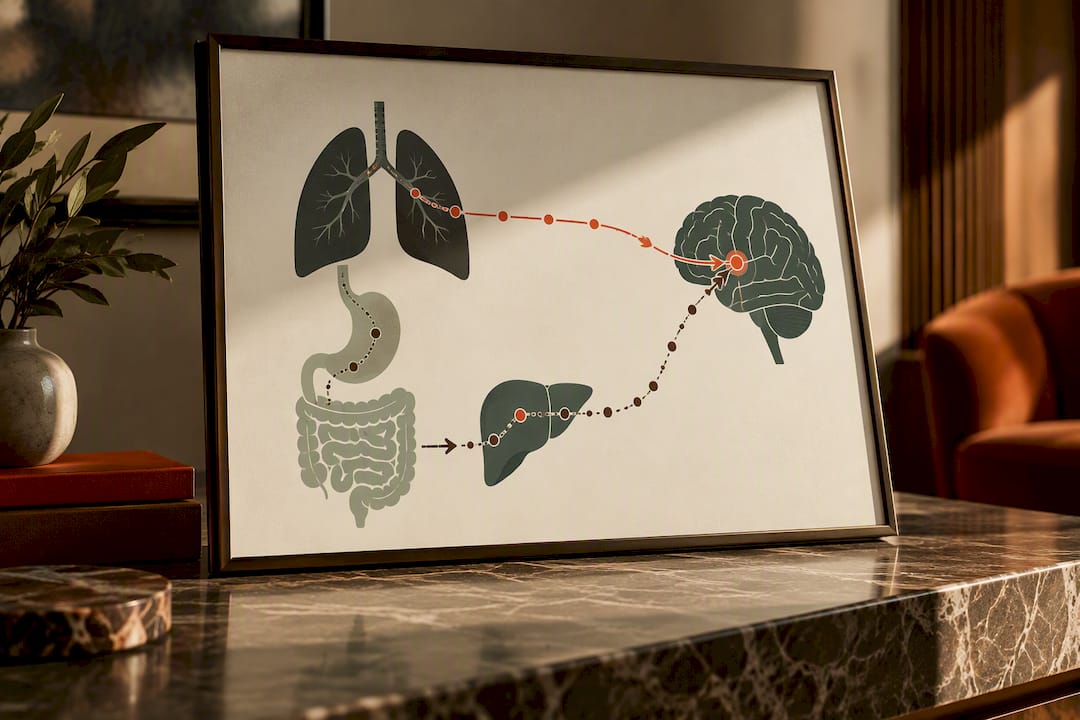
When you smoke or vape, THC moves from your lungs directly into your bloodstream and up to your brain within minutes, largely intact. When you eat cannabis, THC first travels to your stomach and intestines, then to your liver, where enzymes convert a meaningful portion of it into a compound called 11-hydroxy-THC. That metabolite crosses the blood-brain barrier more efficiently than THC itself and produces a noticeably more sedating, body-heavy effect. It’s part of why edibles are so often described as a “different” high rather than just a stronger one. Inhaled cannabis produces some 11-hydroxy-THC too, but in much smaller amounts, since it bypasses most of that liver conversion.
Several factors shift how strong that conversion effect feels. Body fat matters, since THC is fat-soluble and stores differently person to person. A recent meal slows gastric absorption and delays onset even further. Liver enzyme activity varies by individual and even by sex, which is part of why two people can eat the same gummy and report wildly different experiences. Tolerance plays a role too. Someone who smokes daily but rarely eats edibles often underestimates how a familiar milligram count will feel once it’s converted through the liver.
The practical takeaway: the number on the label tells you the dose, but the route tells you how that dose will actually behave in your body. Ten milligrams smoked and 10 milligrams eaten are not the same experience, and treating them as interchangeable is the single most common miscalculation new and even experienced users make.
The Real Health Risks: Lungs, Heart, and Acute Overdose Events
Neither method is risk-free, and the risks aren’t the same kind. Smoking trades a lung-health problem for a fast, controllable dose. Edibles trade lung safety for a much higher chance of accidentally taking too much.
Respiratory risk sits almost entirely with smoking. Combusted cannabis smoke contains many of the same irritants and particulate matter found in tobacco smoke, and regular smoking is linked to chronic cough and bronchitis. The link to lung cancer specifically remains inconclusive, largely because studies are confounded by tobacco co-use, but irritation and airway inflammation are well documented regardless of that open question. Vaping isn’t automatically safer here either. Cartridge quality varies, and unregulated or contaminated products have caused documented lung injuries, which is one more reason to buy only lab-tested vape products from a licensed source.
Cardiovascular risk cuts across both methods. Any THC use can trigger acute effects like a temporary spike in heart rate and shifts in blood pressure, regardless of how it’s consumed. The more significant finding is longer term. A 2025 report tied to JAMA Cardiology found that chronic cannabis users, whether they smoked or ate their cannabis, showed markedly reduced vascular function compared to non-users, roughly on par with what’s seen in chronic tobacco smokers. That’s a meaningful data point because it undercuts a common myth that edibles sidestep cardiovascular risk simply by avoiding smoke. The route may differ, but chronic, heavy use appears to carry a shared cardiovascular cost either way.
Chronic cannabis users showed vascular function reductions comparable to tobacco smokers, regardless of whether they smoked or ate cannabis. The finding applies to both methods, not just one.
Acute over-intoxication risk sits mostly with edibles. Some observational data from hospital emergency reporting shows a higher rate of acute psychiatric and cardiovascular events tied specifically to edible use, and the pattern traces almost entirely back to that delayed onset. Someone eats a dose, feels nothing, eats more, and ends up with far more THC in their system than intended once everything finally kicks in at once. Panic attacks, racing heart, nausea, and disorientation are the most common results, and while they’re rarely medically dangerous on their own, they’re frightening enough to send people to the ER.
Dependency risk depends more on frequency and potency than on the method itself. Using high-potency products more than once a week is the strongest predictor of tolerance and dependence, not whether you smoke or eat your cannabis. The evidence on which route reinforces habitual use more strongly is mixed, so frequency and concentration remain the two levers that matter most if you’re trying to keep use moderate.
Dosing and Harm Reduction: What Actually Keeps You Safe
The single biggest driver of edible-related emergencies isn’t potency. It’s timing confusion. Most bad experiences trace back to someone re-dosing before the first dose has finished kicking in.
Start with the numbers. Public health guidance from the Canadian Centre on Substance Use and Addiction recommends new edible users start with no more than 2.5 mg of THC, which is often half or a quarter of a standard 5 or 10 mg gummy.
Here’s the harm-reduction sequence worth following every time, whether it’s your first edible or your fiftieth:
- Check the label before you buy or eat anything. Confirm the milligram count per piece, not per package. A single chocolate bar with 100 mg total might contain 10 pieces at 10 mg each, and eating the whole bar because “it’s just chocolate” is how overdoses happen.
- Start at 2.5 mg if you’re new, tolerant-but-out-of-practice, or trying a new brand. Even experienced smokers should treat an unfamiliar edible brand as a fresh start, since potency and formulation vary by manufacturer.
- Wait a full two hours, minimum, before considering more. Some guidance extends that window to four hours for people with slower digestion or a recent large meal. If in doubt, wait longer, not less.
- Never mix with alcohol or sedatives like benzodiazepines. Combining depressants with THC compounds sedation and raises the risk of dangerous drops in coordination, breathing, or blood pressure.
- Store edibles like medication, not snacks. Keep them in original, labeled packaging, out of reach of children and pets, and never in a container that looks like regular food.
Pro Tip: If you’ve eaten an edible and don’t feel anything after an hour, resist the urge to eat more. You can always take another dose later once the wait window passes, but you can’t undo what’s already in your stomach.
For smokers, the safety rules look different but follow the same logic. Choose lower-potency flower or pre-rolls when you’re new or unsure how a strain will hit, limit how often you’re taking deep, held-in inhales (which increases particulate exposure without necessarily increasing absorption), and only buy vape cartridges from a source that discloses lab testing, since contaminated or diluted cartridges have caused real harm in unregulated markets.
If anyone experiences chest pain, extreme confusion, a racing heart that doesn’t settle, or difficulty breathing after using either method, that’s a signal to seek medical attention rather than wait it out. THC overdose isn’t typically lethal on its own, but the symptoms can mimic more serious conditions worth ruling out.
Choosing Between Edibles and Smoking: A Quick Decision Guide
Match the method to what you actually need that day, not to habit alone. Run through this short checklist before you decide:
- Do you need relief fast, or can you wait? Inhalation wins if you need results in minutes. Edibles require planning ahead by at least an hour or two.
- How long do you want the effect to last? A few hours points to smoking or vaping. All day or overnight symptom relief points to edibles.
- How are your lungs? Anyone with asthma, chronic bronchitis, or other respiratory sensitivity should lean toward edibles or other smoke-free formats.
- What’s your tolerance level? Low tolerance plus edibles means dosing extremely conservatively, since the delayed feedback makes misjudging your limit easy.
- What’s your setting? Discreet, smoke-free environments favor edibles or beverages. Private, controlled settings make smoking’s fast feedback loop more practical.
Three quick profiles show how this plays out. A social user heading to a low-key gathering who wants to feel present without a long tail of effects usually does better with a couple of controlled puffs than a gummy that might peak two hours after the event ends. Someone managing chronic pain who wants steady relief through the night is often better served by a low-dose edible taken early enough to peak before bed. An adult with respiratory sensitivity who still wants cannabis’s effects without smoke exposure is the clearest case for edibles, tinctures, or a well-tested THC beverage over anything inhaled.
Anyone who is pregnant, has diagnosed cardiac disease, has a personal or family history of psychiatric disorders, or takes medications that interact with cannabinoids should talk to a doctor before choosing either method. The cardiovascular research alone is reason enough to loop in a clinician if heart health is already a concern.
How We Think About Evidence When We Guide Customers
Our guidance hasn’t changed with trends because the underlying pharmacology hasn’t changed either. It is important to choose lab tested and verified products, especially with edibles, where an untested product’s actual milligram count can drift far from its label.
A good practice when starting with edibles is to start low, wait before you re-dose, and choose lab tested products. That’s not a slogan. It’s the same harm-reduction logic public health researchers recommend, and it’s the difference between a good first edible experience and a scary one.
None of this replaces a conversation with your doctor if you have a heart condition, take prescription medications, or are managing a psychiatric diagnosis. Use responsibly, and when in doubt, dose smaller than you think you need.
— Jake
Get Lab-Tested Edibles and Smoke-Free Options Delivered Same Day
Choosing lab-tested and verified products helps avoid guessing your dose from unverified products. The milligram count on the label is more likely to match the actual content with verified products.
If the evidence above pushed you toward starting low with an edible, our beginner’s guide to dosing edibles safely walks through exact starting amounts and wait times before you order. If smoke-free but fast-acting sounds more like what you need, our THC drink dosage guide covers beverages that tend to hit a bit quicker than solid edibles. Delivery is available across New York City, with fees varying by borough; current prices are available on the pricing page.
You must be 21 or older to order. Browse the full menu and pick the format that actually fits your night, not just the one you defaulted to last time.
Sources
This comparison draws on public health dosing guidance from the Canadian Centre on Substance Use and Addiction, timing and metabolism data from Go Ask Alice at Columbia University, a peer-reviewed review of edible pharmacology and regulatory challenges published on PubMed Central, and recent cardiovascular research covered by the American College of Cardiology. Additional respiratory-risk context comes from a PubMed Central review of cannabis smoke effects on lung health.
This article is general information, not a substitute for advice from a qualified doctor. Consult a qualified healthcare professional about your own circumstances before acting on anything here.
- Cannabis: Inhaling vs Ingesting (CCSA infographic)
- Are there health differences between eating and smoking marijuana? | Go Ask Alice!
- Tasty THC: Promises and challenges of cannabis edibles (PMC review)
FAQ
Are THC Drinks Stronger Than Edibles?
Not inherently. THC beverages are absorbed a bit faster than solid edibles like gummies since liquids clear the stomach quicker, but they still pass through the same liver conversion into 11-hydroxy-THC that makes edibles hit harder than their milligram count suggests. Strength ultimately comes down to dose and your individual metabolism, not the format alone.
Is a Tincture Weaker Than a Gummy?
Not necessarily. Tinctures taken sublingually (under the tongue) can bypass some of the digestive process and reach your bloodstream faster than a swallowed gummy, though swallowed tinctures behave more like a standard edible. The actual milligram dose on the label matters more than the format when comparing intensity.
How Long Does an Edible High Last Compared to Smoking?
An edible high typically lasts up to 12 hours, with onset taking 30 minutes to two hours. Smoking’s effects kick in within minutes but usually taper off within six hours, making it the shorter, faster option of the two.
What’s the Safest Starting Dose for a First-Time Edible User?
Public health guidance recommends starting with 2.5 mg of THC or less for first-time or infrequent edible users. Wait a minimum of two hours before considering another dose, since the delayed onset is the main reason people accidentally overconsume.
Is Smoking Worse for You Than Eating Edibles?
They carry different risks rather than one being universally worse. Smoking exposes your lungs to irritants tied to bronchitis and chronic cough, while edibles carry a higher risk of acute over-intoxication from delayed onset. Chronic heavy use of either method has been linked to reduced vascular function, so neither route is risk-free with regular, high-frequency use.