Read our Google Birdeye Reviews

The practical child-resistant routes for cannabis products are reclosable CR bags, CR jars and bottles, tins or slide-lock systems, blister packs for edibles, and CR pre-roll tubes. Before ordering any of them, confirm third-party test reports showing the design passes 16 CFR §1700.20 or the relevant state equivalent. Match the format to the product, flower, edibles, or pre-rolls, and get those test reports in hand before you commit to a purchase order.
TL;DR:
- A passing report applies only to the tested configuration, so match bag size, film thickness, resin, and closure tooling to the exact SKU you order.
- State rules vary: some require primary packaging designed to resist opening by children, while others allow that protection at sale; audit each market before launch.
- The federal protocol tests children and adult usability, while repeated openings can weaken closures; ask suppliers for cycle results, not just a first pass.
- Keep the lab report, test date, conditioning details, and applicable conformity statement on file, and require retesting after material or tooling changes.
Table of Contents
- Which child-resistant formats fit flower, edibles, and pre-rolls
- How child-resistant closures work and what “tested” actually means
- What regulators require and what documentation to collect
- Choosing materials without losing child-resistant performance
- Designing compliant packaging that still looks like your brand
- Vetting suppliers before you sign a packaging contract
- Getting legally compliant packaging to market
- Helping consumers open and store packaging correctly
- Why child-resistant packaging also protects freshness and potency
- What child-resistant packaging actually costs to implement
- What matters more than the mechanism on the package
- A retail partner’s view on packaging that holds up in the real world
- FAQ
- Sources
Which child-resistant formats fit flower, edibles, and pre-rolls
Picking the right format starts with the product itself. A jar built for dense flower will not serve a multi-dose edible pack, and a pre-roll tube has different sealing needs than a bag of gummies.
- Resealable CR bags (pinch-and-pull or slide-lock) suit flower and multi-unit edibles that need flexible, lightweight packaging with repeated reclosure.
- PET or HDPE bottles with CR caps work well for pre-rolls, capsules, or small edibles that need a rigid, stackable container.
- Child-resistant jars with press-and-turn or squeeze-turn closures are a standard choice for flower, offering a wide mouth and a familiar twist action.
- Metal tins with slide-lock systems give flower and concentrate brands a durable, reusable container with a premium feel.
- Blister or unit-dose packs fit edibles well, since each dose sits in its own sealed cavity, which also supports portion control.
- Pre-roll tubes with CR caps protect delicate joints while meeting the same reclosure standard as other formats.
Two of the most recognized reclosable bag mechanisms on the market are Pinch N Pull™ Child Resistant Bags, built around a pinch-and-pull action suited to flexible film packaging, and Pinch N Slide™ Child Resistant Bags, which use a slide-lock action and leave more printable surface for branding. Variants marketed specifically for marijuana packaging exist under both names and follow the same mechanical logic. Before you settle on any of them, ask the supplier for the exact test report tied to the bag size and film thickness you plan to order, since a passing result on one gauge does not automatically carry over to another.
How child-resistant closures work and what “tested” actually means
Child-resistant closures use mechanisms that are difficult for young children to open but adults can learn to use. Common mechanisms include:
- Press-and-turn caps, which require downward pressure plus rotation.
- Squeeze-turn closures, which need a pinch at specific points before the cap turns.
- Push-tab mechanisms, found on some blister cards and tins.
- Two-hand slide locks, common on tins and slide-lock bags.
- Pinch-and-pull actions, used on resealable film bags.
The testing procedure in 16 CFR §1700.20 lays out a sequential child test using panels of children, plus a separate adult usability test, with specific conditioning and application torque rules for closures. A design that opens too easily for the child panel fails, and one that is genuinely unusable by seniors or adults with limited grip strength fails the adult half, since the standard requires both.
Lifecycle testing matters just as much as the first open. A closure that passes once but loosens with repeated use may not protect anyone in the real world, which is why cycle testing across the expected number of uses belongs in any supplier conversation.
Pro Tip: Ask suppliers for cycle-test data, not just a single pass/fail result, before you commit to a production run.
What regulators require and what documentation to collect
The Poison Prevention Packaging Act applies to household substances that pose a risk to young children, and CPSC guidance makes clear there is no blanket exemption for institutional or specialty use, pointing manufacturers back to the PPPA list and 16 CFR §1700.15 for effectiveness specifications. Those specifications require that packaging continue to function correctly when it’s actually in contact with the product inside it, not just in a lab mockup.
There’s no single government stamp that certifies a cannabis package as compliant. Instead, brands collect a third-party lab test report demonstrating the design passed the mandated protocol, along with a General Certificate of Conformity where applicable.
Request these items from every packaging supplier before placing an order:
- The name of the testing lab and the date testing was performed.
- The specific film, resin, or closure specification that was tested, matched to the SKU being ordered.
- Conditioning and application torque details used during the test.
- Cycle-test results showing performance across repeated openings.
- A General Certificate of Conformity or equivalent written statement of compliance.
- Written retest triggers, meaning what changes in material or process require a new test.
CPSC has also issued enforcement discretion guidance in the past describing alternate adult-resecuring test data under constrained conditions, a reminder that compliance evidence can shift and should be retained and re-checked rather than treated as permanent.
Choosing materials without losing child-resistant performance
Material choice affects both product protection and how well a closure continues to work over time. PET and HDPE are lightweight and widely recyclable, but they’re more sensitive to temperature swings than glass. Glass holds odor and moisture barriers well and feels premium, but it’s heavier and costs more to ship. Metal tins resist light and moisture effectively, and laminated flexible films offer a good odor barrier at low weight, which is part of why pinch-and-pull and slide-lock bags use them.
- Confirm whether a liner or gasket takes a set over time, since a liner that compresses permanently can loosen a closure’s resistance.
- Ask how the material performs across the temperature range your product will actually experience in transit and storage.
- Request documentation on recycled content percentage if recyclability matters to your brand story.
- For compostable films, ask for the specific compostability certification and whether it covers industrial or home composting.
- Clarify end-of-life handling instructions you’ll need to print on the package itself.
Compostable films are gaining traction, but some struggle to hold a two-motion closure’s tolerances as reliably as laminated plastic film, so verify cycle-test data on the compostable option specifically rather than assuming it matches a conventional film’s performance.
Designing compliant packaging that still looks like your brand
Compliance and branding can coexist, but closures and mandatory labeling need to be designed around first.
- Keep heavy foil stamping, embossing, or thick coatings away from the seal area, since finishes applied too close to a closure can interfere with its mechanical action.
- Use opaque material or an opaque label where law requires it, and reserve bold color and texture for areas that don’t need to stay clear for warnings.
- Place required warnings and legally mandated phrasing where they won’t be obscured by a seal or torn during normal opening.
- Lean on a secondary carton or sleeve for premium finishes, keeping the primary CR package itself simple and functional.
Before a full production run, approve a pre-production sample and a functional prototype separately. The pre-production sample confirms print and finish quality, while the functional prototype gets opened and reclosed repeatedly to confirm the mechanism still works once your artwork and coatings are applied.
Pro Tip: Test your approved prototype after it’s been through the same transit conditions (heat, cold, vibration) your shipments actually face, not just on a clean desk.
Vetting suppliers before you sign a packaging contract
A short supplier call can save a recall later. Work through these steps in order.
- Ask which independent lab performed testing, on what date, and whether the report covers the exact SKU and material gauge you’re ordering.
- Request cycle-test data and the conditioning procedure used, not just a pass result.
- Move from an engineering sample to a cycle test, then a small pilot run, before committing to full volume.
- Set clear acceptance criteria for the pilot run, including closure function, print quality, and seal integrity.
- Confirm minimum order quantities and lead times in writing before you build them into a launch timeline.
- Require contract language obligating the supplier to notify you of any material or process change that could affect test results.
- Require the supplier to retain test certificates for the life of the contract and to cooperate on any recall or compliance inquiry.
Getting legally compliant packaging to market
Legally marketing child-resistant cannabis packaging starts with confirming whether your state requires the primary package itself to be child-resistant or allows child-resistant exit packaging applied at the point of sale, since practice varies and brands should audit state rules regularly. Once you know which standard applies, obtain a third-party test report against 16 CFR §1700.20 or the state’s named standard for the exact packaging configuration you intend to ship.
Keep that report, along with any General Certificate of Conformity, on file and accessible for audits. Build in a retest trigger clause with your supplier so any change in resin, film thickness, or closure tooling automatically prompts a new test rather than relying on the original approval indefinitely.
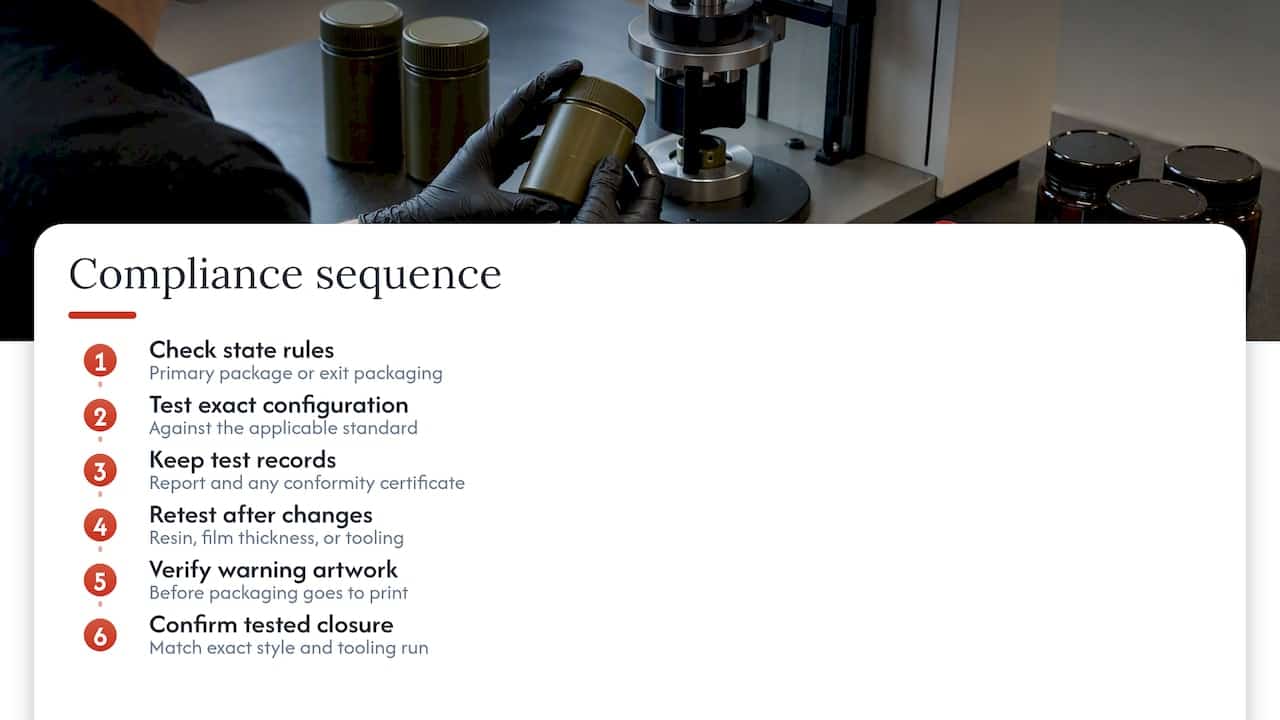
Review your CBD labels artwork against your market’s mandated warning language before the packaging goes to print. Four cannabis label checks commonly required of buyers offer a useful starting checklist for what regulators expect to see, and running through them before approval avoids a reprint. Finally, confirm with your packaging supplier that the specific closure style, not just the general category, was the one tested, since a press-and-turn cap from one tooling run is not interchangeable with another without its own report.
Helping consumers open and store packaging correctly
Child-resistant packaging only works as intended when the adult handling it understands the mechanism. A two-motion closure that confuses a first-time buyer gets forced open or left unlatched, defeating the purpose.
Printed instructions directly on the package, in plain language with a simple diagram, help more than a line buried in a separate insert. “Push down and turn” or “pinch the tabs and pull” reads faster than a technical description of the mechanism.
Storage guidance matters as much as opening instructions. Encourage consumers to keep the package in its original child-resistant container after use rather than transferring the product to an unsecured dish or bag, and to store it out of sight and reach of children regardless of the closure’s rating. Reclosing a resealable bag fully, not just folding the top over, keeps the pinch or slide mechanism engaged for the next use.
Why child-resistant packaging also protects freshness and potency
Child-resistant doesn’t have to mean a tradeoff against product quality. Many of the same features that keep small hands out, a tight seal, a secure closure, a barrier film or rigid wall, also slow the exposure that degrades cannabinoids and terpenes over time.
Flower loses terpene content and can lose potency when exposed to oxygen, light, and humidity swings. A tin or jar with a working gasket and an opaque or UV-blocking material addresses both the child-resistant requirement and the freshness problem at once. Laminated films used in pinch-and-pull or slide-lock bags provide an odor and moisture barrier that serves the same dual purpose for flower and multi-dose edibles.
The practical takeaway for procurement teams is to treat barrier performance and closure performance as one evaluation, not two separate checklists. A package that reseals well but leaks moisture around the seam still shortens shelf life, even if it technically passes the child-resistant test.
What child-resistant packaging actually costs to implement
Child-resistant packaging typically costs more per unit than standard packaging because of the engineered closures, the materials needed to hold tolerances over repeated openings, and the testing required before a design ships. Budgeting for that difference upfront, rather than treating it as a late-stage surprise, keeps a product launch on schedule.
Testing itself carries its own cost, since third-party lab reports and any retesting triggered by a material or tooling change are a line item separate from the packaging unit price. Smaller brands sometimes manage this by choosing a stock CR bag or jar design that already carries a valid test report for the exact specification they need, rather than commissioning custom tooling, which avoids paying for a dedicated test run.
Order volume also affects unit economics. A pilot run followed by a larger production order, as outlined in the supplier vetting steps above, lets a brand validate the format before committing to the volume discount that usually comes with a bigger purchase order.
What matters more than the mechanism on the package
Most packaging guides focus on which closure style to pick. The bigger risk sits upstream of that choice: brands ordering a format that technically exists in a catalog without confirming the test report actually covers their specific film gauge, bag size, or closure tooling.
A pinch-and-pull bag that passed testing at one thickness isn’t automatically compliant at a thinner gauge chosen to cut cost. The mechanism name on a spec sheet means little without the paperwork tied to the exact configuration being shipped. Brands that build retest triggers into supplier contracts, rather than assuming one approval covers every future order, are the ones that avoid a compliance problem showing up after product is already on shelves.
— Jake
A retail partner’s view on packaging that holds up in the real world
High Fashion Smokes & Prints describes itself as a cannabis delivery service in New York City, handling orders and age verification.

If you’re a brand, reach out through our homepage. You can also check how we verify a secure checkout.
FAQ
What makes packaging “child-resistant” versus “childproof”?
“Child-resistant” is the accurate industry term for packaging designed to resist opening by children while remaining accessible to adults. It does not mean that a package is childproof. “Childproof” overstates what any tested package can guarantee and isn’t the standard regulators use.
Which regulation governs child-resistant cannabis packaging?
The Poison Prevention Packaging Act sets the federal framework, and 16 CFR §1700.20 specifies the actual testing procedure, including the sequential child test and separate adult usability test. State cannabis programs often layer their own packaging rules on top, so check your state’s specific requirement alongside the federal standard.
Do I need a government certificate to sell compliant packaging?
There’s no single official government certification stamp for child-resistant packaging. Instead, you need a third-party lab test report showing your exact packaging specification passed the required testing protocol, plus a General Certificate of Conformity where applicable, retained for audits.
How often does child-resistant packaging need to be retested?
Retesting is triggered by a change, not a calendar date, meaning any change to material, film thickness, resin, or closure tooling should prompt a new test rather than relying on the original approval. Building that retest trigger into your supplier contract is the most reliable way to catch this before it becomes a compliance gap.
Can child-resistant packaging also keep cannabis fresher?
Yes, many of the same features, tight seals, barrier films, and opaque or rigid materials, that keep packaging child-resistant also slow the oxygen, light, and humidity exposure that degrades potency and terpenes over time. Evaluating barrier performance and closure performance together gives a more complete picture than checking compliance alone.
Sources
- Poison Prevention Packaging Act (PPPA) Updated Guidance on Substances Not Intended for Household Use
- eCFR :: 16 CFR 1700.20 – Testing procedure for special packaging.