Read our Google Birdeye Reviews
Cannabis can help many adults focus, but only when the terpene profile and dose are right. Pinene and limonene-forward products taken in small amounts tend to sharpen attention, while myrcene-heavy strains and high-THC doses do the opposite. The action that matters most: check the lab panel before you check the strain name, and start with 1 to 2.5 milligrams of THC, not a full bowl or gummy.
TL;DR:
- Pinene and limonene are the most effective terpenes for enhancing focus, especially at higher percentages and when combined with low-dose THC.
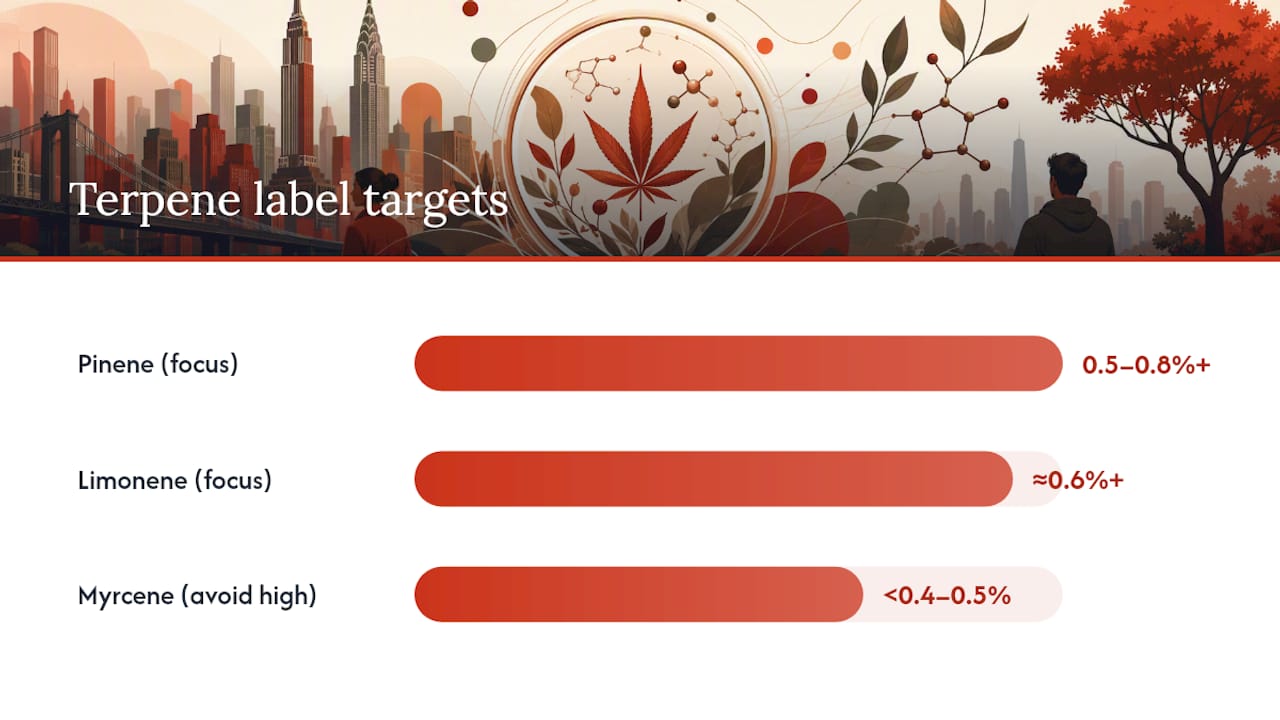
- Lab panels should show pinene at 0.5 to 0.8 percent, limonene above 0.6 percent, and myrcene below 0.4 percent for focus-optimized products.
- Low-dose THC, in the 1 to 5 milligram range, supports attention and task engagement, while higher doses impair working memory and increase impairment risk.
- Cannabis products should contain detailed terpene data, recent testing, and pass pesticide and residual solvent tests to ensure safety and intended effects.
- Microdosing requires starting small, tracking effects over several sessions, and avoiding frequent high-THC use to prevent longer-term cognitive impacts.
Table of Contents
- Which Terpenes and Cannabinoids Actually Help Focus
- How to Read Lab Panels and Product Labels Before You Buy
- A Step-by-Step Microdosing Protocol for Work Sessions
- Strains Worth Trying, and What They’re Actually Good For
- Choosing the Right Method for the Task at Hand
- Safety, Side Effects, and When to Pull Back
- How High Fashion Smokes & Prints Supports Safe, Focused Use
- The Brain Science Behind Cannabis and Attention
- What Regular Use Might Mean for Cognition Down the Road
- Cannabis Versus Other Focus Aids: Where It Fits
- The Bottom Line on Choosing Weed for Focus
- Shop Verified, Terpene-Tested Products for Focus
- Sources
Which Terpenes and Cannabinoids Actually Help Focus
Not all cannabis compounds work the same direction. Some sharpen attention, some blur it, and the difference comes down to chemistry most shoppers never look at.
Alpha-pinene is the standout. It inhibits an enzyme called acetylcholinesterase, which in preclinical models translates to better working memory and attention, and it crosses the blood-brain barrier easily enough to matter. Frontiers in Molecular Neuroscience’s pinene review treats it as one of the more predictive terpenes for sustained attention across lab and observational reports.
Limonene works differently. It supports mood and motivation and appears to blunt cortisol reactivity, so it pairs well with pinene by keeping stress from hijacking your attention span.
Terpinolene and ocimene bring an energizing, almost creative lift. Beta-caryophyllene and humulene add a steadying, anti-inflammatory quality without sedation. Then there’s the terpene you want to avoid for daytime work:
- Myrcene: heavily sedating, the terpene behind the classic “couch lock” effect. Keep it under 0.4 to 0.5 percent for focus work.
- Linalool: calming and useful for sleep, but counterproductive if you need to stay sharp.
- Pinene: alertness, memory support, motor coordination.
- Limonene: mood lift, stress reduction, motivation.
- Terpinolene: energizing, mentally stimulating.
On the cannabinoid side, research on cannabinoids and cognition points to a clear pattern: low-dose THC (in the 1 to 5 milligram range) tends to support task engagement, while doses climbing past 10 milligrams commonly impair working memory instead of helping it.
Terpene reality check: Reviews on terpenes and neurological effects confirm that terpene composition meaningfully shifts the subjective and cognitive experience of a product, independent of THC percentage. Two 20% THC flowers can feel completely different depending on whether pinene or myrcene dominates the panel.
CBD deserves a mention too. It buffers THC-driven anxiety in clinical evidence on CBD and anxiety, which matters if you’ve ever felt your focus dissolve into a spiral of racing thoughts after a strong edible. THCV and CBG show early promise for energy and clarity, though the human data lags behind the terpene research.
How to Read Lab Panels and Product Labels Before You Buy
A strain name tells you almost nothing on its own. The Certificate of Analysis, or COA, tells you everything that actually matters.
Start with the terpene totals. You want to see pinene at 0.5 to 0.8 percent or higher, limonene around 0.6 percent or above, and myrcene sitting under 0.4 to 0.5 percent. If a panel lists myrcene as the dominant terpene, that flower is built for winding down, not grinding through a spreadsheet.
For THC and CBD, plan around your tolerance and anxiety risk. Low-to-moderate THC (roughly 15 to 20 percent) with visible terpene diversity tends to outperform ultra-high-potency flower for sustained attention, according to terpene-first comparisons in the cannabis industry. If you’re anxiety-prone, look for a CBD ratio in the 2:1 to 4:1 CBD:THC range.
When you pull up a COA, confirm these basics:
- The lab name and license number are visible and the report isn’t a stock PDF reused across unrelated products.
- Terpene percentages are itemized, not just lumped into a single “total terpenes” figure.
- Testing date is recent, since terpenes degrade over time and a six-month-old panel may no longer reflect what’s in the jar.
- Pesticide and residual solvent results are listed as “pass,” not omitted entirely.
Pro Tip: If a product page only lists THC percentage and nothing else, treat that as a red flag rather than an oversight. A brand confident in its terpene profile shows the numbers.
Ask your budtender directly: “What’s the pinene and limonene content on this batch?” A shop that can’t answer, or answers with a shrug, isn’t the shop for terpene-driven shopping. Reading a full breakdown of THC versus CBD effects and safety helps you frame the ratio conversation before you even walk in.
A Step-by-Step Microdosing Protocol for Work Sessions
Microdosing for focus is less about the strain and more about the discipline of starting small and tracking what happens.
- Pick your method and starting dose. For inhaled products (vape or flower), start at 1 to 2.5 milligrams of THC. That’s often a single small inhale, held briefly, not a full session.
- Wait through the full onset window before judging the effect. Vaping and smoking hit in 5 to 15 minutes. Tinctures take 15 to 45 minutes. Edibles can take 45 to 120 minutes, sometimes longer on an empty stomach.
- Add CBD if anxiety is a risk factor. A 2:1 to 4:1 CBD:THC ratio preserves some of the CB1-mediated focus benefit while dulling the edge that can spiral into distraction.
- Hold that dose for at least three to four sessions before adjusting. Tolerance builds fast with daily use, and chasing a bigger effect too soon just leads to overshooting into impairment territory.
- Reduce or stop if you notice flatness, sluggish reaction time, or the same anxious loop CBD was supposed to prevent. That’s your signal the dose or ratio needs adjusting, not increasing.
Frequency matters as much as the dose itself. Two or three focused sessions a week, rather than daily use, keeps tolerance from creeping up and dulling the very effect you’re chasing.
Strains Worth Trying, and What They’re Actually Good For
Strain names are a starting point, not a guarantee. The genetics point you toward a likely terpene profile, but you still need the COA to confirm what’s actually in the batch.
Jack Herer leans pinene-forward with balanced stimulation, which makes it a reasonable pick for analytical work that needs to hold your attention for hours rather than minutes.
Durban Poison combines pinene with terpinolene and sometimes elevated THCV, producing a sharper, more solo-focused cerebral lift. It’s the one people reach for when they need to knock out a single demanding task without much room for distraction.
- Harlequin and ACDC: both CBD-forward, useful for anyone who wants mental clarity without the intoxication that comes with THC-dominant flower. Good entry points if you’re nervous about impairment at all.
- Sour Diesel: known for drive and quick motivational energy, better suited to short bursts than all-day sessions.
- Super Lemon Haze: limonene-heavy by reputation, which tracks with its mood-lifting, stress-reducing effect profile.
- Green Crack: despite the name, it’s prized for a clean energetic effect that suits quick creative or administrative tasks.
Consumer strain guides consistently point to these names for focus, but lab variability is real. The same strain grown by two different cultivators can post very different terpene numbers. Before you commit to a batch, glance at how sativa, indica, and hybrid genetics generally differ so you know what baseline effect to expect, then verify the specific COA for the jar in front of you.
Choosing the Right Method for the Task at Hand
The method you choose changes the effect as much as the strain does.
- Vaping: the best option for fast, precise microdosing. Moderate-temperature vaporizing preserves pinene and limonene far better than combustion, which matters directly for a terpene-driven strategy.
- Smoking: quick onset, but harder to dose precisely puff to puff, and it carries the added downside of respiratory irritation with regular use.
- Tinctures: solid middle ground. Onset is slower than inhalation but far more predictable than edibles, which makes them useful for a scheduled 2 p.m. work block.
- Edibles: the longest duration but the least predictable onset. Reserve them for long, uninterrupted stretches and dose conservatively, since a slow onset tempts people into redosing before the first dose has even landed. A closer look at dosing edibles safely is worth the five minutes before your first attempt.
Redose cautiously. Wait through the full onset window of whichever method you picked before adding more, especially with edibles.
Safety, Side Effects, and When to Pull Back
The same compounds that sharpen focus at low doses can wreck it at high ones. Above roughly 10 milligrams of THC, impairment to working memory and attention becomes far more common, along with slowed reaction time and, for some users, anxiety that undoes any focus benefit entirely.
- Check with a doctor before combining cannabis with prescription medications, especially sedatives, benzodiazepines, or anything with its own cognitive side effects.
- Never drive or operate machinery after use. Impairment laws vary by location, but the safe assumption is always “don’t.”
- Test any new product or dose at home first, never before a meeting or a deadline you can’t afford to fumble.
- Avoid mixing with alcohol or other sedatives, which compounds impairment risk rather than adding to any focus benefit.
Following the basic rules of starting low, waiting, and buying lab-tested products covers most of what goes wrong for first-time focus-seekers.
How High Fashion Smokes & Prints Supports Safe, Focused Use
Highfashionsmokesandprints has served New York City delivery customers since 2011, and every product listed carries lab-tested verification so you’re not guessing at terpene content or potency. Product pages show COA access directly, which means you can check pinene, limonene, and myrcene percentages before you order rather than after.
The educational library covers dosing, strain selection, and safe-use practices in plain language, built for adults who want to make an informed choice rather than a lucky guess. Same-day delivery means you’re never stuck with a product that doesn’t match what the label promised.
The Brain Science Behind Cannabis and Attention
Attention runs on a network of brain regions, and THC interacts with that network through CB1 receptors concentrated in the prefrontal cortex and hippocampus, the areas responsible for working memory and sustained concentration.
At low doses, that interaction appears to modestly increase engagement for some users, which lines up with findings on low-dose THC and task performance. At higher doses, the same CB1 activation disrupts the signaling loop the hippocampus needs to hold information steady, which is why heavier use so often produces the classic “lost my train of thought” experience.
Terpenes add a second layer. Alpha-pinene’s acetylcholinesterase inhibition means more acetylcholine stays active in synapses tied to memory and learning, a mechanism distinct from anything THC does on its own. That’s part of why a pinene-forward, low-THC product can feel clearer than a myrcene-heavy product at the same potency. The two compounds are acting on different systems, not just different amounts of the same effect.
This is still an evolving area of research. Much of the terpene-cognition data comes from preclinical or observational work rather than large human trials, so treat the mechanism as a coherent, plausible explanation rather than settled science. The practical takeaway holds regardless: what’s in the terpene panel changes what you feel, not just the THC number.
What Regular Use Might Mean for Cognition Down the Road
Daily, heavy use and occasional microdosing are not the same conversation, and conflating them leads to bad advice in both directions.
Frequent high-THC use, especially starting in adolescence, has been associated in various studies with changes in memory and attention that can persist. The mechanism traces back to the same CB1 disruption discussed above, just applied repeatedly over months or years rather than once. Tolerance also builds with regular use, meaning the same dose that once sharpened focus can stop working, or start working against you, without a deliberate break.
Low-dose, terpene-conscious use appears to carry a different risk profile, though long-term human data specifically on microdosing protocols remains thin. That’s the honest gap in this field: researchers have far more data on heavy, high-THC use than on the disciplined, small-dose approach this guide recommends.
The practical response to that uncertainty is simple. Cycle off periodically, even from a low-dose routine. Track how you feel week to week rather than assuming a good day means the protocol is risk-free forever. And treat any noticeable memory fog, motivation dip, or mood shift as a signal to scale back immediately rather than push through it.
Cannabis Versus Other Focus Aids: Where It Fits
Cannabis isn’t the only option on the table, and it’s worth being honest about where it sits next to the alternatives.
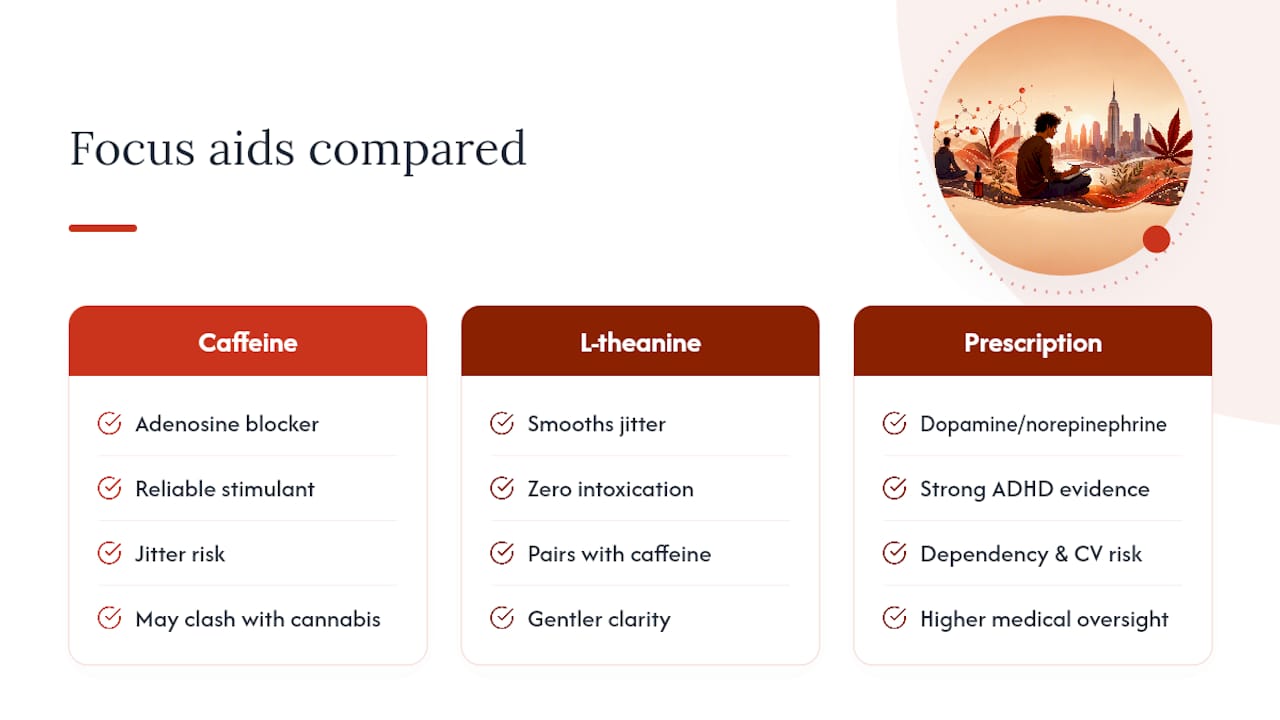
Caffeine remains the most reliable, best-studied cognitive stimulant available without a prescription, and it works through an entirely different mechanism, blocking adenosine receptors rather than engaging CB1. Many people find the two compounds create tension rather than synergy when combined carelessly. If you’re going to mix them, understanding how weed and caffeine interact before you do is worth the read.
L-theanine, often paired with caffeine, smooths out jitteriness without the psychoactive component cannabis carries, making it a gentler option for people who want clarity with zero intoxication risk. Prescription stimulants like methylphenidate work through dopamine and norepinephrine pathways and carry a stronger evidence base for attention disorders specifically, but come with their own dependency and cardiovascular considerations that put them in a different risk category entirely.
Cannabis’s advantage is precision and personalization. A terpene-forward, low-dose product lets you dial in a specific feeling, alert but not wired, clear but not jittery, in a way caffeine’s blunter mechanism doesn’t offer. Its disadvantage is legal complexity and the intoxication risk if you miscalculate the dose. For adults comfortable navigating that tradeoff, it’s a legitimate tool in the rotation rather than a replacement for every other option on the shelf.
The Bottom Line on Choosing Weed for Focus
Skip the guesswork and read the terpene panel before you read the strain name. Pinene and limonene are doing the real work, and no amount of marketing copy changes what’s actually in the jar. Document how you respond to a new product or ratio for at least a few sessions before drawing conclusions, and be especially cautious the first time you combine cannabis with any other stimulant or supplement. When in doubt, buy from a shop that makes lab data easy to find.
— Jake
Shop Verified, Terpene-Tested Products for Focus
Highfashionsmokesandprints puts the COA on the product page, not buried in a customer service email you have to request. Every flower, vape, and tincture listed on the day and night menus carries terpene and potency data upfront, so you can check pinene and limonene content before checkout instead of hoping the strain name delivers.
If flower isn’t your preferred format, comparing flower against vape cartridges can help you decide which delivery method fits your dosing precision needs. For readers leaning toward edibles for longer work sessions, the beginner’s guide to dosing edibles safely walks through starting doses and realistic timing before you order. Every delivery is age-verified and tracked, with same-day windows across New York City. Browse the current menu, filter by terpene profile where listed, and place your first order with the lab data already in hand.
Sources
- Frontiers in Molecular Neuroscience — pinene review
- Cannabinoids and cognition — review (PMC3165946)
- CBD and anxiety clinical evidence (PubMed 23339024)
- Leafly — strains for focus