Read our Google Birdeye Reviews
The most reliable way to avoid weed anxiety is to keep your THC dose low (start at 2.5 to 5 mg for edibles), choose a product with a balanced or CBD-forward ratio, and use it somewhere calm and familiar. Skip the guesswork, skip the mixing with alcohol, and have a grounding plan ready before you start. Everything else in this guide supports that one decision.
TL;DR:
- Using low doses of 2.5 to 5 mg of THC and choosing CBD-balanced products reduces the risk of anxiety and panic during consumption.
- Inhalation allows real-time dose assessment, making small puffs and waiting ten minutes a safer approach than edibles, which have delayed effects.
- Avoid concentrates, alcohol, and stimulants to prevent amplifying THC’s anxiety-provoking effects and maintaining better control over your experience.
- If anxiety occurs, stopping consumption, moving to a calm environment, and practicing slow breathing typically help resolve symptoms within hours.
- People with a history of psychosis, severe anxiety, young age, cardiovascular issues, or on interacting medications should consult a healthcare professional before use.
Table of Contents
- Quick Prevention Checklist Before Any Cannabis Session
- Why Cannabis Can Cause Anxiety in the First Place
- How to Avoid Weed Anxiety: Dosing, Products, and Method Rules
- If You Get Anxious or Paranoid While High: A Step-by-Step Playbook
- Who Should Avoid Cannabis or Take Extra Precautions
- How to Buy Safer Products and Build a Safe-Use Kit
- Small Habits Beat One-Time Fixes
- Find Lab-Tested Products Built for Predictable Doses
- Sources
Quick Prevention Checklist Before Any Cannabis Session
Run through this before you light up or eat an edible. It takes two minutes and it’s the difference between a relaxing evening and a rough one.
- Measure your dose. Don’t eyeball an edible or guess at a vape hit. Know the milligrams.
- Check the ratio. A product with CBD alongside THC, rather than pure THC, gives you a built-in buffer.
- Pick your setting. Home, a friend’s place, or anywhere you feel safe. Not a party, not a first date.
- Line up your company. A sober friend who knows your plan is worth more than any app.
- Skip the mixers. No alcohol, no stimulants, nothing unfamiliar in the mix.
- Stock your kit. Water, a light snack, and a breathing exercise you already know.
Pro Tip: Write your plan down before you start. “2.5 mg, home, with Sam, done by 9pm” takes ten seconds to jot and removes the decision fatigue that leads to overdoing it later in the night.
Why Cannabis Can Cause Anxiety in the First Place
THC doesn’t just relax you. It also revs up your brain’s threat-detection system, and which effect wins depends almost entirely on dose.
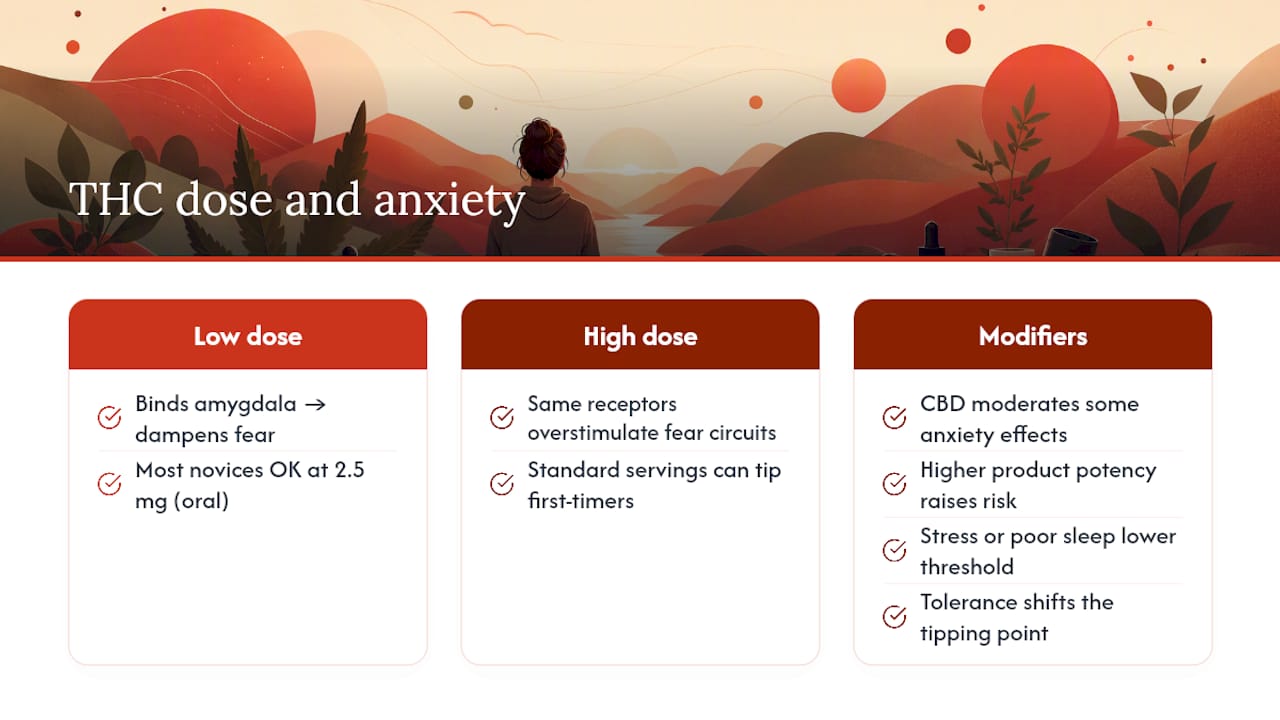
The amygdala, the part of your brain that flags danger, has cannabinoid receptors that THC binds to directly. At low doses, that binding tends to dampen fear responses. Push the dose higher, and the same mechanism can overstimulate those fear circuits instead of calming them. Researchers call this a biphasic dose-response: a little bit soothes, a lot backfires. It’s the same substance producing opposite outcomes depending on how much you took.
The math that matters here: most novice users do fine at 2.5 mg oral doses, while standard state-recommended servings can push some first-timers past their comfort threshold.
CBD complicates the picture in a useful way. It appears to moderate some of THC’s anxiety-provoking effects when the two are taken together, though it’s not a guaranteed fix for everyone. What has changed the risk calculus over the past decade is potency. Flower and concentrates on today’s market run far stronger than what was common a generation ago, so a “normal” hit now delivers a dose that would have been considered heavy in the past.
Your personal baseline matters too. Chronic stress, poor sleep, or a stressful week all lower the amount of THC it takes to tip you from relaxed into anxious. Tolerance shifts the line as well, sometimes in your favor, sometimes not, depending on how your endocannabinoid system has adapted to regular use.
How to Avoid Weed Anxiety: Dosing, Products, and Method Rules
This is where the science turns into action. The rules differ slightly depending on how you consume, so treat each method on its own terms.
Edibles are the riskiest for overshooting your dose, because the delay tricks people into redosing. Start at 2.5 to 5 mg and wait. Onset can take up to four hours in some people, especially on an empty stomach, and taking a second dose before the first one lands is one of the most common paths to a bad experience. Standard single doses in many legal markets can be too strong for many first-time or anxiety-prone users.
Inhalation gives you faster feedback, which is its main safety advantage. Take one small puff, wait ten minutes, and reassess before taking another. Counting inhalations rather than smoking freely is the simplest form of microdosing available, and it works because you get real-time information your body doesn’t give you with an edible.
A few product and method rules worth building into your routine:
- Favor CBD-balanced products. A 1:1 THC:CBD ratio, or CBD-forward beyond that, reduces the odds of a spike into panic for people who know they’re prone to it.
- Buy lab-tested products only. Look for a certificate of analysis showing exact THC and CBD milligrams per serving, not a vague potency range.
- Skip concentrates while you’re troubleshooting anxiety. Dabs and high-potency vape carts remove your margin for error almost entirely.
- Never combine with alcohol or stimulants. Both amplify THC’s anxiogenic side and make the biphasic curve far less predictable.
Pro Tip: If you’ve had a bad experience before, try a strain or product with terpenes like linalool or myrcene, which some users find more calming. It’s not a guarantee, but combined with a lower dose, it stacks the odds in your favor.
If You Get Anxious or Paranoid While High: A Step-by-Step Playbook
Panic during a cannabis session almost always passes on its own. The goal isn’t to fight it chemically. It’s to ride it out with your nervous system given the least additional stimulation possible.
- Stop consuming immediately. No more puffs, no more bites, even if you think “a little more might help.” It won’t.
- Move somewhere calm and familiar. Your couch, your bed, a quiet room. Not a crowded party or a car.
- Breathe in a fixed pattern. Box breathing, four seconds in, four seconds hold, four seconds out, four seconds hold, gives your body a physical off ramp from the panic loop.
- Ground yourself in your senses. Name five things you see, four you can touch, three you hear, two you smell, one you taste. It pulls your attention out of the spiral.
- Hydrate and eat something light. Dry mouth and low blood sugar make anxiety feel worse than it needs to.
- Cut the sensory noise. Dim the lights, turn off the music, silence notifications.
- Consider CBD only if you’ve used it calmly before. This isn’t the moment to experiment with something new.
Clinical guidance on cannabis intoxication is consistent on one point: there’s no fast pharmacological antidote for a routine bad reaction, and supportive care, calm environment, hydration, reassurance, is the standard approach. Most episodes resolve within one to a few hours as THC blood levels drop. If you experience chest pain, a racing heart that won’t settle, thoughts of self-harm, or a sense that you’re completely losing touch with reality, that’s your signal to call 911 or Poison Control rather than waiting it out.
Who Should Avoid Cannabis or Take Extra Precautions
Some people carry a meaningfully higher risk of a bad reaction, and for them, prevention starts with a harder conversation than “just start low.”
- A personal or family history of psychosis or severe anxiety disorders raises the odds that THC will provoke a more serious reaction than typical paranoia.
- Young people, whose brains are still developing, and anyone with cardiovascular disease face elevated risk, since THC raises heart rate and blood pressure.
- People on medications that interact with cannabinoids should check with a pharmacist or physician first, since interactions can amplify side effects unpredictably.
- Frequent high-potency users cycling between heavy use and withdrawal often experience more volatile anxiety responses than occasional, lower-dose users.
Public health guidance is direct on this point: cannabis worsens anxiety for a meaningful subset of users, and that risk compounds with high potency and frequent use. If any of the above applies to you, talk to a clinician before your next session, not after a bad one.
How to Buy Safer Products and Build a Safe-Use Kit
Better labeling removes most of the guesswork that causes bad reactions in the first place.
- Check the certificate of analysis for exact THC and CBD milligrams per serving, plus contaminant screening.
- Assemble a kit ahead of time: a measuring tool for edibles, a CBD tincture you’ve already tested when calm, a written breathing script, water, and a snack.
- Buy only from age-verified, legally compliant sources. It’s a proxy for testing standards, not just a legal checkbox.
- Log your sessions: date, product, dose, and how you felt. Patterns show up faster than memory alone.
Pro Tip: Keep your log in your phone’s notes app. Three entries in, you’ll usually spot your personal ceiling dose before you cross it again.
Small Habits Beat One-Time Fixes
Most bad reactions I’ve seen written about trace back to the same root cause: someone treated dosing as a guess instead of an experiment. Run small, deliberate tests. Same product, slightly different dose, same setting, and write down what happened. That log becomes more useful than any single tip after a few tries. If anxiety keeps showing up regardless of dose, that’s a pattern worth bringing to a doctor or therapist, not something to keep managing alone.
— Jake
Find Lab-Tested Products Built for Predictable Doses
Guesswork is the enemy of a good session, and it’s exactly what Highfashionsmokesandprints removes from the equation. Every product listed comes with clear milligram-per-serving labeling and lab verification, so you know your dose before you take it instead of finding out the hard way.
That matters most with edibles, where a mislabeled 10 mg gummy can turn a calm night into a rough one. Browse the day and night menus, check the CBD:THC ratio on anything you’re considering, and read the three rules for safe cannabis use before you order. Age verification and same-day delivery across NYC mean you can build your safe-use kit and have it at your door the same afternoon. Start with a low-dose, CBD-balanced product on your next order and see how your body actually responds.
This article is general information, not a substitute for advice from a qualified doctor. Consult a qualified healthcare professional about your own circumstances before acting on anything here.
Sources
- Five things you should know about marijuana edibles — UCHealth Today
- Peer-reviewed review (PMC) on cannabinoids and anxiety-related neurobiology — NCBI PMC
- Marijuana risks — SAMHSA
- Clinical perspectives on cannabis intoxication and emergency care — PMC article