Read our Google Birdeye Reviews
Most 510 cartridges run well within a moderate voltage range, with live resin and other terpene-rich oils favoring the lower end and thicker distillates needing more power. The reliable method is to start at the lowest setting your device allows, take a short preheat, then raise voltage in 0.1 to 0.2V steps until flavor and vapor hit their peak. Push past that point and you risk a scorched taste and a shorter cartridge life.
TL;DR:
- Live resin users often settle around 2.2V to 2.4V, while thick distillate may need more power, especially in cold weather.
- For sluggish oil, warm the cartridge between your palms for a minute or use a 1 to 3 second preheat before increasing power.
- A burnt taste, harsh throat hit, dark residue, or leakage suggests excess heat; thin vapor and flat flavor point to insufficient coil heat.
- Direct coil measurements found that higher voltage pushed some cartridges to 400 to 500 degrees Celsius, while carbonyl emissions rose sharply above power recommended by manufacturers.
- Because electronics and coil resistance vary, two batteries at the same voltage can produce different temperatures; follow the cartridge maker’s power limits.
Table of Contents
- Recommended voltage ranges by cartridge type
- Step-by-step dialing method: how to find your sweet spot
- Signs your voltage is too high or too low
- Temperature, safety, and what research shows about high-voltage risks
- Practical battery and cartridge care
- An experienced take on dialing in voltage
- Tested carts and same-day delivery that make dialing in easier
- FAQ
- Sources
Recommended voltage ranges by cartridge type
Oil composition drives nearly every voltage decision you make. Live resin and other terpene-rich extracts are the most temperature-sensitive products on the market because the compounds that carry flavor break down fast under heat. Distillate is more heat-stable, and factory-sealed disposables remove the choice entirely by locking in a preset.
- Live resin and terpene-rich carts typically start in a low voltage range to protect delicate terpenes.
- Standard distillate carts operate well at moderate voltages sufficient for clean vaporization.
- High-viscosity distillates may require somewhat higher voltage settings, especially in cold weather.
- Disposables and factory presets generally run in a range defined by their internal coil, with LED colors signaling the active setting — learn more about disposable vapes and safety considerations.
These ranges shift because cartridge design, oil viscosity, and coil resistance all interact. A ceramic coil built for thick distillate behaves differently from a quartz coil designed for runnier live resin, even at an identical voltage. CCELL’s own guidance treats voltage as a personal calibration tool rather than a fixed number, since no two cartridges or oil batches behave identically. That is why the ranges above are starting points, not settings to lock in permanently.
If you are still deciding between a cartridge and a disposable pen, the coil and battery differences matter as much as the oil itself, which we cover in our cart versus disposable comparison.
Step-by-step dialing method: how to find your sweet spot
Calibrating a new cartridge takes a few minutes and a little patience. The goal is to find the lowest voltage that still delivers full flavor and satisfying vapor, since that setting also protects the cartridge longest.
- Check that your battery is charged and the cartridge is screwed in snugly to avoid a weak or inconsistent connection.
- If the cartridge feels cold or the oil looks sluggish, warm it between your palms for a minute before you start.
- Set your battery to its lowest voltage, preheat for 1 to 2 seconds if your device has that function, then take a 2 to 4 second puff.
- Raise the voltage by 0.1 to 0.2V, take one more test puff, and note any change in flavor or harshness.
- Repeat the small increases until the flavor turns crisp and vapor production feels satisfying, then stop there.
- If a puff ever tastes burnt or feels harsh in your throat, drop back down immediately rather than continuing to climb.
Pro Tip: When oil feels thick or sluggish, reach for a longer preheat before you reach for more voltage. It often solves the problem without adding heat.
Signs your voltage is too high or too low
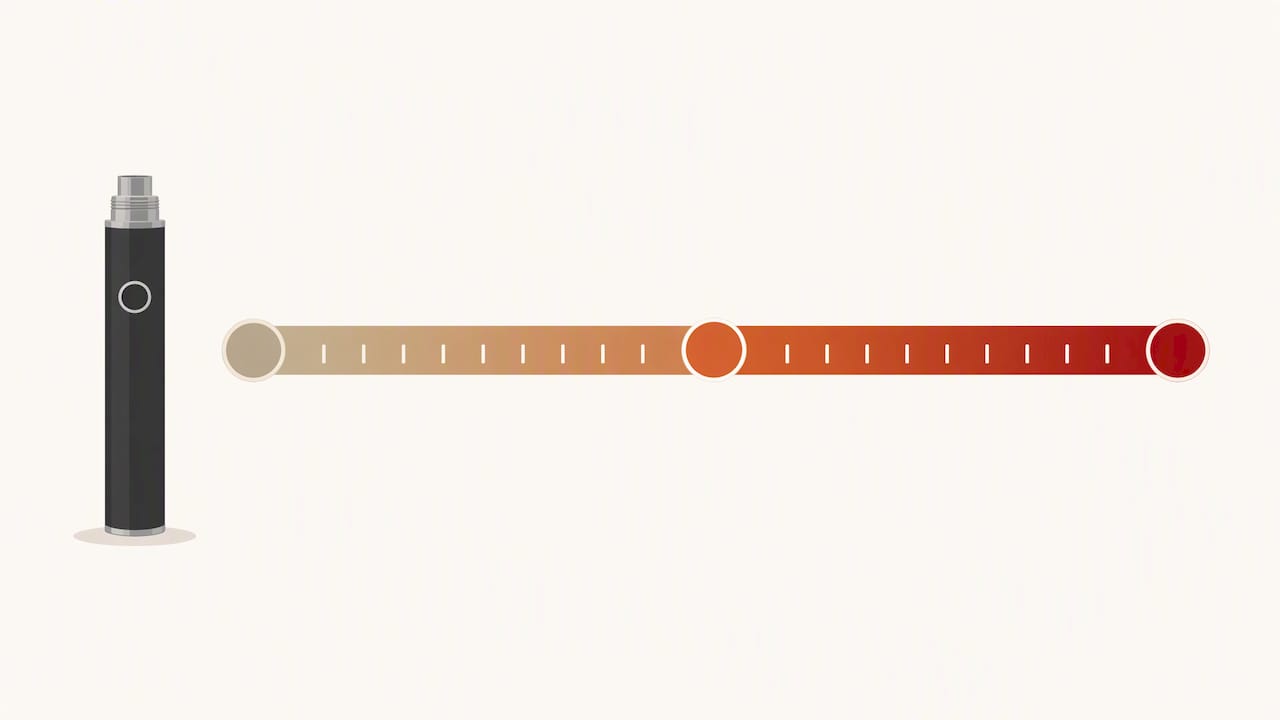
Your senses are the fastest diagnostic tool you have mid-session. A burnt or ashy taste, a harsh hit at the back of your throat, dark residue building on the mouthpiece, or oil leaking from the cartridge all point to excess heat breaking down the oil faster than it can vaporize cleanly. Voltage set too high also tends to shorten how long a cartridge lasts before it clogs or dries out unevenly.
On the other end, weak, thin vapor or almost no flavor usually means the coil isn’t getting hot enough to vaporize the cannabinoids and terpenes consistently.
- Too high: burnt taste, harsh throat hit, dark residue, leaking around the mouthpiece.
- Too low: thin vapor, flat flavor, inconsistent activation from puff to puff.
- Quick fixes: lower the voltage one notch, add a short preheat, confirm the airflow path is clear, and let a cold cartridge warm up before your next pull.
If a clog is the real culprit rather than voltage, our guide to clearing a clogged cart walks through a fix that takes under two minutes.
Temperature, safety, and what research shows about high-voltage risks
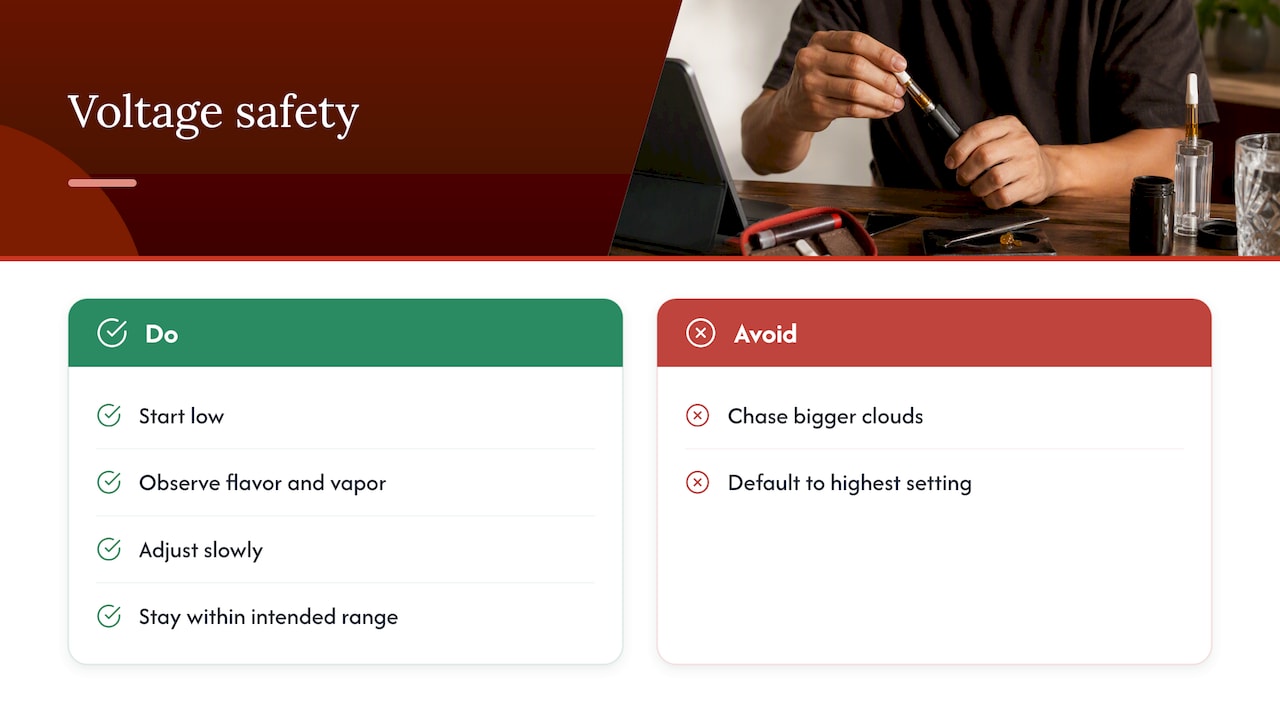
Voltage and coil temperature are related but not identical, and the gap between them matters more than most people realize. Lab testing that measured coil temperature directly while vaping found that higher applied voltage and power pushed some cartridges to 400 to 500 degrees Celsius, a range associated with thermal breakdown of the oil rather than clean vaporization.
A separate study found that carbonyl emissions rise with higher power settings and can increase sharply once power exceeds what the manufacturer recommends. That single finding is the clearest argument for staying within a cartridge’s intended range rather than chasing bigger clouds.
Treat voltage as a personal calibration tool. Start low, observe how the flavor and vapor respond, and adjust slowly rather than defaulting to the highest setting.
Two batteries set to the same voltage will not always produce the same coil temperature, since internal electronics and coil resistance vary by device. That variability is one more reason to let taste and vapor quality guide your final setting rather than the number on the screen alone.
Practical battery and cartridge care
Good habits keep you from ever needing to crank the voltage in the first place. A short preheat of 1 to 3 seconds mobilizes thick oil far better than extra power does, especially in cold weather when oil naturally thickens.
- Store cartridges upright in a cool, dark place, since sunlight and heat break down terpenes over time.
- Wipe battery contacts clean periodically and keep the battery charged rather than running it down repeatedly.
- Avoid leaving your device parked on its highest setting out of habit.
- Replace a cartridge once you notice persistent clogging or a burnt taste even at low voltage, since those symptoms often point to a worn coil rather than a settings problem.
Pro Tip: A clog or a loose connection can mimic the exact symptoms of bad voltage. Rule those out before you touch the dial.
For longer-term storage questions, our tips for keeping cartridges potent for up to six months cover the conditions that protect flavor over time.
An experienced take on dialing in voltage
Customers who vape live resin almost always gravitate toward the lower end of the range, usually around 2.2V to 2.4V, because anything higher flattens the terpene flavor they’re paying for. Distillate users tend to be more forgiving and often settle a bit higher without complaint. The pattern holds consistently enough that it’s worth starting low regardless of what cartridge you’re holding. For anyone who wants the deeper safety rundown on batteries, LED indicators, and charging habits, our Vape Battery Safety page covers it in full.
— Jake
Tested carts and same-day delivery that make dialing in easier
We stock lab-tested vapes alongside 510-compatible batteries, so you’re not guessing about compatibility before your order even arrives. We offer delivery that lets you get a new cartridge quickly when yours starts acting up, and our team is available if you have questions about which battery pairs well with a given cart.

Browse our current menu and place an order through High Fashion Smokes & Prints, or reach out to our support team if you need help matching a battery to your cartridge.
FAQ
What do the different colors on an O.pen battery mean?
LED colors on an O.pen battery typically indicate the active voltage or power setting rather than battery charge, with different colors corresponding to low, medium, and high output. Check the manual for your specific model, since color-to-voltage mapping varies between device generations.
Is one puff of a vape equal to one cigarette?
There’s no fixed equivalence between a single vape puff and a cigarette, since the comparison depends heavily on device wattage, oil or e-liquid content, and puff duration. The honest answer is that the two aren’t directly comparable in any reliable one-to-one way.
What ohm are disposable vapes?
Disposable vapes commonly use coils with resistance depending on the manufacturer and device design. Lower resistance generally pairs with higher power output at a given voltage.
How do I use a 510 battery pen?
Screw your cartridge clockwise into the 510-threaded connector until it’s snug, select your voltage if the battery is adjustable, and press the button (or draw, on buttonless models) to activate the coil. Start at the lowest voltage setting and work upward in small increments to find the flavor and vapor level that suits your cartridge.
What voltage should I use for a new cartridge I’ve never tried?
Start at the lowest setting your battery offers, generally around 2.0V to 2.2V, and take a single test puff before adjusting. Raise voltage in small 0.1 to 0.2V steps until the flavor is clean and vapor production feels right, since this protects both the oil’s flavor and the cartridge’s lifespan.
Sources
- Simultaneous temperature measurements and aerosol collection during vaping (PMC)
- CCELL: Best voltage for live resin carts (CCELL blog)