Read our Google Birdeye Reviews
Cannabis lab results, formalized as a Certificate of Analysis, are the batch-specific document proving what’s actually in your product and whether it’s safe to consume. Before you trust one, run three checks: the batch number on the COA has to match your packaging, the Total THC figure should reflect a real calculation rather than a guess, and every contaminant screen needs to read “Pass or ND.” A COA from an accredited lab backs all three with verifiable data.
TL;DR:
- Always verify that the batch number on the COA matches the packaging and that the test date is recent to ensure you’re viewing current, authentic results.
- Total THC is calculated by multiplying the THCA percentage by 0.877 and adding it to the delta-9 THC percentage, providing an accurate potency measure after decarboxylation.
- Contaminant screens report results as Pass or ND, and any fail in pesticides or solvents indicates the product should not be consumed.
- Variability exists between different accredited labs due to differences in calibration and testing methods, so results may not match perfectly across facilities.
- Reputable vendors often provide batch-specific COAs upon request, making it safer to buy from sources that verify product safety and potency transparently.
Table of Contents
- What Cannabis Lab Results (COA) Actually Include
- How to Read Potency Numbers and Calculate Total THC
- Contaminant Screens and Safety Flags Worth Knowing
- Why Lab Results Aren’t Always Identical Between Labs
- Where to Find and Verify Your Product’s Lab Results
- How Highfashionsmokesandprints Handles Lab Verification
- Browse Verified Products and Request a COA
- Sources
- FAQ
What Cannabis Lab Results (COA) Actually Include
A Certificate of Analysis is an independent lab document that verifies a cannabis product’s potency and safety, and it follows a fairly predictable format once you know what to look for. Every legitimate COA identifies the batch, the lab, and the testing date up front, then breaks down cannabinoids and contaminants in separate panels.
Here’s what should be on the page:
- Batch ID and product type, tying the report to a specific production run, not a general product line
- Testing date and lab name, along with the lab’s accreditation number or credentials
- Cannabinoid breakdown, including delta-9 THC, THCA, CBD, and minor cannabinoids like CBG or CBN, plus a total cannabinoids line
- Terpene panel, listing individual terpenes and a total terpene percentage
- Contaminant screens for pesticides, heavy metals, microbes, and residual solvents
You’ll also see notation like “ND” (not detected) or “<LOQ” (below the limit of quantitation) scattered through the contaminant section. Those aren’t red flags. They mean the lab’s equipment couldn’t detect the substance at all, or detected only a trace too small to reliably measure. California’s testing requirements mandate this full panel, covering cannabinoids, terpenes, solvents, pesticides, heavy metals, microbial impurities, mycotoxins, and moisture, before a product can legally reach a shelf.
How to Read Potency Numbers and Calculate Total THC
Labs report delta-9 THC and THCA as two separate line items because they’re chemically different compounds until heat converts one into the other. THCA is the acidic form that exists in raw flower; it doesn’t get you high until decarboxylation, the process of applying heat, converts it into active delta-9 THC.
That’s why “Total THC” matters more than either number alone. The industry-standard formula, used by accredited labs across the country, is:
- Take the THCA percentage and multiply it by 0.877
- Add that result to the delta-9 THC percentage
- The sum is your Total THC
The math behind the 0.877 multiplier: THCA loses a carboxyl group when it converts to delta-9 THC, which changes its molecular weight. That conversion factor accounts for the weight lost, so labs aren’t overstating potency by counting the raw THCA number at face value.
For example, if a flower’s COA lists THCA and delta-9 THC percentages, the Total THC can be calculated by multiplying the THCA percentage by 0.877 and adding the delta-9 THC percentage, giving a more accurate potency number reflecting decarboxylation. That’s the number that reflects what you’d actually get from combustion or vaporization, not from eating the raw plant material. Worth noting: edibles process differently through the liver, so a flower’s Total THC percentage doesn’t translate directly to how an edible will hit. Our guide comparing flower and vapes breaks down how method changes the experience even at matching potency.
Contaminant Screens and Safety Flags Worth Knowing
The potency numbers get most of the attention, but the contaminant panel is where a COA actually protects you. Cannabis absorbs pesticides, heavy metals, and mold from soil and cultivation practices, and inhaling or ingesting contaminated product carries real health risk.
Standard panels test for:
- Pesticides, screened against a list of banned agricultural chemicals
- Heavy metals, typically lead, arsenic, cadmium, and mercury
- Microbial contaminants and mycotoxins, covering mold, yeast, and bacterial counts
- Residual solvents, relevant mainly for concentrates and vapes processed with butane or ethanol
- Moisture content, which affects both potency stability and mold risk
Results are typically reported in parts per million or parts per billion, with a simple Pass or Fail next to each category. “ND” means the lab found nothing at all. Anything marked “Fail,” any solvent level flagged above the lab’s stated action limit, or a missing contaminant panel entirely should stop you from consuming the product.
Pro Tip: If a COA shows a “Fail” anywhere in the pesticide or solvent section, don’t just avoid that product. Contact the retailer immediately and ask whether the batch was pulled, since a failed test on one unit often means the whole batch needs to come off shelves.
Why Lab Results Aren’t Always Identical Between Labs
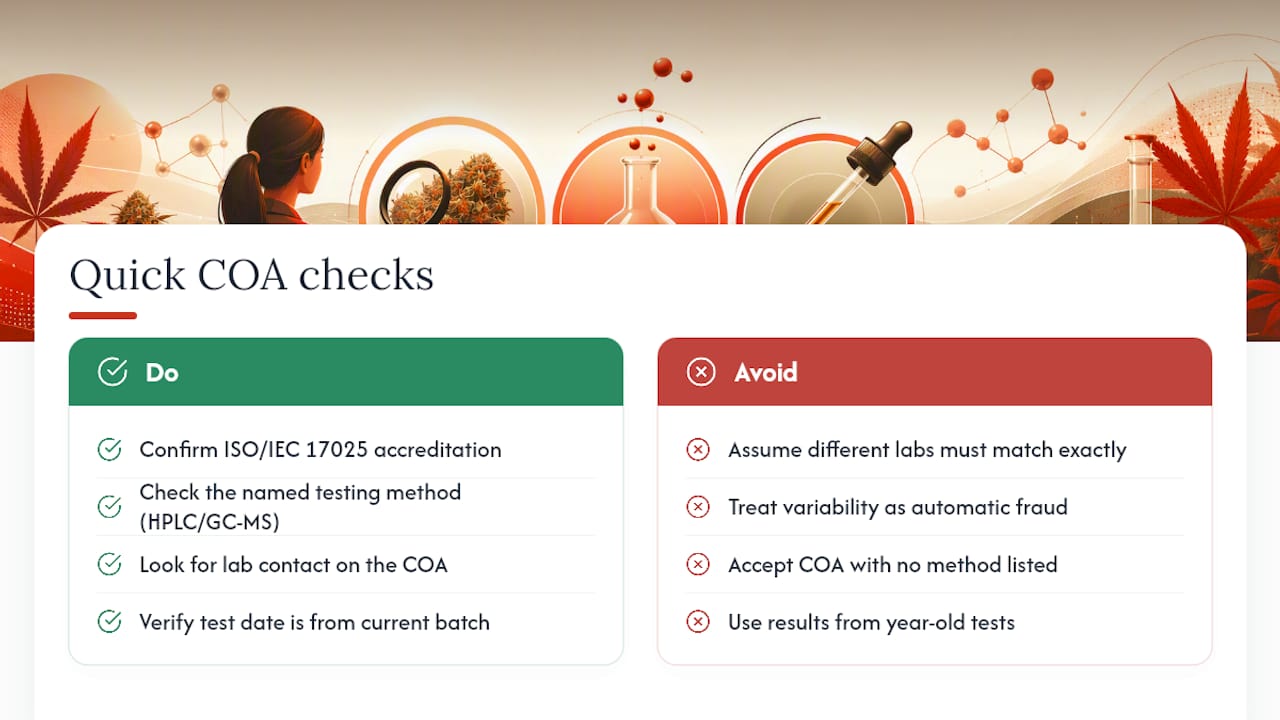
Accreditation is the first thing worth confirming on any COA, and it’s usually listed as an ISO/IEC 17025 certification number near the lab’s name. That standard means the lab follows documented testing procedures and calibration practices, not that every result will match perfectly across facilities.
Variability between labs is real, and it’s not necessarily a sign of fraud. Differences in extraction solvent, calibration method, and sample dilution can shift readings even when both labs are technically competent, a pattern documented in analytical chemistry reviews of cannabinoid testing methods.
Interlaboratory testing conducted through NIST’s CannaQAP program found measurable variability between labs on some cannabinoid measurements, even when each lab performed consistently within its own method. NIST’s recommendation: labs should use traceable calibration standards and validate methods rigorously, and consumers should favor labs that document both.
Practically, that means checking whether the COA names its testing method (HPLC or GC-MS, covered next), lists a lab contact, and carries a test date from the current production cycle rather than one that’s a year old.
Where to Find and Verify Your Product’s Lab Results
Every legitimate cannabis product ships with a way to trace its COA back to the exact batch you’re holding, and skipping this step is the most common mistake consumers make.
- Find the batch number printed on the product packaging, usually near the barcode or net weight
- Scan the QR code if one’s provided, or search the batch number on the brand’s or retailer’s COA page
- Confirm the test date is recent and matches the product’s shelf life, not a stale report from an earlier harvest
- Check for a lab name and method disclosure on the report itself; a COA with no lab credentials listed isn’t verifiable
- If the batch number doesn’t match or you can’t find a COA at all, contact the retailer before consuming anything
State track-and-trace systems and lab portals exist specifically so consumers can cross-check this information independently rather than trusting packaging claims alone, a point Washington’s Liquor and Cannabis Board emphasizes in its consumer guidance.
How Highfashionsmokesandprints Handles Lab Verification
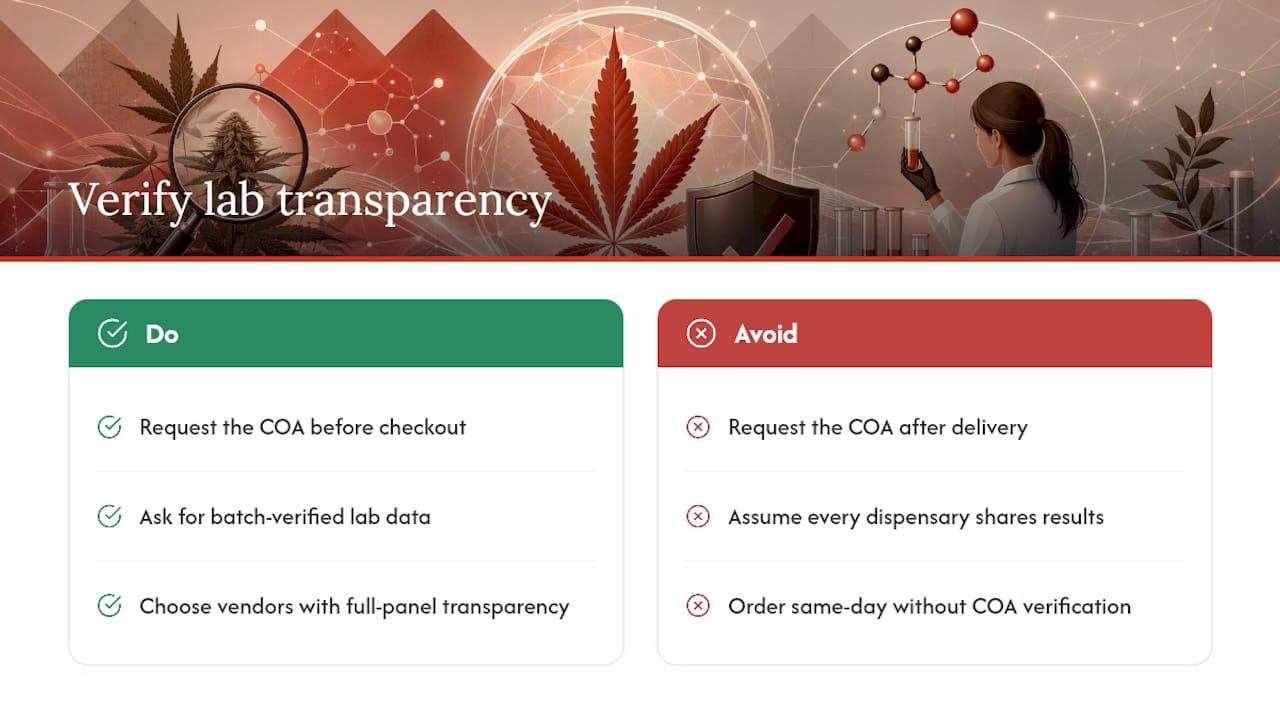
Some cannabis vendors check Certificates of Analysis before listing products and keep batch-verified lab data available to customers who ask for it. If you’re ordering for same-day delivery and want to see the COA behind a specific batch, request it before checkout rather than after your order arrives.
Not every dispensary makes this easy, and that gap is exactly why full-panel transparency should factor into where you choose to shop. A vendor willing to hand over a complete cannabinoid, terpene, and contaminant breakdown on request is telling you something about how seriously they treat quality assurance.
— Jake
Browse Verified Products and Request a COA
Some online dispensaries list lab-tested flower, vapes, edibles, and concentrates with COA access available on request, helping customers know what’s in their delivery. That’s the practical advantage over sourcing from an unverified seller: every batch on our menu has a paper trail you can actually check before you buy.

If you’re still deciding which product format fits your tolerance and schedule, our dosing guide for edibles walks through how to translate a COA’s potency numbers into a safe starting dose. Once you’ve picked a category, browse the current menu and place a same-day order, or reach out to customer service if you want a specific batch’s lab results before you commit.
This article is general information, not a substitute for advice from a qualified doctor. Consult a qualified healthcare professional about your own circumstances before acting on anything here.
Sources
- New Jersey Cannabis: Highpoints — Certificate of Analysis explanation (2025)
- Connecticut Cannabis Portal — How is total THC calculated
- NIST IR 8519 — Cannabis Laboratory Quality Assurance Program: Exercise 2 (2024)
- California Department of Cannabis Control — Testing laboratories and required testing
FAQ
What is a cannabis lab result or COA?
A Certificate of Analysis is an independent lab report confirming a specific product batch’s cannabinoid content, terpene profile, and contaminant status, including pesticides, heavy metals, microbes, and solvents.
How do I calculate Total THC from a lab report?
Multiply the THCA percentage by 0.877, then add the delta-9 THC percentage. The result is Total THC, the figure that reflects potency after decarboxylation.
What does “ND” mean on a cannabis lab report?
“ND” stands for “not detected,” meaning the lab’s testing equipment found no measurable trace of that substance in the sample.
Why do two labs sometimes report different potency numbers for the same product?
Differences in extraction method, calibration, and sample dilution can shift readings between labs, a variability documented by NIST’s CannaQAP program even among accredited facilities.
How can I tell if a COA is fake or doesn’t match my product?
Check that the batch number on the COA matches your packaging exactly, confirm the lab’s accreditation is listed, and verify the test date is recent. If anything’s missing or doesn’t line up, contact the retailer before consuming.
Does Highfashionsmokesandprints provide lab results for its products?
Yes. Highfashionsmokesandprints verifies COAs before listing products and provides batch-specific lab data to customers who request it for their delivery order.