Read our Google Birdeye Reviews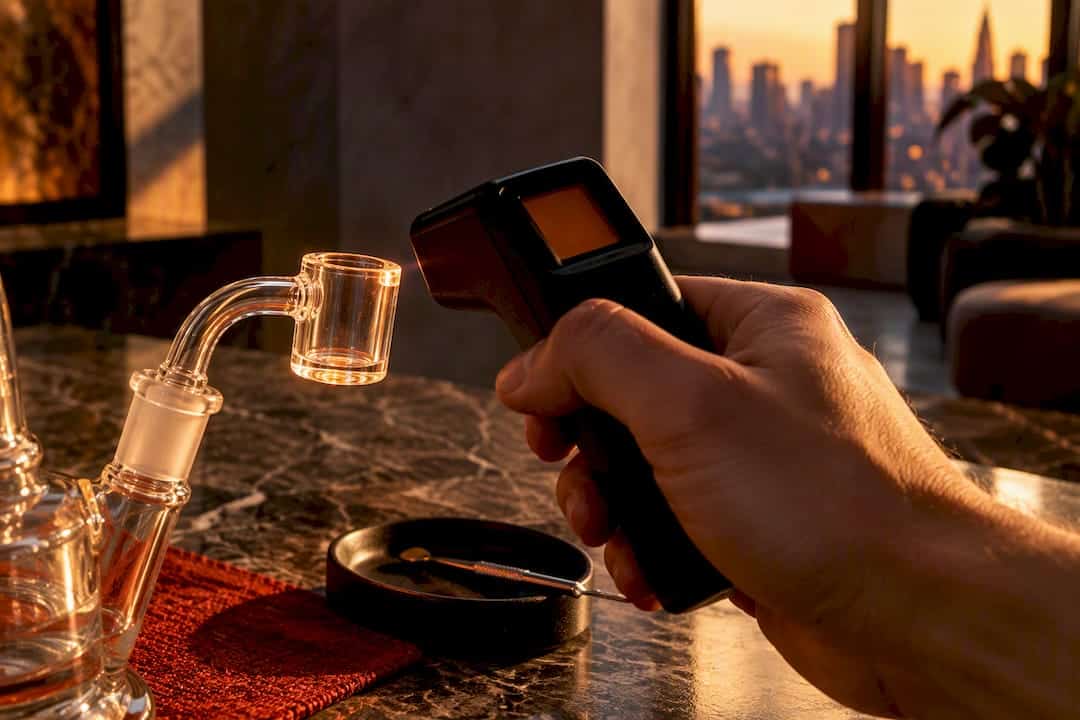
The sweet spot for most cannabis concentrates sits within a moderate temperature range that balances flavor preservation and vapor production, with a commonly preferred subrange offering a good compromise. Lower in that range preserves terpenes and flavor; higher builds bigger clouds but pushes degradation byproducts up. If you’re using an e-nail, set it to 460°F and start there. Torch users, heat your banger until it glows, then count roughly 40 to 45 seconds before the dab.
TL;DR:
- Using an infrared thermometer to verify banger temperature ensures precise control and reduces exposure to harmful degradation products.
- Most concentrates like live resin and rosin perform best between 440 and 480°F to preserve flavor while minimizing toxicant formation.
- Dabbing at higher temperatures above 550°F increases vapor volume but accelerates terpene breakdown and risks combustion, producing more harmful byproducts.
- Waiting 40 to 45 seconds after glow on a standard quartz banger generally achieves a mid-range temperature suitable for flavorful vaporization.
- Regular calibration of your device and avoiding chain-dabbing significantly lowers exposure to potentially hazardous chemicals.
Table of Contents
- What Do Low, Mid, and High Dab Temperatures Actually Do?
- What Temperature Should You Use for Different Concentrates?
- How Do You Measure and Hit Your Target Dab Temperature?
- What Does the Research Say About Dabbing at High Temperatures?
- Which Materials and Tools Actually Improve Flavor and Control?
- How Long Should You Wait Before Taking a Dab?
- Why Precision Over Guesswork Wins Every Time
- Where to Find Lab-Tested Concentrates and Dabbing Gear in NYC
- Studies and Resources Behind This Guide
- Sources
- FAQ
What Do Low, Mid, and High Dab Temperatures Actually Do?
Every temperature band changes what comes off your concentrate, not just how much of it.
Low temp (400 to 450°F / 204 to 232°C): This is where terpenes stay closest to intact. Most cannabis terpenes, including myrcene, limonene, and pinene, boil off between roughly 300 and 450°F, so a low-temp dab tastes closer to the raw extract. Vapor production is thin, and you’ll notice a lot of leftover residue (“reclaim”) stuck to the banger.
Mid temp (450 to 550°F / 232 to 288°C): This is the working range most experienced dabbers settle into. THCA has fully converted to THC by this point, terpenes are still largely present, and vapor output climbs without tipping into harsh territory.
High temp (550°F and up / 288°C+): Clouds get thick and the hit feels more aggressive, but you’re now cooking off terpenes fast and edging toward combustion. Combustion starts around 600°F, and past that point you’re not vaporizing anymore. You’re burning, which brings the same kind of byproducts associated with smoking rather than dabbing.
A few practical takeaways worth pinning down:
- Terpenes degrade well before cannabinoids fully combust, so “hotter” doesn’t mean “stronger.” It often means less flavor for a similar high.
- Cannabinoid vaporization for THC starts around 315°F, meaning even a conservative low-temp dab still delivers potency.
- Research on dabbing aerosols found that significant portions of the gas phase can consist of degradation products, with their concentrations increasing with applied heat.
What Temperature Should You Use for Different Concentrates?
Not every extract behaves the same way at the same heat, since consistency and terpene content change how fast a dab vaporizes versus scorches.
- Live resin: Start at 440 to 480°F. Live resin is loaded with volatile terpenes preserved from the fresh-frozen plant, so this material rewards a gentler touch. Push much past 500°F and you lose the flavor that makes live resin worth the price in the first place.
- Live rosin: Similar range, 440 to 480°F. Solventless extraction concentrates terpenes without solvent residue, and readers comparing this to traditional resin extraction should know rosin’s texture (often softer and stickier) transfers heat a bit differently than resin.
- Sauce: 450 to 490°F. The terpene-rich liquid layer in sauce vaporizes fast, so err low to avoid flash-vaporizing your terpenes before you inhale.
- Diamonds: 480 to 530°F. Diamonds are near-pure THCA crystals with little inherent terpene content (the sauce around them carries the flavor), so they tolerate more heat before anything starts to taste burnt.
- Shatter: 480 to 540°F. Stable and glassy, shatter handles mid to upper-mid heat well without much loss in vapor quality.
- Sugar and budder/badder: 460 to 520°F. Softer textures with more surface area heat up quickly, so start on the lower end of that window and adjust from there.
- Hash and dry-sift rosin: 430 to 480°F. These traditional concentrates carry a wide terpene profile that’s easy to scorch, so lower heat protects the flavor you’re paying for.
As a general adjustment rule, move in 10 to 40°F increments when dialing in a new batch. Texture changes (a runnier sauce versus a firmer shatter) rarely call for a jump larger than that.
How Do You Measure and Hit Your Target Dab Temperature?
E-nails give you a programmable, repeatable setpoint. You dial in a number, wait for it to stabilize, and dab. Torches are cheaper and portable but rely entirely on timing and glow color, which varies with banger thickness, ambient temperature, and torch strength.
Neither method is foolproof without verification. Here’s how to check your actual temperature:
- Heat your banger to your target method (torch or e-nail).
- Aim an infrared thermometer at the inner wall or bottom of the banger, not the top lip, since that’s where readings run most accurate.
- Wait through your cool-down period, then take a second reading right before dabbing.
- Adjust your timing or e-nail setpoint based on what the IR reader shows, not what the display claims.
That last step matters more than people assume. Device studies on temperature variability found that setpoints and actual surface or coil temperatures can diverge sharply, sometimes by over 100°C, depending on probe placement and device power.
Pro Tip: Run one calibration session with an IR thermometer per new banger. Quartz, ceramic, and titanium all hold and lose heat differently, so a timing rule that works on one won’t transfer cleanly to another.
For standard-thickness quartz bangers, 40 to 45 seconds after the glow fades typically lands in the mid-temp range. Thinner bangers cool faster and need less wait time; thicker bangers hold heat longer and need more.
What Does the Research Say About Dabbing at High Temperatures?
Peer-reviewed testing backs up what a lot of dabbers already suspect from taste alone: hotter isn’t just harsher, it’s chemically different.
Terpene-focused experiments found that dabbing terpene-rich mixtures generates methacrolein and benzene under realistic dabbing conditions, with methacrolein detected at elevated temperatures and not detected at the lowest temperatures tested. That’s a direct, measured link between heat and specific toxicant formation, not a hypothetical one.
Not all terpenes behave the same way under heat. Isotope-labeling work on β-myrcene decomposition showed this particular terpene, common in many cannabis strains, produces disproportionately more isoprene and other hazardous compounds when dabbed compared to THC alone. Interestingly, the same research found β-myrcene can reduce certain harmful compounds in some vaping setups, a reminder that the device and method change the chemistry as much as the plant material does.
A few steps cut your exposure without asking you to give up dabbing:
- Stay in the low to mid range (400 to 525°F) as your default, reserving higher heat for occasional use.
- Avoid chain-hitting. Back-to-back dabs on a device that hasn’t fully cooled can push coil or surface temperatures well above your intended setpoint.
- Buy concentrates that come with lab testing and clear potency and terpene data, so you know what you’re actually vaporizing.
Which Materials and Tools Actually Improve Flavor and Control?
Quartz bangers are the standard for flavor. They heat cleanly, don’t impart taste, and cool at a predictable rate that makes timing easier to learn.
Titanium heats up faster and holds heat longer, which some people like for durability, but it can subtly alter flavor over repeated use as the metal surface degrades.
Carb caps let you dab at lower temperatures without sacrificing vapor production, since restricting airflow creates a mini-vacuum that pulls vapor off the concentrate more efficiently.
For accuracy, an external IR thermometer beats trusting a built-in display, especially on vape pens and cartridges, where reported setpoints often run well below actual coil temperature.
How Long Should You Wait Before Taking a Dab?
Cool-down timing depends almost entirely on your banger’s thickness and material.
- Thin-wall quartz: 30 to 35 seconds after the glow disappears usually lands in the mid-temp zone.
- Standard quartz (most common): 40 to 45 seconds gets you into that same 450 to 525°F window.
- Thick-wall or quartz “buckets”: 60 seconds or more, since these retain heat longer and cool more slowly.
- Cold-start method: Load your concentrate into a cold banger, then apply low, gentle heat until it fully vaporizes. This skips guesswork on cool-down entirely and tends to preserve flavor exceptionally well, though it takes practice to avoid uneven heating.
Watch for cues: excessive popping or a scorched smell means you’re too hot; a weak, cool vapor with little effect means you waited too long. Track what works on your own setup and adjust in small increments.
Why Precision Over Guesswork Wins Every Time
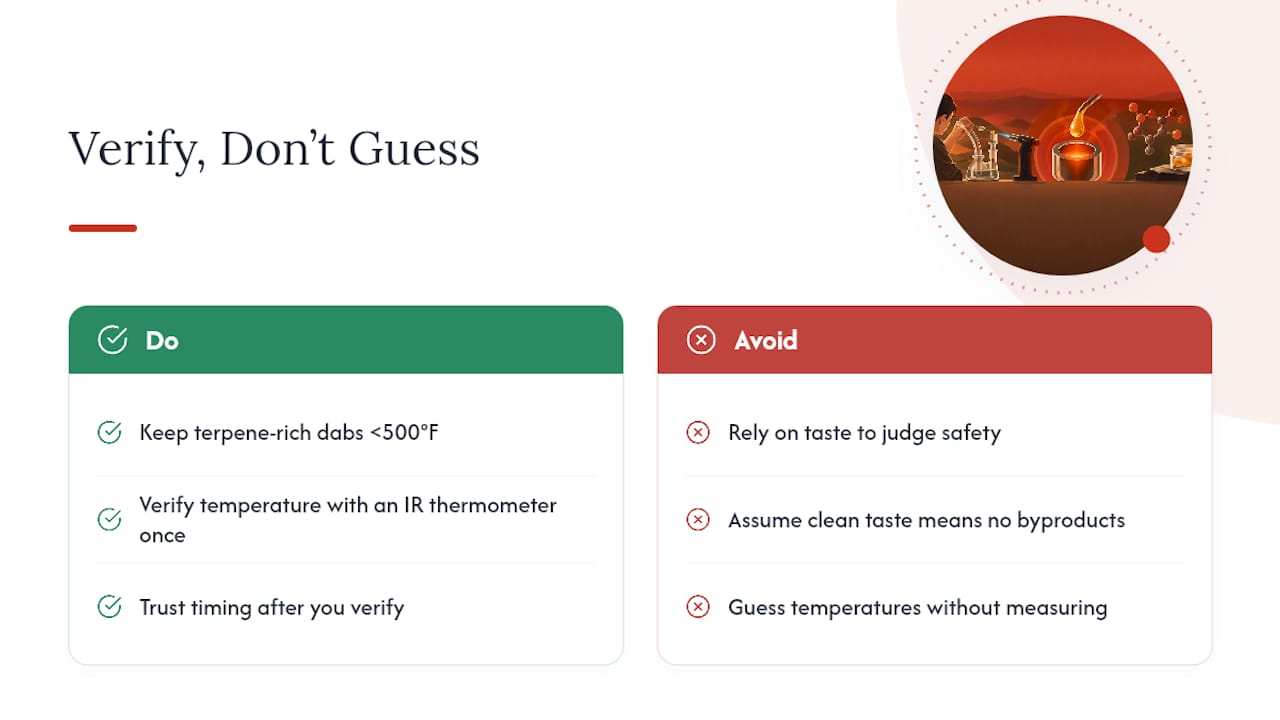
Most guides tell you to “find your sweet spot” and leave it there, which is only half the advice worth giving. The real gap is between what a dab tastes like and what’s actually happening chemically at that heat, and that gap is where the toxicant research matters most. A dab that tastes clean can still be forming byproducts you can’t smell or taste.
We lean conservative on purpose. For terpene-rich concentrates like live resin and live rosin, staying under 500°F isn’t about being cautious for its own sake, it’s about matching the heat to what the research shows those terpenes can handle before they start breaking down into something you didn’t choose to inhale. Verify your temp with an IR thermometer once, then trust your timing.
— Jake
Where to Find Lab-Tested Concentrates and Dabbing Gear in NYC
Highfashionsmokesandprints is the straightforward alternative to guessing at potency or terpene content from a random source. Every concentrate on the menu comes lab-tested and verified, so the temperature guidance above actually means something when you know what’s in your banger.

Browse the concentrates category for live resin, live rosin, sauce, and diamonds, and pick up the carb caps and accessories that make hitting your target temperature easier session after session. Same-day delivery covers multiple boroughs in New York City, with delivery fees varying by location. Check the full menu and place an order to get lab-verified concentrates delivered on your schedule today.
Studies and Resources Behind This Guide
- Meehan-Atrash et al. (2019) measured degradation products in dabbing aerosols across temperature ranges.
- Meehan-Atrash et al. (2017) quantified methacrolein and benzene formation from terpene dabbing.
- Munger et al. traced β-myrcene decomposition into isoprene and related compounds.
- Geiss et al. documented how device power and probe placement skew temperature readings.
- Cannaone’s vaporizer temperature guide covers practical device settings for related vaping and dabbing setups.
This article is general information, not a substitute for advice from a qualified doctor. Consult a qualified healthcare professional about your own circumstances before acting on anything here.
Sources
- Meehan-Atrash et al. (2019) – Terpene dabbing / aerosol study (PubMed)
- Meehan-Atrash et al. (2017) – Toxicant formation from terpene dabbing (PubMed)
- Munger et al. – decomposition of cannabinoids and terpenes in dabbing and vaping (PMC)
- Geiss et al. – device temperature variability and measurement (PMC)
FAQ
What Are the Best Temperatures for Dabbing?
Most concentrates perform best between 400°F and 550°F, with 450 to 525°F offering the clearest balance of flavor and vapor. Terpene-heavy extracts like live resin do better on the lower end, around 440 to 480°F.
Do Higher Temperature Dabs Get You Higher?
Not necessarily. THC vaporizes starting around 315°F, so a low or mid-temp dab still delivers full potency; higher heat mainly increases vapor volume and harshness, not strength, while accelerating the formation of degradation byproducts.
Is Dabbing Better for Your Lungs Than Smoking?
Dabbing avoids the combustion byproducts tied to burning plant material, but it isn’t free of risk. Research shows that at higher temperatures, dabbing produces measurable amounts of benzene and methacrolein, so staying in the low to mid-temp range matters for minimizing exposure.
How Can You Tell When a Dab Rig Is Hot Enough?
The most reliable method is an infrared thermometer aimed at the inner wall or bottom of the banger, since built-in display readings and glow color can be misleading. Without a thermometer, count roughly 40 to 45 seconds after the glow fades on a standard-thickness quartz banger for a mid-temp dab.
How Long Does It Take Live Resin or Rosin to Vaporize Cleanly?
At the recommended 440 to 480°F range, live resin and live rosin typically vaporize within a few seconds once the dab touches the heated surface. Using a carb cap helps pull vapor off the concentrate more completely at these lower temperatures without needing extra heat.