Read our Google Birdeye Reviews

CBN may help some people stay asleep, but the evidence is thin. The best human trial so far found that 20 mg taken before bed cut nighttime awakenings, yet it did not help people fall asleep faster. Bigger claims on product labels run ahead of the science. Below is what has been tested, what dose and timing were used, how CBN stacks up against melatonin, CBD and THC, and what to check before you try it.
TL;DR
- Human research on isolated CBN is small. One 2024 trial found 20 mg nightly reduced awakenings but not time to fall asleep.
- A 2023 trial found CBN performed about the same as 4 mg of melatonin, and both beat placebo on self-reported sleep quality.
- CBN-specific side effects and drug interactions are poorly understood, so talk to a clinician if you take medication or have a health condition.
- Strain labels such as indica and sativa are weak predictors of how you will feel. Cannabinoid and terpene content tells you more.
Table of Contents
- What CBN is and why people connect it with sleep
- What human trials actually found
- CBN dosage for sleep: what has been studied
- CBN vs melatonin, CBD and THC
- Is CBN safe to take every night?
- Choosing a product: edibles, beverages and what to read on the label
- Strains for anxiety and pain: what to know before you shop
- Our perspective at High Fashion
- Get what you need delivered in NYC
- FAQ
- Sources
What CBN is and why people connect it with sleep
Cannabinol (CBN) is a minor cannabinoid. It forms as THC ages and breaks down, which is why old, oxidized flower is often described as sleepy. That folk reputation is where much of the CBN-for-sleep story starts. The research has been catching up slowly.
A 2021 peer-reviewed review found that CBN sleep research was dated and limited. Most human studies came from the 1970s and 1980s, used small samples, and none used validated sleep questionnaires or polysomnography. The authors quote Dr. Jamie Corroon saying that the clinical evidence for CBN as a sleep aid is insufficient, and that many claims may rest on cannabis lore rather than replicated human studies.
So the honest starting point is this: CBN is plausible, lightly tested, and not proven.
What human trials actually found
Here is the evidence in plain terms, from most encouraging to least.
The 20 mg nightly trial
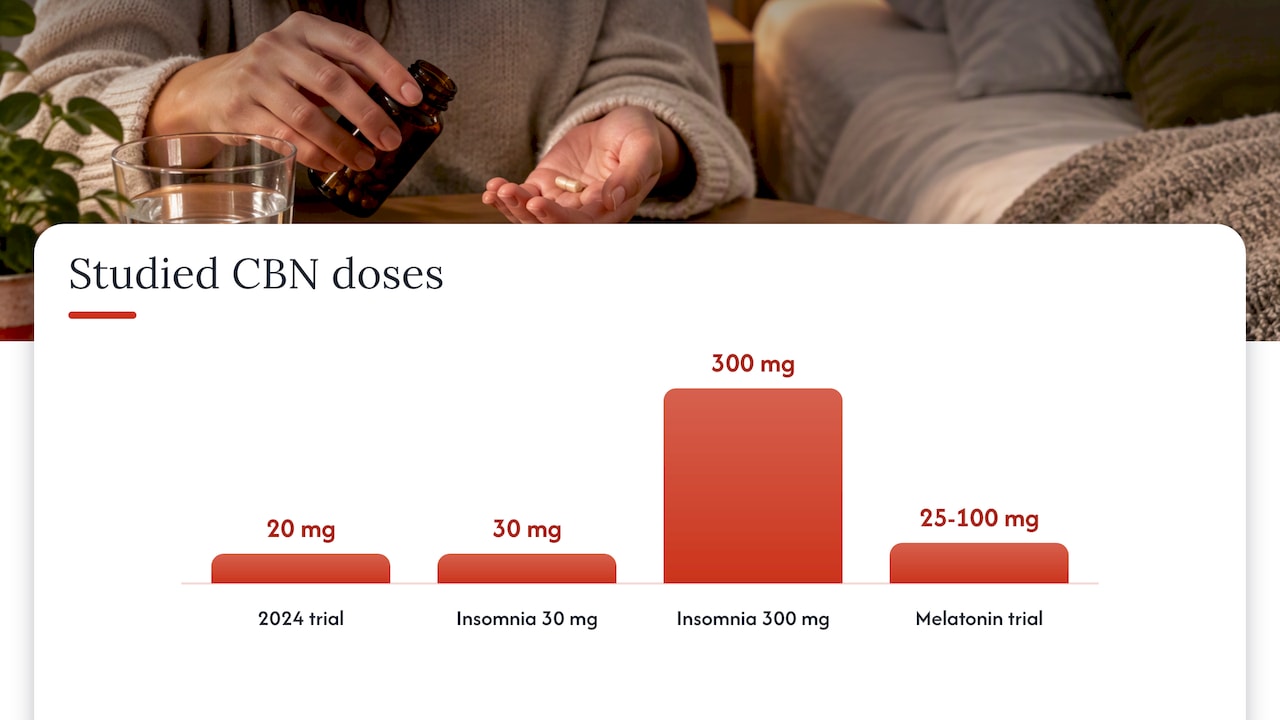
A 2024 double-blind, placebo-controlled study gave participants 20 mg of CBN nightly for seven days. Nighttime awakenings fell significantly (p=0.025), and so did overall sleep disturbance (p=0.023). But there was no significant effect on how long it took to fall asleep, and none on wake after sleep onset. If your problem is lying awake for an hour at bedtime, this result is not a promise. If you wake repeatedly at night, it is the most relevant signal available.
The melatonin comparison
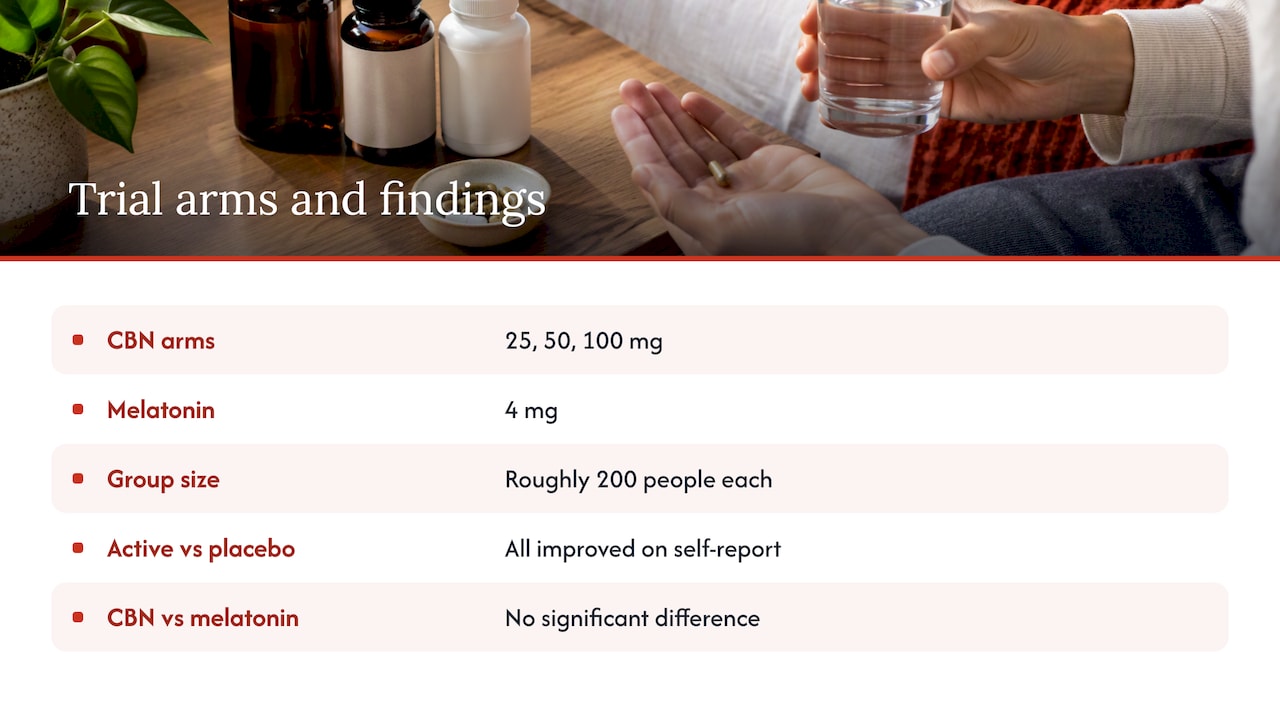
A randomized, double-blind trial tested three hemp-derived CBN formulations (25 mg, 50 mg and 100 mg) against placebo and against 4 mg of melatonin, with roughly 200 people per group. All groups, including melatonin, improved on a self-reported sleep disturbance scale relative to placebo, and no CBN group differed significantly from melatonin. That is useful if you are weighing the two. It does not show CBN is better, and the measure was self-reported.
The lab study in adults with insomnia
The CUPID protocol describes a crossover trial in 20 adults with insomnia using 30 mg and 300 mg of CBN, given two hours before lights out with two-week washouts between doses. Its results were reported in 2026: the primary outcome, wake after sleep onset, did not change significantly, though some secondary measures improved at the 300 mg dose. Researchers recorded mild to moderate side effects such as fatigue, drowsiness, dizziness and nausea, with no serious events and no withdrawals, according to a summary of the trial.
CBN added to CBD
A randomized trial of 1,793 adults tested products with 15 mg of CBD, with or without 15 mg of CBN, for four weeks. Twelve percent reported a side effect and none were severe. Adding CBN did not significantly improve outcomes over CBD alone. Note that this tested a CBD-containing product, not CBN alone.
What this adds up to
| Study | Dose | Main finding |
|---|---|---|
| 2024 placebo-controlled trial | 20 mg nightly, 7 nights | Fewer awakenings, less disturbance; no change in time to fall asleep |
| 2023 melatonin comparison | 25, 50, 100 mg | Better self-reported sleep than placebo; similar to 4 mg melatonin |
| 2026 insomnia crossover (n=20) | 30 and 300 mg, single dose | No change in primary outcome; some secondary gains at 300 mg |
| 2023 CBD with or without CBN (n=1,793) | 15 mg CBN plus 15 mg CBD | No added benefit over CBD alone |
The pattern: small effects, mixed results, short durations. The Sleep Foundation’s review of CBN reaches the same cautious conclusion and notes there are no research-based dosing guidelines for CBN as a sleep aid.
CBN dosage for sleep: what has been studied
No official dose exists. What we have is what researchers used:
- 20 mg as gummies, taken 90 minutes before bed, for seven nights in the 2024 trial that reduced awakenings.
- 30 mg and 300 mg, two hours before lights out, in the single-dose insomnia study.
- 25 to 100 mg in the melatonin comparison.
Three practical takeaways follow from that. First, edibles are slow, so timing matters: the studies dosed an hour and a half to two hours ahead, not at lights out. Second, the one trial with a clear benefit used a modest dose, and higher is not shown to be better. Third, if you try CBN, start at or below the studied 20 mg and change one thing at a time. Keep a simple log of how long it took to fall asleep, how often you woke and how you felt the next morning.
If you already use THC beverages or edibles, our THC drink dosage guide explains the same low-and-slow logic for starting doses.
CBN vs melatonin, CBD and THC
CBN vs melatonin
Melatonin is a hormone supplement that signals your body clock. CBN is a cannabinoid with a proposed, not proven, sedative action. In the one head-to-head-style trial above, both improved self-reported sleep about equally. Melatonin has far more research behind it. Combining them is not a good idea without advice: the Sleep Foundation notes that mixing cannabinoids with alcohol, melatonin, valerian or L-tryptophan may increase excessive sleepiness.
CBN vs CBD
CBD is the better-studied cannabinoid, and a 2025 scoping review found cannabinoids such as CBD show potential for anxiety and sleep disturbances, while noting wide variation in study designs and doses. The 1,793-person trial suggests CBN added little on top of CBD. If your sleep trouble is tied to racing thoughts, CBD may be the more reasonable first experiment. Our THC vs CBD breakdown covers the differences in effects and safety.
CBN vs THC
THC has a dose-dependent relationship with sleep. A 2021 review in Frontiers in Psychiatry describes low doses possibly shortening sleep onset and increasing slow-wave sleep, while high doses may disturb sleep. More broadly, a 2026 Cochrane review found that medical cannabis containing THC, CBD or both may have little to no effect on sleep quality, total sleep time or daytime functioning. Our guide on whether cannabis affects sleep quality goes deeper on that.
What a CBN high feels like
CBN is generally described as mildly or non-intoxicating on its own. Older human studies gave oral doses up to 1,200 mg, including repeated daily dosing for up to four weeks, without notable changes in vital signs, perception, intoxication or postural stability, according to the CUPID protocol. Those studies did not measure sedation, sleep, driving or next-day effects, though. Many consumer products also contain THC, so the experience depends on the full label, not the CBN number.
Is CBN safe to take every night?
Nobody can say for certain. The Sleep Foundation says human research on CBN risks is sparse, so CBN-specific side effects and medication interactions remain uncertain. Broader cannabinoid risks it lists include dizziness, dry mouth, paranoia or memory problems, unsafe driving, injury risk in older adults, cannabis use disorder, and worsening of liver or kidney problems.
The longest dosing in the evidence above is seven nights in the best recent trial, four weeks in the combined CBD and CBN trial, and four weeks in some very old studies that did not track next-day effects. Nightly use for months is untested.
Specific situations call for a conversation with a doctor or pharmacist first:
- You take prescription sedatives, sleep medicines, antidepressants or anything else that causes drowsiness.
- You have liver or kidney disease.
- You are over 65 and get up at night, where a fall is the real risk.
- You have a history of problematic substance use.
- You have loud snoring, gasping or daytime exhaustion. That pattern can point to sleep apnea, which CBN will not treat.
Health Canada advises that cannabis may interact with medicines and substances, and recommends discussing prescription, non-prescription and natural-health products with a healthcare professional before use. Do not drive or operate machinery after a dose until you know how it affects you the next morning.
And if insomnia has lasted more than a few weeks, see a clinician. Behavioral approaches have stronger evidence than any cannabinoid.
Choosing a product: edibles, beverages and what to read on the label
Because most CBN research used oral doses, gummies and other edibles are the form that matches the evidence. Here is what to check:
- Milligrams of CBN per serving, not per package. A 10-piece pack at 20 mg each is 200 mg total.
- Other cannabinoids. Many sleep products pair CBN with THC or CBD. Know which you are getting, especially if you do not want to feel high.
- Lab results. Look for a batch-specific certificate of analysis that confirms potency and tests for contaminants.
- Onset time. Plan for an hour or more with edibles. Redosing too early is the most common mistake.
- Storage. Stability testing on medicinal CBN products points to a 24-month shelf life when stored at 15 to 25°C, away from sunlight and humidity, per the CUPID protocol. Keep gummies cool and dark.
Our CBN and sleep science guide walks through label reading in more depth.
Strains for anxiety and pain: what to know before you shop
Many people searching for sleep help also want something for anxiety or pain, so a few honest words on strains.
Indica vs sativa. These are botanical terms, and they are not reliable predictors of effects. Cannigma’s guide to choosing strains says cannabinoids and terpenes, including linalool and pinene, may better indicate potential effects. So “sativa or indica for anxiety” is the wrong question. Ask for the THC level, the CBD level and the dominant terpenes.
Terpenes for anxiety. Linalool and alpha-pinene have shown positive modulation of GABA-A receptors in lab studies, which could in theory enhance calming signals. That is electrophysiology, not proof of a human anxiety benefit. Our piece on terpenes and anxiety relief separates what is established from what is hype. Higher THC can also worsen anxiety for some people, which is another reason to go low.
Strains for pain. A 2025 review of cannabis terpenes in chronic pain concludes that the evidence is largely from preclinical models. Myrcene and caryophyllene are theorized to help via cannabinoid and inflammatory pathways, but human trials are scarce. If you want to see which strains are richest in it, we have a page on the highest-myrcene strains.
The entourage effect. The idea that cannabinoids and terpenes work better together is popular, but most data are preliminary, as we explain in our entourage effect article. Treat strain names as a starting point and your own notes as the real data. If you are in Brooklyn, our list of indica strains for nighttime is a practical place to begin.
Our perspective at High Fashion
We have been delivering in New York City since 2011, and sleep is one of the most common reasons people tell us they are shopping. Here is how we think about it.
We would rather you leave with realistic expectations than a miracle claim. The research does not support one, and our customers notice quickly when a label promises more than the product delivers. What we can do is put verified, tested products in your hands, tell you exactly what is in them, and encourage you to start low.
If you are new to cannabis, we suggest picking one product and one dose, trying it on a night when you have nowhere to be the next morning, and writing down what happens. Skip stacking edibles, a drink and a vape in the same evening. And if you take medication, check with your doctor first. That is not a legal line we recite. It is how we want to be treated ourselves.
We also think the day and night menus matter here: you can browse in the evening, plan the next night’s order and avoid the late-night impulse buy.
— Jake
Get what you need delivered in NYC
If you want to try an edible, a THC beverage or a CBD product for winding down, you can browse our day and night menus and order for same-day or scheduled delivery on our homepage. Delivery fees start from $8 in Queens and from $12 in Manhattan and the Bronx. Age verification is part of checkout, because every customer must be 21 or older. If you live in Manhattan, see our Manhattan delivery page. To avoid missing the handoff, look at our delivery time guide and schedule ahead of the evening rush.
FAQ
Does CBN really help with sleep?
Maybe, modestly. A 2024 trial found 20 mg nightly reduced nighttime awakenings and sleep disturbance, but other studies found no change in their main sleep measure. Researchers say the evidence is too limited to call it proven.
Is CBN better than CBD?
Not on the evidence we have. CBD has more research behind it, and a trial of 1,793 adults found that adding CBN to CBD did not significantly improve results. Some people try CBD first and add CBN only if they want to experiment.
What dose of CBN should I take for sleep?
There is no official dose. The trial with a clear benefit used 20 mg as gummies about 90 minutes before bed. Starting at or below that and changing one variable at a time is the cautious approach. Check with your doctor if you take other medicines.
Is CBN safe to take every night?
Nobody knows for sure. CBN-specific side effects and interactions are poorly understood, and the longest well-measured use was a few weeks. Avoid combining it with alcohol or other sedating supplements, and talk with a clinician before regular use.
What does a CBN high feel like?
CBN on its own is generally described as mild, with drowsiness, fatigue or dizziness the most reported effects in trials. Many products also contain THC, which can cause a stronger high, so read the full cannabinoid breakdown on the label.
Sources
- Cannabinol and Sleep: Separating Fact from Fiction (PMC, 2021)
- CBN 20 mg nightly sleep trial (APA PsycNet, 2024)
- Melatonin and TruCBN randomized trial (PMC)
- CUPID protocol: CBN 30 and 300 mg and sleep (PMC, 2023)
- Summary of the 2026 CBN insomnia trial
- Safety and comparative effectiveness of CBD with or without CBN (PubMed, 2023)
- CBN for Sleep, Sleep Foundation
- Health Canada: Cannabis for medical purposes
- Cannabinoids for Anxiety and Sleep Disturbances: A Scoping Review (PMC, 2025)
- Prospects for the Use of Cannabinoids in Psychiatry (Frontiers, 2021)
- Cochrane: medical cannabis for insomnia and sleep problems (2026)
- How to choose a cannabis strain (Cannigma)
- Phytochemical Modulators of Nociception: cannabis terpenes in chronic pain (2025)