Read our Google Birdeye Reviews

A percolator, or “perc,” is a piece of glass inside a bong that breaks smoke into many small bubbles as it passes through water. Leafly’s glossary describes it as a part of a bong or dab rig that diffuses smoke, cooling and filtering it so it is easier to inhale. Yes, a perc makes a difference to how a hit feels: cooler, more humid, usually less harsh. It does not make smoke safe, and more percs are not automatically better. The right one depends on how much drag you like and how much cleaning you will actually do.
If you are 21 or older in New York City and still working out your setup, this guide covers how percs work, the common types, what each costs you in airflow and upkeep, and how to use and clean one. We keep it practical, because the best perc is the one that matches your habits.
TL;DR
- A perc splits smoke into many small bubbles so it touches more water, which cools it and softens the hit.
- Every perc adds some drag. More diffusion generally means more effort per pull and more to clean.
- For most people, one well-made perc (showerhead, honeycomb or inline) does most of the job without a hard pull.
- A perc improves the feel of a hit, not its safety. Smoke is still smoke.
- Fill the water to just cover the perc slits, pull slowly, change the water after each session and deep-clean weekly.
Table of Contents
- What a percolator does
- Do percolators make a difference?
- Percolator types, in plain terms
- The trade-off: diffusion versus drag
- How to use a percolator bong
- How to clean a percolator
- Which percolator suits which person
- Fill your piece with flower you trust
- FAQ
- Sources
What a percolator does
In a basic bong, smoke travels down a tube, exits underwater as a stream of large bubbles and rises through the water into the neck. That is one stage of filtration. A percolator bong adds at least one more stage: a piece of glass with slits or holes that forces the smoke to split into far more, far smaller bubbles.
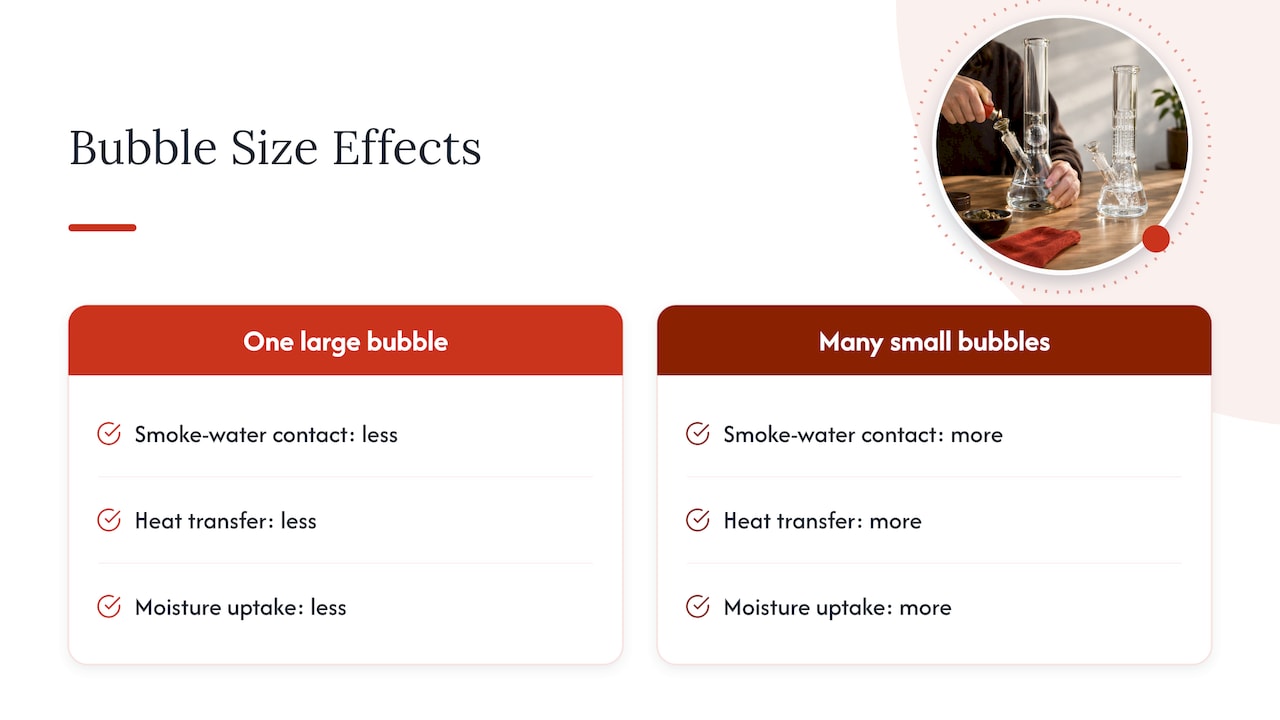
The logic is surface area. Think of a drink cooled by crushed ice instead of one big cube. Smaller bubbles mean more contact between smoke and water, so the smoke gives up more heat and picks up more moisture. Larger, heavier particles such as ash are more likely to be left behind in the water, which is why bong water darkens with use.
The simplest version is a slitted downstem, the tube that carries smoke into the water. Many entry-level pieces already have one, so “does my bong have a perc” is sometimes a yes before you add any extra glass. The fancier versions are discs, trees, domes and grids fused into the glass during manufacturing.
Do percolators make a difference?
For feel, yes. Users commonly describe the same three changes when they move from a straight tube to a perc piece:
- Cooler smoke. Water absorbs heat, and more bubbles means more heat absorbed before it reaches your throat.
- Less harshness. Cooler, more humid smoke tends to be easier to inhale and can mean less coughing.
- A different pull. Diffusion creates resistance, so the hit takes slightly more effort.
The difference between a good perc and a mediocre one is real but often smaller than people expect. Glass thickness, water level and a clean piece all shape the hit as much as the perc type. A well-made single perc in a clean piece with the right water level will usually beat an elaborate stacked perc that is dirty or overfilled.
What a perc does not do
A perc is a comfort feature. It does not turn smoke into something healthy. Healthline notes that smoke is harmful to lung health regardless of what is burned, and that smoother smoke can make it easy to overdo it, since people tend to inhale deeply and hold their breath. If your hits feel gentle, pace yourself and keep your dose modest. If you have a lung condition or any respiratory concern, talk to your doctor before smoking anything.
If you want to avoid combustion altogether, flower vs vapes lays out how the two methods compare.
Percolator types, in plain terms
There are dozens of named designs, but most fall into a handful of families. Leafly’s glossary describes the main ones: honeycomb percs as round discs with many small holes, tree percs as rods with holes in their limbs, inline percs as tubes with holes, showerheads as directing and diffusing smoke through the main tube, spirals as coils, and turbines as moving smoke around the inner chamber. Here is how they differ in daily use.
| Perc type | What it looks like | Diffusion | Drag | Upkeep |
|---|---|---|---|---|
| Slitted downstem | Tube with cuts at the bottom | Basic | Low | Easy |
| Showerhead | Domed head with slits or holes | Moderate to high | Low to medium | Easy |
| Inline | Horizontal tube with holes | Moderate | Low | Easy |
| Honeycomb | Flat disc with many small holes | High | Low to medium | Holes can clog |
| Tree | Vertical arms with slits | High | Medium | Delicate, harder to clean |
| Matrix | Grid of slits around a cylinder | Very high | Medium to high | Hardest to clean |
| Turbine or cyclone | Angled slits that spin the smoke | Moderate | Low | Easy |
| Coil | Glass coil, sometimes freezable | Moderate | Low to medium | Easy |
The ratings in the table are general tendencies, not guarantees. Two pieces with the same perc name can feel different depending on hole size, water level and glass quality.
Showerhead and inline: the easy daily drivers
A showerhead sends smoke through a slitted dome on the end of the downstem. An inline perc is a horizontal tube with slits or holes. Both are simple to clean and light on drag, which is why they suit people who smoke often or want a relaxed pull. You give up a little of the silky feel of denser diffusion.
Honeycomb: smooth and quiet
A honeycomb is a flat disc full of small holes, often producing a fine, steady stream of bubbles. It can give a lot of diffusion for relatively little extra effort. The catch is that small holes trap resin and ash, so it needs regular cleaning to keep from clogging.
Tree: lots of arms, lots of surface area
Tree percs spread smoke through several vertical arms, commonly in the range of four to a dozen. They are popular for a reason: they look great and diffuse well. They are also among the most delicate structures in a piece, and an overfilled tree can splash. If a bong will travel or sit on a busy table, consider how much you trust the glass.
Matrix: maximum diffusion, maximum effort
A matrix perc spreads smoke through a grid of closely spaced slits. It gives some of the coolest hits, but the tight spacing makes it harder to pull through and harder to reach with a brush. It is a good fit for patient sessions, less so for quick ones.
Turbine, coil and the novelty designs
Turbines use angled slits to spin smoke around a chamber, which helps control splashback. Coils make the smoke travel a longer path, and some glycerin coils can be frozen to chill hits. Beyond these there are swiss, dome, drum and many other variations. Most of them are refinements on the same idea, so judge them by the same three questions below.
The trade-off: diffusion versus drag
The core rule is simple. The more finely a perc divides smoke, the more cooling you get and the harder you have to pull. Stacking two or three percs multiplies that resistance, and a piece that looks impressive can become tiring to use for more than a couple of hits.
Smaller bubbles also rise higher, so high-diffusion pieces can be more sensitive to splashback if the water level is off. That is why “more percs” is not the same as “better.” For many people a single well-designed perc delivers most of the smoothness without a hard pull.
Three questions to pick a perc
- How often will you use it? Daily use favors easy-clean designs: showerhead, inline or honeycomb.
- How much do you tolerate cleaning? If you dislike scrubbing, skip tight matrix grids and trees with many arms.
- How much drag do you like? A light, airy pull points to an inline or honeycomb. A fuller, chuggier pull suits a tree or a stacked double perc.
Add a fourth: glass thickness. Thicker glass survives a knock and holds up to cleaning, and it often matters more than the perc name on the box.
How to use a percolator bong
Good technique prevents most complaints about splashing, whistling and weak hits.
- Fill to the right level. The perc’s slits or holes should sit just under the water, well below any splash guard. Too little water and the perc does not work. Too much and water surges into the neck.
- Do a dry test pull. Check that air moves and the piece is stable before you pack it.
- Pack lightly. A loosely packed bowl burns evenly. Keep flower fresh first; our guide on how to store cannabis flower covers it.
- Pull slowly and steadily. Let each perc bubble before you clear the bowl. A hard, fast pull can overwhelm the perc and push water up the neck.
- Change the water after every session. Stale water smells and tastes bad, and it makes the hit rougher.
If you are still learning to pack and light a small piece, how to use a one hitter is a simple place to practice with less gear.
Where you can use it in NYC
New York legalized adult-use cannabis for people 21 or older. The state’s Office of Cannabis Management says it is legal to smoke or vape cannabis in most places where you can smoke tobacco, such as a private home, but not in motor vehicles, restaurants (patios included) or most public parks. Landlords can still ban smoking in apartment buildings, so check your lease. The state’s adult-use page has the current rules.
How to clean a percolator
Percs are the part of a bong that gets dirty fastest, because small openings catch resin. A dirty perc restricts airflow and flattens flavor, which undoes the reason you bought it.
Cannigma’s cleaning guide recommends this routine:
- Use isopropyl alcohol and coarse salt, seal the openings and shake the piece.
- Soak for about 30 minutes for typical buildup, or several hours to overnight for heavy buildup.
- Plug the perc openings, shake the alcohol and salt through the slots, and flush narrow holes with a syringe or squeeze bottle.
- Change the water after every session and deep-clean about weekly with regular use.
Rinse thoroughly with warm water afterward until no alcohol smell remains, and let the piece dry fully. Never apply a torch or hard knocks to glass to free a clog.
Quick fixes for common problems
- Splashing into your mouth: water is too high, or you pulled too hard. Pour a little out and slow down.
- Whistling: usually a water level or airflow issue. Adjust the water first.
- Weak, hard-to-pull hits: clogged perc holes. Time for a deep clean.
Which percolator suits which person
Busy people who smoke after work tend to want fast setup and easy cleaning: a showerhead or inline is hard to beat. Connoisseurs who care about flavor and are happy to spend time on upkeep often enjoy a honeycomb or tree. Newer consumers do well with a simple, lighter-drag perc, since it is more forgiving of technique and easier to keep clean.
Whatever you choose, the flower you put in it matters as much as the glass. Smooth smoke from a good piece cannot rescue stale or poorly stored product.
Our view on percs
We have been serving New York adults since 2011, and the question we hear most about glass is the same one: do I need a fancy perc? Our answer is that you need a piece you will keep clean and enjoy using. A simple, well-made perc you wash weekly will always beat a complicated one that sits dirty.
What matters most is what goes into the piece. We focus on lab-tested, verified flower with honest pricing, because smooth glass cannot make up for a poor product. Pick the perc for your habits, then fill it with flower you trust.
Jake
Fill your piece with flower you trust
Once your glass is sorted, the next question is what goes in it. We deliver lab-tested flower, pre-rolls, vapes, edibles, concentrates, THC beverages and CBD products across New York City, with same-day delivery, age verification and day and night menus. Delivery fees start from $8 in Queens and from $12 in Manhattan and the Bronx. If you want something ready to go without packing a bowl, browse our pre-rolls and blunts or start at our menu.

FAQ
What is a percolator in a bong?
It is a glass piece inside the bong that breaks smoke into many small bubbles as it moves through water. That extra contact with water cools the smoke and softens the hit. Even a slitted downstem counts as a basic perc.
Do percolators make a difference?
Yes, mostly in how the hit feels: cooler, smoother and less harsh. The effect is real but depends on the perc type, glass quality, water level and cleanliness. A perc does not make smoking safer, so pace yourself.
What is the best percolator type for beginners?
A showerhead, inline or simple honeycomb is a good start. They give a noticeable smoothness boost with low to moderate drag, and they are easier to clean than trees or matrix grids.
Is more percolation always better?
No. More diffusion cools smoke further but adds drag, so stacked or matrix pieces take more effort and can tire you out over a longer session. They are also harder to clean. One good perc is plenty for most people.
How often should I clean a percolator bong?
Change the water after every session and deep-clean about weekly if you use it regularly. Use isopropyl alcohol and coarse salt, and flush the narrow perc holes with a syringe or squeeze bottle so buildup does not clog them.
Sources
- Leafly Cannabis Glossary: Percolator
- Healthline: How Does a Bong Work? Benefits, Risks, and Myths
- Cannigma: How to Clean a Bong
- NY Office of Cannabis Management: Know Your Rights
- NY Office of Cannabis Management: Adult-Use Information