
A licensed NYC delivery order gets taxed exactly like an in-store purchase: a 13% retail excise tax (9% state + 4% local), collected right at checkout. There’s no extra “delivery tax” tacked on top of your cannabis products. Adult-use cannabis is exempt from New York’s regular sales tax, and this excise takes its place entirely.
Here’s what that means for your wallet:
- The 13% applies to the product price, not to shipping or service fees.
- Delivery or service fees are typically itemized separately and taxed differently (or not at all) depending on how the retailer structures its checkout.
- Whatever total appears on your confirmation screen right before you hit “place order” is the number that matters. Ignore any math you’re doing in your head.
Key Takeaways
| Point | Details |
|---|---|
| Retail excise rate | Adult-use cannabis carries a 13% retail excise (9% state + 4% local), collected at checkout on delivery and in-store sales alike. |
| Delivery fees itemized separately | Most licensed retailers list delivery charges apart from the cannabis excise, so the fee itself usually isn’t taxed as cannabis. |
| Wholesale tax hides in shelf prices | The 9% distributor tax gets baked into product cost before the 13% excise is even calculated, inflating totals beyond the visible tax line. |
| Compliance costs push prices up | Lab testing, licensing, insurance, and IRC 280E’s federal deduction limits all add cost layers that street sellers don’t carry. |
| Confirm your total with Highfashionsmokesandprints | Highfashionsmokesandprints itemizes product cost, excise tax, and delivery fees clearly at checkout, so NYC customers see their real total before confirming. |
Where to Find Official NYC Cannabis Tax Guidance
- The NYS Department of Taxation and Finance’s adult-use cannabis page covers registration, the 13% retail excise, and filing procedures for retailers and distributors.
- The New York Office of Cannabis Management explains licensing rules, consumer protections, and how tax revenue supports community reinvestment.
- For exact legal language on the distributor, retail, and local tax components, review tax law section 493 directly.
Table of Contents
- What Is the Weed Delivery Tax in NYC, Exactly?
- Does NYC Tax Delivery Fees the Same as In-Store Purchases?
- Why Legal Weed Delivery Costs More Than the Corner Guy
- How to Calculate Your Total Cost for a NYC Weed Delivery Order
- Why Trust This Breakdown of NYC Weed Delivery Costs
- What Are the Filing Requirements for NYC Cannabis Delivery Businesses?
- Record-Keeping Rules Every NYC Cannabis Delivery Operator Should Know
- How New Legislation Could Change NYC Weed Delivery Taxes
- What Happens If a Delivery Business Doesn’t Pay Cannabis Taxes Correctly?
- The Real Skill Isn’t Understanding Tax Law, It’s Reading Your Receipt
- Order With Confidence: Transparent Pricing on Every NYC Delivery
- Frequently Asked Questions
- Sources
What Is the Weed Delivery Tax in NYC, Exactly?
New York’s cannabis tax framework has three moving parts, and only one of them shows up on your receipt. Understanding all three explains why the price you see at checkout looks the way it does.
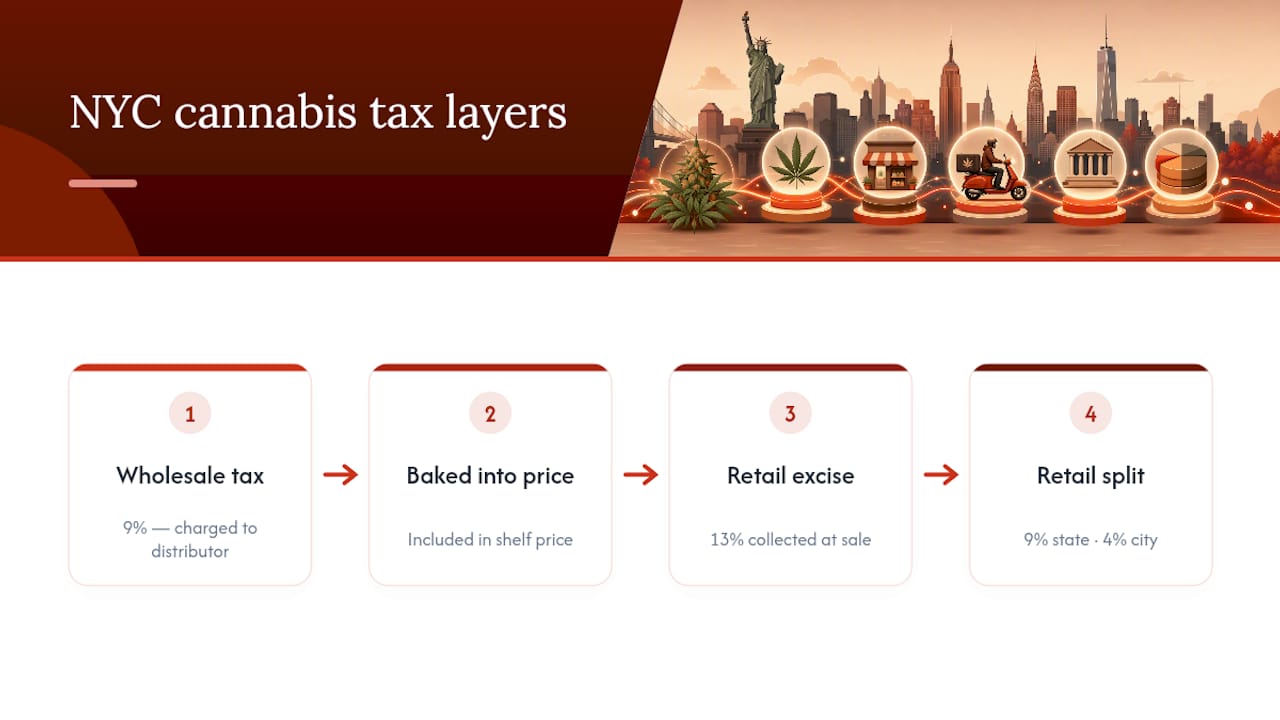
The retail excise tax is the one you actually pay: 13% total, split into 9% that goes to New York State and 4% that goes to the city or municipality where you’re buying. Licensed retailers collect this at the point of sale, and it replaces the standard sales tax you’d pay on, say, a t-shirt or a sandwich. The New York State Department of Taxation and Finance spells this out directly on its adult-use cannabis tax page, and it’s the definitive source if you want to check the current rate yourself.
Behind that consumer-facing number sits a second tax you’ll never see itemized: the 9% wholesale/distributor tax. This gets charged when a licensed distributor sells product to a retailer, long before it reaches your phone screen. You don’t pay this directly, but it’s baked into the shelf price of everything you buy. There’s a wrinkle here for vertically integrated sellers, too. Microbusinesses and registered organizations that grow, process, and sell their own product pay the wholesale tax on 75% of the retail amount when they sell directly to consumers, a structural detail that affects how some smaller operators price their menus.
State guidance frames these dollars as intended for community reinvestment in the municipality where the sale happened, part of the broader push to funnel cannabis revenue back into the neighborhoods most affected by decades of prohibition enforcement. If you want the exact legal language behind all three tax layers, including some special-case exemptions for research-licensed sales, the statute itself is public record under New York tax law section 493.
Quick math: on a $50 product order, the 13% retail excise adds $6.50, bringing your product subtotal to $56.50 before any delivery fee.
Does NYC Tax Delivery Fees the Same as In-Store Purchases?
The short answer: the product is taxed the same way whether you pick it up or have it delivered, because the retail sale itself is the taxable event. The state doesn’t care how the product physically reaches you. What can differ is how the delivery charge itself gets treated on your receipt.
That fee usually isn’t subject to the cannabis retail tax, since it’s not a cannabis product, it’s a service charge. But practices vary by retailer, and some smaller operators fold delivery costs into product pricing instead of breaking them out.
A few things worth checking before you confirm an order:
- Look at your cart summary for a distinct “delivery fee” or “service fee” line, separate from the excise tax line.
- If you’re ordering through a third-party platform layered on top of a dispensary’s own system, watch for platform fees stacked on top of the delivery charge.
- When in doubt, the confirmation screen is the final word. That’s the number you’re contractually agreeing to pay.
Why Legal Weed Delivery Costs More Than the Corner Guy
If you’ve ever compared a licensed dispensary’s menu to what you used to pay on the street, the gap can feel jarring. Several cost layers stack before your order ever hits checkout.
You’re often paying tax on a price that already reflects a different tax.
Then there’s the operational overhead that illicit sellers simply don’t carry:
- Mandatory lab testing for potency and contaminants on every batch
- Seed-to-sale tracking software and compliance reporting
- State licensing fees and ongoing regulatory costs
- Commercial insurance and security requirements
- Trained, background-checked delivery staff
- Compliant packaging and required warning labels
Layer federal tax law on top of all that. IRC Section 280E blocks cannabis businesses from taking most standard federal business deductions, since cannabis remains federally classified as a controlled substance. That pushes effective tax burdens on cannabis retailers well above what a typical small business pays, and retailers pass at least some of that pressure through to prices.
Pro Tip: “Free delivery” promotions can be a wash if the product prices are quietly higher to compensate. Always compare the full checkout total, not the advertised per-item price, before assuming you’re getting a deal.
How to Calculate Your Total Cost for a NYC Weed Delivery Order
Here’s how the math actually plays out on three common order sizes.
- Small order ($20 item): Product price $20.00, retail excise (13%) $2.60, product total $22.60. A typical delivery fee (often $5 to $10 depending on the retailer and order minimum) gets added on top, bringing the full checkout total to roughly $27.60 to $32.60.
- Mid-size cart ($60 order): Product subtotal $60.00, retail excise (13%) $7.80, product total $67.80. Add a delivery fee, and you’re looking at somewhere around $72.80 to $77.80 out the door, depending on whether the retailer waives the fee at higher order values.
- Larger order ($200 cart): Product subtotal $200.00, retail excise (13%) $26.00, product total $226.00. Many retailers waive delivery fees entirely above a certain threshold, so this could land right at $226.00, or slightly higher if a small service fee still applies.
What shifts is the delivery fee’s weight relative to your cart, which is exactly why larger orders often feel more cost-efficient on a percentage basis.
Does Medical Cannabis Get Taxed Differently in New York?
Medical cannabis patients in New York generally are not subject to the same retail excise structure applied to adult-use purchases, though the specifics depend on registration status and the dispensary type making the sale; for broader regulatory context, see Is CBD legaal in Nederland? Het antwoord en de regels. If you’re a registered medical patient, confirm your certification status is active and check with your provider on documentation requirements. For the current, authoritative breakdown of medical versus adult-use tax treatment, the OCM’s consumer resources and the Tax Department’s guidance page are the two places to verify before assuming an exemption applies to your purchase.
Why Trust This Breakdown of NYC Weed Delivery Costs
Highfashionsmokesandprints has operated as an online dispensary serving New York City since 2011, well before adult-use legalization reshaped the market. That means running compliant delivery operations through multiple regulatory eras, not just adapting after the fact.
A few things worth knowing about how orders actually work here:
- Every product listed goes through lab testing before it hits the day or night menu.
- Age verification happens securely before checkout, and ID confirmation happens again at the door.
- Same-day delivery windows are built around realistic timing, not vague promises.
The goal at checkout is simple: no surprise math. The retail excise, any delivery fee, and your product total are all visible before you confirm, so the number you agree to is the number that shows up at your door.
What Are the Filing Requirements for NYC Cannabis Delivery Businesses?
Licensed cannabis retailers and distributors operating in NYC, including delivery-only operations, must register with the NYS Department of Taxation and Finance before making a single taxable sale. Registration isn’t optional paperwork filed after the fact; it’s a prerequisite to legally collecting the retail excise from customers.
Once registered, businesses file returns on a periodic schedule set by the Tax Department, generally aligned to quarterly filing windows, though the exact frequency can depend on sales volume and license type.
Missing a filing deadline doesn’t just risk a late fee. It can trigger a broader compliance review of the license itself, since New York’s cannabis regulatory structure ties tax compliance directly to licensing standing through the Office of Cannabis Management. A retailer that falls behind on filings risks more than a penalty notice; it risks the ability to keep operating legally.
For delivery-specific operators, there’s an added layer: many run hybrid models with a physical retail license plus a delivery service component, and each piece of that structure may carry its own registration and reporting obligation. If you’re evaluating a delivery business rather than just shopping as a consumer, the Tax Department’s guidance page is the starting point, not a general accounting firm’s blog post.
Record-Keeping Rules Every NYC Cannabis Delivery Operator Should Know
Tax compliance in cannabis retail runs on documentation, arguably more than most retail categories, because both state tax auditors and OCM regulators can request records covering the same transactions for different purposes.
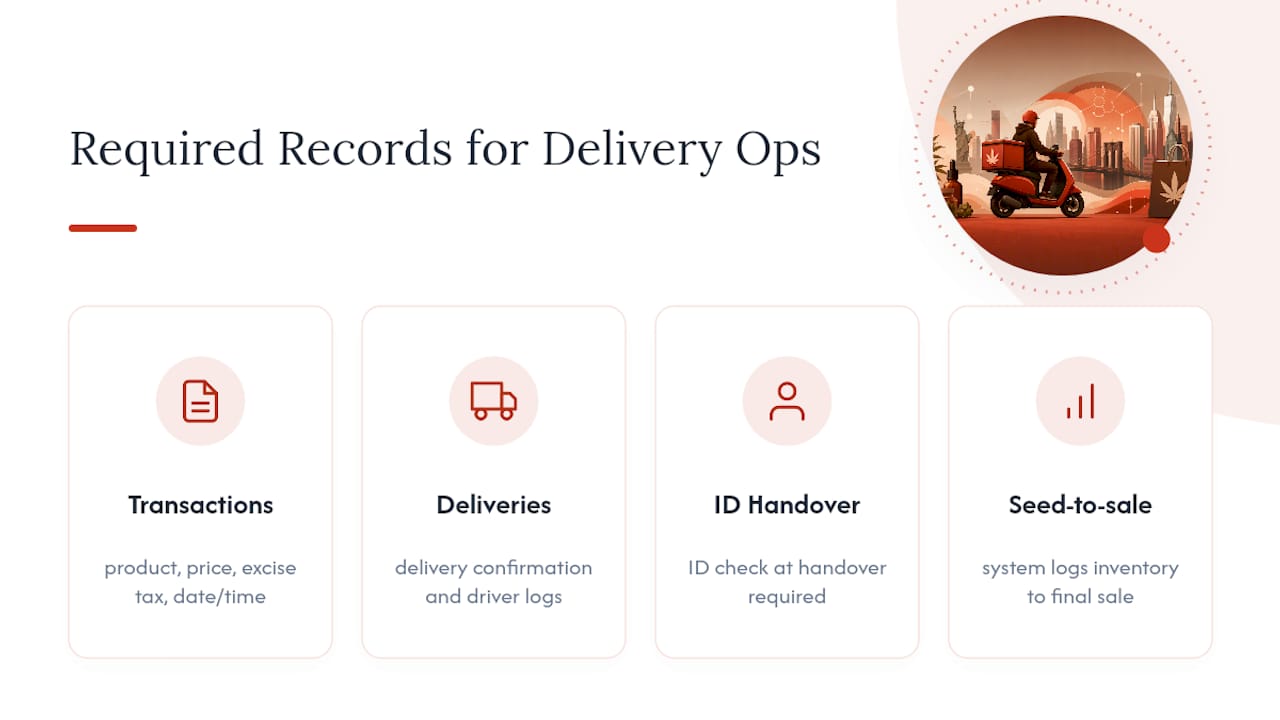
Retailers need to maintain detailed records of every sale: product type, sale price, excise tax collected, and the date and time of the transaction. This isn’t a “keep it if you feel like it” suggestion. New York’s cannabis tax statute ties recordkeeping directly to audit authority, meaning the state can request transaction-level detail going back multiple years.
Delivery-specific records add another layer. Operators typically need to document delivery confirmation (proof the product reached a verified adult recipient), driver logs, and any third-party platform fees separate from product sales. Since ID verification at handover is a legal requirement for every delivery, not just a best practice, the paper trail behind that verification matters just as much as the sales ledger.
Seed-to-sale tracking software, which most licensed operators already run for regulatory compliance, doubles as the backbone of tax recordkeeping. It logs inventory from cultivation or acquisition through final sale, which means the same system used to satisfy OCM’s product-tracking rules generates most of the data needed for a Tax Department audit.
For consumers, none of this changes your checkout experience directly, but it explains why a legitimate dispensary’s ordering process feels more procedural than a street transaction. That paperwork trail is exactly what keeps a delivery operator licensed.
How New Legislation Could Change NYC Weed Delivery Taxes
Cannabis tax policy in New York isn’t frozen. Lawmakers and regulators have adjusted licensing and enforcement mechanics multiple times since adult-use sales began, largely in response to the unlicensed shop problem that flooded the city in the early rollout years.
Most of the legislative energy so far has focused on enforcement and licensing speed rather than the tax rate itself. But state budget negotiations regularly touch cannabis revenue allocation, and any significant shortfall in projected tax collections could prompt lawmakers to revisit rates or reporting requirements.
There’s also an ongoing conversation at the federal level about cannabis rescheduling, which wouldn’t change New York’s state tax structure directly but could eliminate or soften the 280E restrictions that currently inflate cannabis business costs nationwide.
For now, the practical guidance is simple: the tax rate you calculate today is the rate that applies. But if you’re running a delivery business rather than just ordering from one, keeping an eye on Tax Department bulletins and OCM regulatory updates matters more than watching general cannabis news coverage, since rate or filing changes get announced through those channels first.
What Happens If a Delivery Business Doesn’t Pay Cannabis Taxes Correctly?
Non-compliance with New York’s cannabis tax rules carries real consequences, and they hit at two levels: the Tax Department and the Office of Cannabis Management, often simultaneously.
These aren’t unique to cannabis; they mirror penalty structures across other New York excise tax categories.
What makes cannabis different is the licensing overlay. OCM treats tax compliance as a licensing condition, not a separate issue. A retailer or delivery operator with unresolved tax violations risks license suspension or revocation on top of whatever the Tax Department assesses directly. That’s a much bigger consequence than a typical retail tax penalty, since it can end the business entirely rather than just costing money.
Unlicensed operators selling cannabis without any registration face a separate and more serious enforcement track, including potential criminal exposure, since they’re operating entirely outside the legal framework rather than falling short on compliance within it. New York has ramped up enforcement against unlicensed shops specifically because they undercut both public safety testing standards and the tax base funding community reinvestment programs.
For consumers, this is part of why buying from a licensed, verifiable operator matters beyond just legal peace of mind. It’s a signal the business is actually paying into the system the tax revenue is meant to support.
The Real Skill Isn’t Understanding Tax Law, It’s Reading Your Receipt
That’s a mistake. You don’t need to understand distributor tax accrual timing to order weed responsibly.
Where I think the conventional advice falls short is in treating “effective tax rate” as some hidden number consumers need to reverse-engineer. It isn’t. The wholesale tax is a business-side cost that shows up as a higher shelf price, not a second line item on your receipt. Conflating the two just creates confusion where none needs to exist.
If you take one thing from all this math, let it be this: run the three worked examples above against your own typical order size once, so you know roughly what to expect before you’re staring at a checkout screen. That fifteen minutes of homework beats re-deriving the tax structure every time you order.
Order With Confidence: Transparent Pricing on Every NYC Delivery
Highfashionsmokesandprints has been running compliant NYC delivery since 2011, which means the checkout process is built to show you exactly what you’re paying before you confirm, no hidden math required.

Browse the day and night menus for lab-tested flower, vapes, and edibles for beginners, or check out what’s currently in stock, including the recently restocked Flav carts. First-time customers get onboarding incentives, and the referral program rewards repeat orders without locking anyone into a subscription. Place your order today and see the full breakdown, product cost, excise tax, and delivery fee, laid out clearly before you ever hit confirm.
Frequently Asked Questions
Is there a separate weed delivery tax in NYC on top of the product tax?
No. Delivery or service fees are typically itemized as a separate charge, not taxed as part of the cannabis excise.
Why do NYC weed delivery prices seem so much higher than expected?
Beyond the visible 13% excise, a 9% wholesale tax gets built into shelf pricing before you ever see it, and compliance costs like lab testing, licensing, and IRC 280E’s federal deduction limits add further cost pressure that legal retailers pass through to consumers.
How do I calculate the total cost of my weed delivery order in NYC?
That combined figure is your out-the-door total.
Do medical cannabis patients pay the same taxes as adult-use customers in NYC?
Medical cannabis generally isn’t subject to the same retail excise structure as adult-use purchases, though the details depend on registration status. Check the OCM’s consumer resources to confirm your specific tax treatment.
Where does NYC’s cannabis tax revenue actually go?
The 4% local portion of the retail excise is directed toward the municipality where the sale occurred, with state framing emphasizing community reinvestment in areas historically affected by cannabis enforcement.
This article is general information, not a substitute for advice from a qualified financial advisor. Consult a qualified financial professional about your own circumstances before acting on anything here.