Read our Google Birdeye Reviews

Most cannabis gummies are not vegan by default, because the usual gelling agent is gelatin, which comes from animal collagen. A vegan weed edible is one made with no animal-derived ingredients at all: no gelatin, no honey, no dairy, no beeswax. In practice you confirm that by reading the full ingredient list and looking for pectin or agar in place of gelatin. Below you’ll find what to look for, which hidden ingredients catch people out, how New York labeling rules help, and how to dose once you’ve found the right product.
TL;DR
- Gelatin is the most common non-vegan ingredient in gummies. Pectin (from fruit) and agar-agar (from algae) are the plant-based swaps.
- Gelatin is not the only issue. Honey, dairy, eggs, beeswax, shellac, carmine dye and some cane sugar can also be animal-derived.
- In New York, marketing can only use the word “vegan” for a cannabis product that contains no animal products, and packages must list every ingredient.
- Vegan edibles hit the same way as any other edible. Start with 2.5 mg THC and wait before taking more.
- We carry vegan gummies you can have delivered across NYC, including Punch Edibles Vegan Gummies 100MG and Viscous Mixed Flavor Vegan Gummies 500mg THC.
Table of Contents
- Are gummies vegan?
- The animal-derived ingredients to look for
- How gelatin-free gummies are made
- How to confirm an edible is really vegan
- What New York rules mean for vegan labeling
- Vegan does not mean clean: what else to check
- Do vegan edibles hit differently?
- Dosing vegan edibles safely
- Perspective
- Vegan gummies we deliver in NYC
- Finding vegan edibles in New York City
- FAQ
- Sources
Are gummies vegan?
Not automatically. Standard gummy candy, cannabis or not, relies on gelatin to get its bouncy chew. Gelatin is made from the skin, bones or connective tissue of animals, so a gummy can taste of strawberry and still be off the table for a vegan. Fruit flavor tells you nothing about what holds the gummy together.
The Vegan Society describes veganism as excluding, as far as is possible and practicable, all forms of exploitation of and cruelty to animals. That phrase “as far as is possible and practicable” matters for edibles, because the animal-derived material can sit several layers deep: in a flavor blend, a coating, a dye or the sugar itself.
So the working answer to “are gummies vegan?” is: some are, many are not, and you can tell which by reading the label rather than the front of the package.
The animal-derived ingredients to look for
Edibles are food, and food has a long list of animal-derived ingredients. These are the ones that most often turn up in cannabis products.
| Ingredient | Where it appears | What to look for instead |
|---|---|---|
| Gelatin | Gummies, marshmallow-style chews | Pectin, agar-agar |
| Dairy (milk, butter, casein, whey) | Chocolate, baked goods, caramels | Plant milks, plant-based butter, dark chocolate made without milk solids |
| Eggs (whites, yolks, egg powder) | Baked goods, some candies | Flaxseed, plant-based binders |
| Honey | Sweetener in gummies, drinks, baked goods | Agave, fruit syrups, organic sugar |
| Beeswax, shellac | Glazes and coatings on gummies | Plant-based waxes, uncoated gummies |
| Carmine (insect-derived red dye) | Red and pink candies | Fruit and vegetable colorants |
| Bone char | Used to process some cane sugar | Organic, coconut or beet sugar |
The first five are the obvious ones. The last two are where careful shoppers get surprised. Carmine appears on an ingredient list, so you can spot it. Bone char is a processing step and never appears on the list, which is why a brand’s own statement or a vegan claim on the package carries weight when sugar is involved.
The beeswax and shellac point is worth remembering for gummies in particular: Herb notes that beeswax and shellac are common in regular gummies, usually as the shiny coating that keeps pieces from sticking together.
How gelatin-free gummies are made
Gelatin-free gummies use plant-based gelling agents. Two do most of the work.
Pectin. Pectin comes from the cell walls of fruit. Commercial pectin is typically extracted from citrus peel, apple pomace or beet pulp. It sets to a firmer, cleaner bite than gelatin, with less bounce. Many people describe pectin gummies as softer to bite through and less chewy.
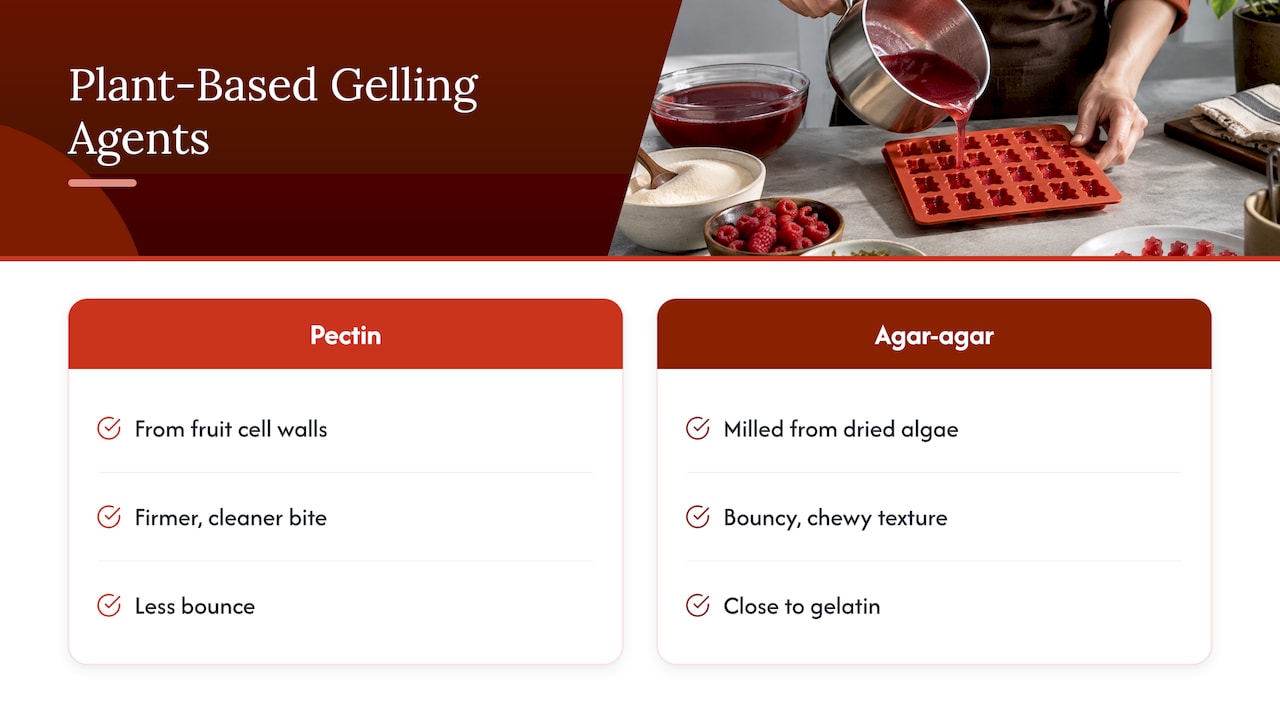
Agar-agar. Agar is milled from dried algae. According to Herb, agar gives vegan gummies a bouncy, chewy consistency close to gelatin, so it suits people who want the classic gummy feel.
Other plant-derived ingredients you’ll see in vegan formulas include plant glycerin, xanthan gum and natural fruit or vegetable extracts. None of these are red flags.
One caution. Seeing pectin on the label is a good sign, but it does not prove the whole product is vegan. The same gummy could still carry a honey-based sweetener, a beeswax glaze or a flavor of unclear origin. Read past the gelling agent.
How to confirm an edible is really vegan
A short routine works for any edible, from any brand.
- Read the whole ingredient list, including sub-ingredients in brackets. Look for the items in the table above.
- Look for a vegan claim on the package or product page. In New York this is not a casual term, as explained in the next section.
- Flag vague words. “Natural flavors,” “food starch” and “glaze” can each hide an animal-derived component. If a listing isn’t clear, ask the seller or brand.
- Be specific when you ask. Give the product name, flavor and batch or lot number, and ask whether all ingredients, flavor components, coatings and processing aids are free of animal-derived materials.
- Check the sugar. Organic, coconut or beet sugar avoids the bone char question that applies to some conventional cane sugar.
The lab report is the other document worth looking at. A certificate of analysis (COA) tells you what’s in the product from a safety and potency standpoint, and it pairs well with an ingredient check. If you want a primer on the format, a walkthrough on reading a CBD COA covers the panels and what each one tells you, and the same logic applies to THC products.
What New York rules mean for vegan labeling
New York gives you a bit more to rely on than most states do, and it’s useful when you shop for plant-based products.
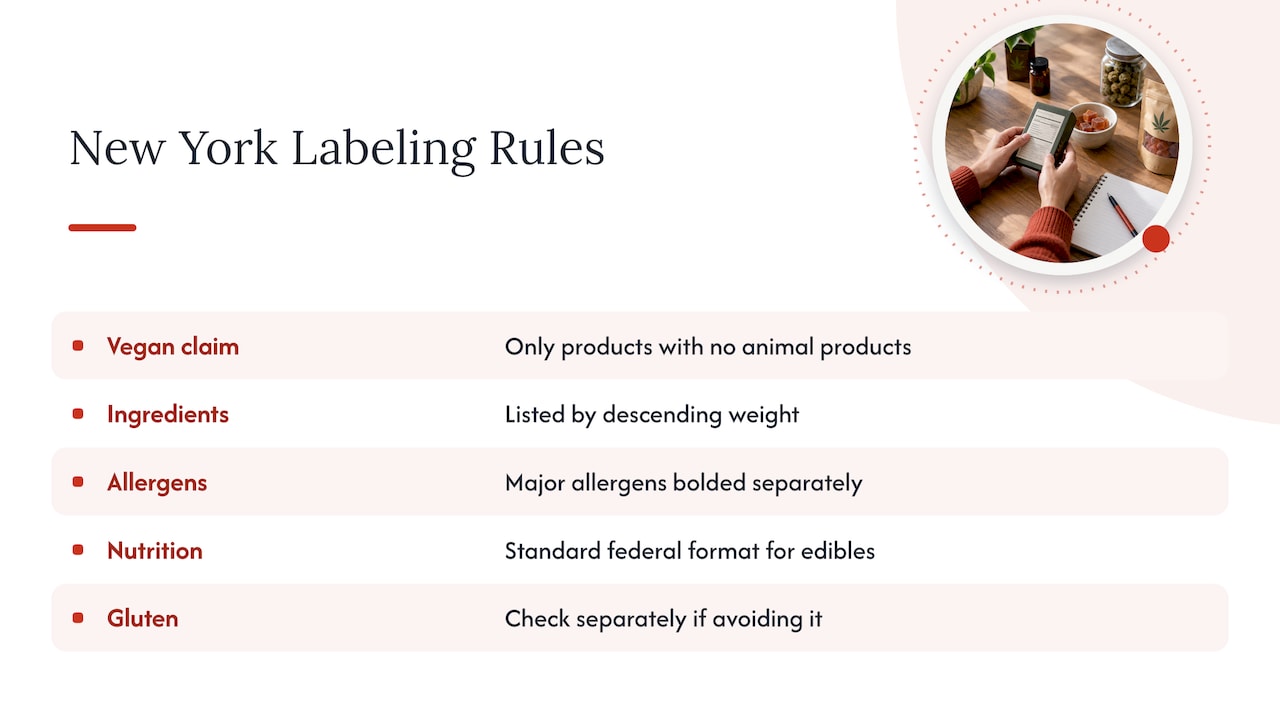
The word “vegan” is regulated. Under New York’s adult-use rules, cannabis marketing and advertising may use the term “vegan” only when describing a product containing no animal products. A licensed product that calls itself vegan is making a claim it has to stand behind.
Ingredients must be listed. The state’s packaging and labeling rules require the retail package, or the marketing layer if one is used, to list all active and inactive ingredients in descending order of predominance by weight. Major allergens must be listed separately in bold, and edibles carry a nutrition label in the standard federal format.
That last point is handy because “vegan” and “allergen-free” are different things. A vegan gummy can still contain soy or tree nuts. The FDA recognizes nine major food allergens: milk, eggs, fish, crustacean shellfish, tree nuts, peanuts, wheat, soybeans and sesame. If you have an allergy, check the bolded allergen line every time, whatever the vegan claim says. Gluten is a separate matter again, so look for it specifically if you avoid it.
Vegan does not mean clean: what else to check
A product can be fully plant-based and still be loaded with sugar, artificial colors or poorly made extract. Vegan tells you about animal ingredients. It says nothing about:
- Potency accuracy. The mg of THC on the front should match what’s in the gummy, which is what third-party lab testing is for.
- Contaminants. A complete lab report covers cannabinoid potency plus heavy metals, pesticides, residual solvents and microbials.
- Sugar and additives. If you’re choosing vegan for health reasons, scan the sugar content and color additives too.
We sell lab-tested products and care about knowing what we put in front of you, which is why we encourage reading the label and the lab information together rather than treating a single word on the package as the whole story.
Do vegan edibles hit differently?
No. The plant-based gelling agent doesn’t change what the THC does in your body. A vegan gummy and a gelatin gummy with the same dose of THC work the same way, and the same timing rules apply.
When you eat or drink THC, your liver converts it to 11-hydroxy-THC, which can cross into the brain and produce a long, intense effect. Los Angeles County Public Health’s fact sheet puts edible effects at roughly 3 to 10 hours. Inhaled THC, by contrast, is felt within about 6 to 10 minutes, which is why edibles catch newer users out. The slow start tempts people to take more.
If you want the full timeline, our guide on how long edibles last breaks down onset, peak and comedown.
Dosing vegan edibles safely
New York’s Office of Cannabis Management (OCM) is clear on this. Its Know Your Edibles card advises newer users to start with 2.5 mg of THC and wait up to 2 hours before consuming more. The OCM’s product-warnings document goes further and says effects of edibles and drinkables may be delayed by 4 or more hours. Taking more before the first dose kicks in can lead to anxiety, panic, nausea, dizziness or confusion.
A practical way to apply that with a gummy:
- Check how many mg are in each piece, not just in the pack. A 100 mg pack and a 500 mg pack can both be cut into small pieces, but the pieces aren’t the same strength unless the count is.
- Cut a gummy if you need to, to land near 2.5 mg, and eat only that.
- Set a timer and wait. If you feel nothing at 2 hours, that is the earliest point you might consider a little more. Waiting longer is more cautious still.
- Don’t mix with alcohol on your first try, and keep the product away from children and pets.
Our edible dosage guide walks through starting doses in more detail, and dosing edibles safely covers the beginner routine step by step. If you take medication or have a medical condition, talk to your doctor or pharmacist before using cannabis. And if you prefer drinks over chews, there’s a matching THC drink dosage guide.
Perspective
We’ve been delivering in New York City since 2011, and the question we hear most from edible buyers is a simple one: what is actually in this? Vegan customers ask it for ethical reasons. Plenty of others ask because they care about what goes in their body.
Our view is that a clear ingredient list and tested products are the baseline, and that plant-based choices belong on the shelf next to everything else rather than in a hidden corner. That’s why we stock vegan gummies and list them as such, so you can browse without having to decode a label on your phone at the door.
Our advice is to treat the word “vegan” as a starting point. Read the ingredients, check the dose per piece, and begin low. A good edible experience is a patient one, and a gummy that fits your values and your dose is worth the extra minute of reading.
Jake
Vegan gummies we deliver in NYC
If you want plant-based gummies without hunting through shelves, we carry two vegan options in the edibles category:
- Punch Edibles Vegan Gummies 100MG, a pack at the lower end of the strength range, handy if you want to portion carefully.
- Viscous Mixed Flavor Vegan Gummies 500mg THC, a higher-strength mixed-flavor pack for more experienced consumers.
If you want a non-THC option, we also have CBD edibles. Check the individual product page for its ingredient details before you order.
We deliver same-day across NYC, with day and night menus and age verification at checkout. Delivery fees start from $8 in Queens and from $12 in Manhattan and the Bronx. You can see how it works for your borough on our Manhattan delivery page, or browse the full menu and place an order.

If you’re planning ahead, our guides on scheduled delivery for NYC apartments and delivery times help you pick a window that suits you.
Finding vegan edibles in New York City
Availability changes with each brand’s releases, so the best approach is to check the product page and its ingredient list at the moment you order. A few habits make shopping faster:
- Search by gelling agent. Product descriptions that name pectin or agar are quick to scan.
- Look for the vegan claim on the package. Because New York restricts the word, it is a meaningful signal on a licensed product.
- Ask about unclear flavors or coatings. Give the product name, flavor and batch number so the answer is specific.
- Keep the packaging. The label has the ingredients, the allergen line and the dose, and you’ll want all three later.
Delivery makes this easier: you can read the full listing at home, compare options and order only once you’re happy with the ingredients.
FAQ
Are gummies vegan?
Only if they are made without gelatin and other animal-derived ingredients. Many conventional gummies use gelatin, which comes from animal collagen. Gummies set with pectin or agar-agar can be vegan, but read the whole ingredient list for honey, beeswax, shellac and carmine as well.
What does gelatin-free mean for an edible?
It means the gummy is set with something other than gelatin, usually pectin from fruit or agar-agar from algae. That removes the most common animal-derived ingredient. Gelatin-free is not quite the same as vegan, because a gelatin-free product could still contain honey or dairy.
Do vegan edibles get you as high as regular ones?
Yes, at the same dose. The gelling agent does not change how THC works. What matters is the mg of THC per piece, and edibles can take 2 hours or longer to take effect, so wait before taking more.
How much should a first-timer take?
New York’s Office of Cannabis Management advises newer users to start with 2.5 mg of THC and wait up to 2 hours before taking more. Cut a gummy to reach that dose if needed. Talk to a doctor first if you take medication or have a health condition.
Does a vegan label mean an edible is allergen-free?
No. Vegan means no animal products, but a product can still contain plant allergens such as soy, peanuts, tree nuts, wheat or sesame. New York requires major allergens to be listed separately in bold, so check that line every time.
Sources
- New York OCM: Know Your Edibles rack card
- New York OCM: Understanding Cannabis product warnings
- 9 NYCRR 129.3: Adult-use cannabis advertising and marketing
- 9 NYCRR 128.5: Cannabis packaging and labeling
- Los Angeles County Public Health: Marijuana Edibles Fact Sheet
- Cannabis Unveiled: An Exploration of Marijuana’s History (PMC)
- Herb: Vegan vs. traditional gummies
- The Vegan Society: Practical considerations for vegan-friendly medicines