Read our Google Birdeye Reviews

A tolerance break, or T-break, is a planned pause from cannabis so your body can become sensitive to THC again. Most guidance lands in the same place: a few days can start the process, about three weeks is the benchmark if you use most days, and the way you come back matters as much as the break itself. Below you will find the signs that you need one, how long to go, how to get through the first week, and how to return at a dose that fits your reset tolerance. If you are in NYC and want a smooth restart with lab-tested products, our delivery menu is built for exactly that moment.
This guide is for adults 21 and over who use cannabis recreationally. It is general information, not medical advice. If you feel you cannot stop, or you have health conditions or take medication, talk to your doctor.
TL;DR
- Tolerance builds because repeated THC exposure reduces the number and responsiveness of cannabinoid receptors, so the same dose does less.
- If you use most days, plan for about 21 days. Shorter breaks of a few days can still lower your tolerance somewhat, but they are a starting point.
- Expect irritability, poor sleep and low appetite in the first week or so. Taper first if that sounds rough.
- Restart with a fraction of your old dose and wait before taking more.
- Lab-tested products with clear labels make a low restart far easier to control.
Table of Contents
- What tolerance actually is
- Signs you may be building tolerance
- How long should a tolerance break last?
- Plan the break before you start
- Getting through withdrawal
- Coming back after a tolerance break
- How to keep tolerance from creeping back
- Why the restart is easier with a trusted source
- Order your restart in NYC
- FAQ
- Sources
What tolerance actually is
Tolerance means the dose that used to work no longer does. The mechanism is receptor downregulation: when THC repeatedly activates cannabinoid receptors, they decrease in number and move inside the cell, so THC has less to bind to. The result is that you need more for the same effect.
A 2022 pharmacokinetic analysis of 85 recreational users across three controlled studies found that chronic users needed higher THC blood levels than occasional users to reach a similar degree of feeling high. In other words, the blunting is measurable, not just a feeling.
A 2020 review notes that tolerance is most likely in people who consume high doses continuously over a prolonged period. That is useful: how often and how much you use both shape how fast you build it.
The good news is that these changes are generally reversible. Leafwell’s pharmacist-reviewed overview says the receptor changes can reverse when you reduce or stop THC, and that consistent low doses tend to build tolerance more slowly than high doses.
Signs you may be building tolerance
You do not need a lab test. Look for patterns like these, which are commonly listed in T-break guidance:
- You need more per session to get the effect you used to get.
- You use more often than you did when you started.
- The effects feel weaker or fade sooner.
- You are spending noticeably more per month.
Two more signals deserve attention. The Rhode Island Department of Health says that if you notice a change in memory or behavior from cannabis, it may be time for a break of a week or two. And the CDC lists needing more cannabis to get the same high among the signs of cannabis use disorder, noting that roughly 3 in 10 people who use cannabis have it. Tolerance on its own does not mean a disorder, but if it comes with trouble cutting back, talk to a doctor.
How long should a tolerance break last?
There is no single proven number. Studies on T-breaks are limited, and a University of Colorado pharmacologist told CNN there are only maybe one or two studies on them. What exists points to a rough ladder:
| Break length | What the guidance says |
|---|---|
| 48 hours | A small study of 11 men found a 2-day stop helped reset tolerance, though larger studies are needed. |
| 5 to 7 days | A 2025 qualitative study suggests aiming beyond the typical 5 to 7 day peak of withdrawal, since benefits tended to show with longer breaks. |
| 2 to 4 weeks | A cannabis physician’s clinical experience is that 2 to 4 weeks seems more effective than shorter breaks. |
| About 21 days | The University of Vermont’s guide says that if you use most days, around 21 days is a useful length, because THC takes about three weeks or more to leave your system. |
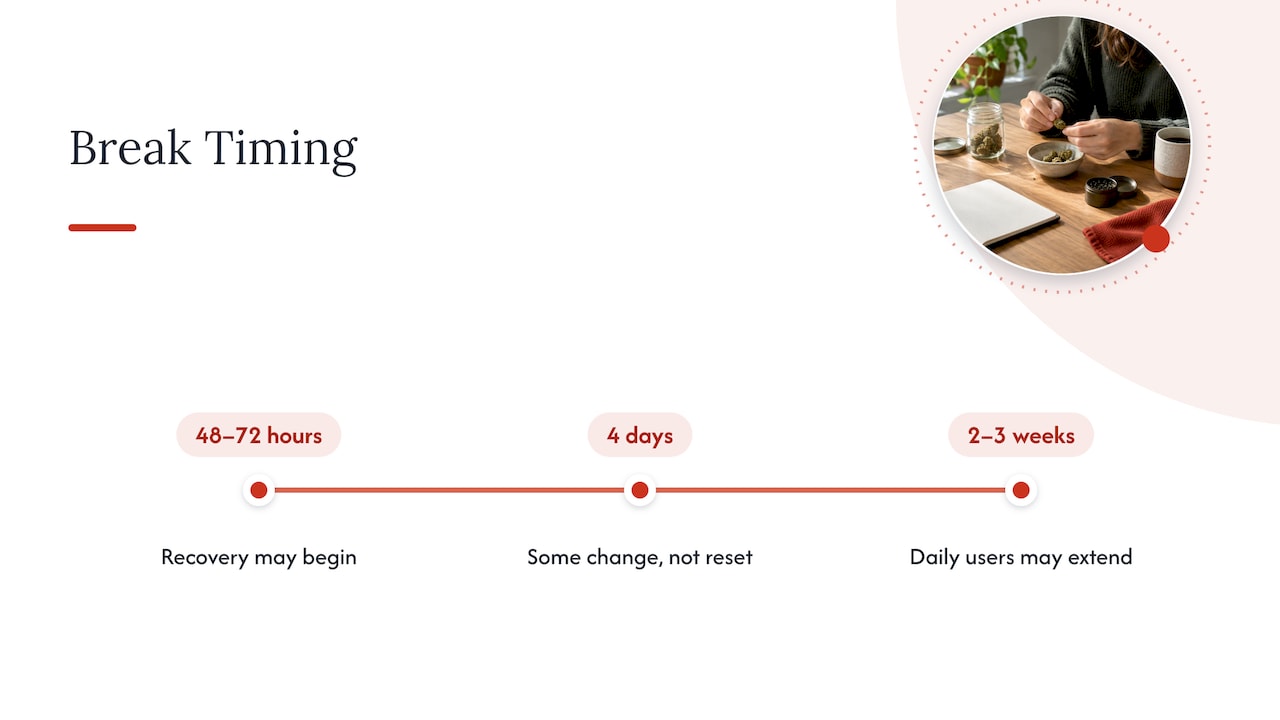
The three-week figure matches a UK psychiatrist’s description: receptor recovery is said to begin 48 to 72 hours after stopping and level out between 21 days and 4 weeks. Another review notes that reported reset times range from a few days to several weeks.
Will a 4-day break do anything?
Probably something, but not a full reset. Four days gets you past the first 48 to 72 hours when recovery is said to begin, but it ends right around the worst of withdrawal for many people. If you smoke or vape a few times a week, a short break may be enough to notice a difference. If you use daily, treat four days as a trial run and extend it toward two or three weeks.
What if I use weed once during the break?
A single session does not erase the days you already put in, but it does restart the clock on receptor recovery and can make the next days harder. Withdrawal symptoms are tied to stopping, so using again may ease them for a few hours and then bring them back. If you slip, note it and keep going rather than abandoning the plan.
Plan the break before you start
People who plan finish. In a study of young adults aged 18 to 29, those who used a structured T-break guide heavily were more likely to complete 21 days (84% vs. 57%) than those who did not. You do not need a formal program, but a plan helps:
- Pick a start date in a low-stress stretch. A clinician writing for Cannabis Health News suggests low-stress periods with regular exercise and a healthy diet. Avoid launching it during a deadline crunch or a holiday week.
- Set a length. Choose 48 hours, one week, or 21 days based on how often you use. Write it down.
- Taper if you use daily. The CNN expert’s concern is withdrawal, and he recommends titrating down over a week or two instead of stopping abruptly. Cut your dose or sessions step by step.
- Change your cues. Move the stash out of sight, shift the evening routine, and plan something else for the time you would normally use.
- Plan your return. Decide now what you will buy and how much you will take first (more on that below).
Getting through withdrawal
Withdrawal is the main reason people quit breaks early. Typical symptoms are trouble sleeping, irritability, anxiety, low mood and low appetite. The same CNN expert describes irritability, nausea, vomiting and nightmares that start in the first three days and can last up to a week or two. The 2025 study found that withdrawal was an early barrier for many people, while positive outcomes came with longer breaks.
For a general picture of how withdrawal from a plant-based substance works and how gradual tapering is approached, this overview of withdrawal symptoms and safe tapering is a handy comparison point.
Practical ways to ride it out:
- Sleep: keep a fixed bedtime, cut caffeine after noon, and expect vivid dreams early on.
- Appetite: eat small, regular meals even when you are not hungry.
- Mood: exercise and daylight help, and so does telling a friend what you are doing.
- Cravings: they come in waves. Wait 20 minutes and do something with your hands.
The Cannabis Health News clinician adds that CBD and terpenes can still be used during the break since they do not cause the same tolerance pattern. If you want a non-THC option for evenings, our CBD edibles are a simple fit.
If withdrawal is severe, or you feel unable to stop despite wanting to, see a doctor. That is not a failure, and it is the right professional for it.
Coming back after a tolerance break
This is where most of your effort can be undone in a single evening. After a break your body is more sensitive, so your old dose can hit much harder. The Rhode Island Department of Health says to be careful when resuming and to try a smaller amount or a lower-strength product because tolerance may have dropped.
A simple return plan:
- Start at a quarter to a half of your old dose. That is a practical rule of thumb, not a clinical number.
- Wait before adding more. Inhaled effects show within minutes, while edibles can take much longer. Our guide to dosing edibles safely covers timing in detail.
- Choose lower-strength products. Higher THC numbers do not tell the whole story about how a product feels, as we explain in what actually determines strength.
- Check the label. Lab-tested products with a clear potency listed let you do the math on your dose.
- Do not use alone in a new setting. Your first session back should be at home, with nothing to drive or do afterward.
Our three rules for safe cannabis use are start low, wait, and buy lab tested. They apply with extra force on the first night after a break.
How to keep tolerance from creeping back
Tolerance responds to dose and frequency. The Leafwell overview notes that consistent low doses may slow tolerance while high doses build it faster. Some habits that follow from that:
- Keep your dose at the lowest amount that does the job.
- Leave gaps. Even a couple of days off each week gives receptors time.
- Rotate between formats. Our flower vs. vapes comparison helps you pick the method that suits the occasion rather than defaulting to the strongest one.
- Track your use for a month. If your spending or sessions creep up, plan another short break.
- Some clinicians suggest a 48-hour break once or twice a year even without clear tolerance, according to one T-break guide.
At higher daily doses, tolerance can escalate toward dependence. A cannabis specialist quoted by Leafwell places that risk at 20 mg of THC or more. If you see yourself there, a break is a smart move.
Why the restart is easier with a trusted source
A low, controlled return needs two things: accurate potency and a product you can portion. That is where where you buy makes a difference. We carry lab-tested flower, pre-rolls, vapes, edibles, concentrates, THC beverages and CBD products, so you can pick a gentler format or strength for your first week back without hunting across town.
Our team has been serving NYC since 2011, and the question we hear most from regulars is some version of “how do I get back to feeling it again?” Our answer is always the same: it is not about buying more, it is about buying right. A fresh start with a lab-tested, clearly labeled product at a modest dose gives you a better night than any high-strength jar. We built our menus around that idea, with fair pricing and discreet delivery, so you can order calmly and plan the evening around it rather than a rushed trip.
If you are taking a break, take it seriously. If you are coming back, come back gently. We are here for both.
Jake
Order your restart in NYC
When your break ends, we offer same-day delivery across the five boroughs, with day and night menus so you can browse when it suits you. Delivery fees are published as from $8 in Queens and from $12 in Manhattan and the Bronx. Age verification is part of checkout, and you can choose scheduled delivery if you want the order timed to your evening. See the full menu and delivery options or check scheduled delivery for apartments.
Want more background first? Our own piece on understanding cannabis tolerance and how to reset it goes through the basics.
FAQ
How long should a tolerance break be?
It depends on how often you use. A 48-hour pause can begin the reset, and 2 to 4 weeks is what clinical experience suggests works better. If you use most days, about 21 days is the common benchmark.
Is one joint a day heavy use?
There is no single cutoff, and the research ties tolerance to dose, frequency and how long you have used. A daily habit can still build tolerance over time, especially at higher doses. If you notice you need more, or you are spending more, take that as your cue to plan a break.
Why am I not getting high from weed?
The most common reason is tolerance from frequent use, because receptors become less responsive. It can also come down to the product, the dose or the method. A short break, then a restart at a lower dose with a lab-tested product, is the usual fix.
Do I have to quit completely?
Not necessarily. Tapering over a week or two before stopping can reduce withdrawal. Non-THC options such as CBD can be used during a break, according to one clinician. If you cannot cut back as planned, speak with your doctor.
Sources
- Tolerance breaks: When and why to take a T-break (Leafwell)
- Weed tolerance: Why it happens and how to lower it (Leafwell)
- What Are Tolerance Breaks and Why Do Young Adults Take Them (PMC, 2025)
- Effect Compartment Model for the Evaluation of Tolerance to THC (PMC, 2022)
- Blunted highs: Pharmacodynamic and behavioral models of cannabis tolerance (PubMed, 2020)
- T-Break Guide (University of Vermont)
- Feasibility and utility of a structured guide for cannabis tolerance breaks (Taylor & Francis, 2023)
- T-breaks for marijuana use have pros and cons (CNN, 2023)
- Understanding Your Risk for Cannabis Use Disorder (CDC)
- Lower-Risk Cannabis Use Practices (Rhode Island Department of Health)
- Is it time for a T-break? (Cannabis Health News, 2021)
- How to lower your cannabis tolerance (The Cannigma, 2022)
- A Guide to Cannabis Tolerance Breaks (Healer)