Read our Google Birdeye Reviews
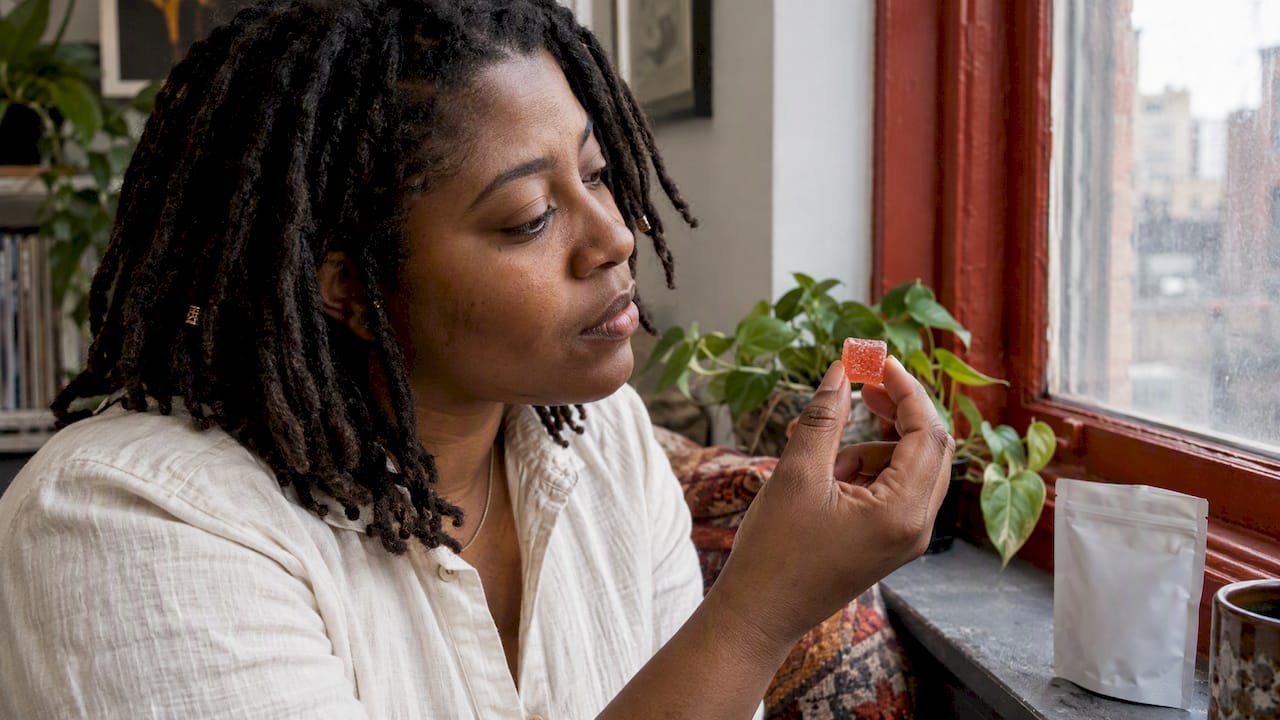
THCV (tetrahydrocannabivarin) is a minor cannabis compound that looks like THC on paper and behaves differently in the body. At the small doses found in most products, studies so far suggest it is not intoxicating. At much higher doses, researchers have seen mild euphoria. The popular claims, that it burns fat, boosts energy and sharpens focus, run well ahead of the human evidence.
This guide separates what has been measured from what gets repeated online. At the end we cover the other compounds readers ask about alongside it: CBC, CBDA, myrcene and beta-caryophyllene.
TL;DR
- THCV is a THC look-alike with different pharmacology. In a small human study, 10 mg of oral Δ9-THCV was not distinguishable from placebo.
- Mild, THC-like effects showed up only at much higher doses, and mostly with Δ8-THCV, a related form.
- “Skinny weed” appetite suppression and “clean energy” are mostly preclinical ideas. Human data is thin, and no therapeutic dose exists.
- Most consumer THCV products contain under 5 mg, far below doses where effects were noticed.
- CBC, CBDA, myrcene and beta-caryophyllene each have their own story. Beta-caryophyllene is the best understood, and mostly in animals and cells.
Table of Contents
- What is THCV?
- What are the effects of THCV?
- THCV vs THC: how the experience differs
- THCV benefits: appetite, weight and energy
- Can THCV cause anxiety or side effects?
- Our perspective
- Beta-caryophyllene effects
- What is CBC?
- CBDA vs CBD
- Myrcene effects
- How to shop for minor-cannabinoid products
- Order tested cannabis in NYC
- FAQ
- Sources
What is THCV?
THCV is a phytocannabinoid, a compound made by the cannabis plant. Its structure is close to THC’s, but its pharmacology differs. A 2025 review in the journal literature, Tetrahydrocannabivarin is Not Tetrahydrocannabinol, describes THC as a potent partial agonist at the CB1 receptor, the receptor behind the classic high. THCV is mainly a CB1 antagonist at most biologically relevant doses. In plain terms, THC switches that receptor on, and THCV mostly sits on it without doing the same.
That difference is why THCV is not simply “weaker THC.” It is a different tool, and one that has been studied in remarkably few people.
Two naming points help avoid confusion:
- Δ9-THCV is the form found naturally in some cannabis plants.
- Δ8-THCV is a related form used in some dose-ranging research. Studies on one form do not automatically transfer to the other, so keep the label in mind when you read a headline.
The same logic applies to THC itself, where the Δ8 and Δ9 versions feel and behave differently. If you want that side by side, see our guide to Delta 8 vs Delta 9.
What are the effects of THCV?
The honest answer depends on dose, and the dose range in studies is wide.
At low doses (around 10 mg)
In a pilot study of 10 male cannabis users, five days of 10 mg oral THCV was subjectively indistinguishable from placebo and generally well tolerated. The 2025 review reaches the same place: oral Δ9-THCV at about 10 mg was generally not intoxicating and not felt differently from placebo.
For context, that review notes that most consumer THCV products contain less than 5 mg, while much higher oral doses were needed in studied adults to produce noticeable subjective effects. A gummy with a few milligrams of THCV is, on current evidence, unlikely to be the source of a strong effect by itself. If you feel something from a product marketed as THCV, it may be other cannabinoids in the formula, often THC.
At high doses
In a dose-ranging study of oral Δ8-THCV, Peters and colleagues (2023) tested 18 people in a randomized crossover design, plus 3 in dose escalation at 12.5, 25, 50, 100 and 200 mg. Findings worth knowing:
- Of 60 adverse events, 55 were mild.
- Euphoric mood was the most common adverse event.
- The 100 mg and 200 mg doses raised ratings of feeling a drug effect and of liking it.
The 2025 review summarizes this as slight THC-like effects at 100 and 200 mg of Δ8-THCV. These are doses far above what a typical product delivers, and the form tested was Δ8, not the Δ9 form people usually mean.
What regulators say about psychoactivity
The UK’s Advisory Council on the Misuse of Drugs reviewed the plant cannabinoids and reported that most evidence suggested Δ9-THCV was not psychoactive. It also noted an older report in which an intravenous 7 mg dose produced weak THC-like effects in five of six participants. The Council treated dose- or route-dependent psychoactivity as unresolved. That is a fair summary of the field: probably mild, probably dose-dependent, not fully settled.
THCV vs THC: how the experience differs
This is the comparison most readers want. The table pulls together what the studies above actually found.
| THC | THCV | |
|---|---|---|
| Main action at CB1 | Potent partial agonist | Mainly antagonist at most relevant doses |
| Typical effect at common product doses | Clearly intoxicating | Not distinguishable from placebo at 10 mg oral Δ9-THCV |
| Effects at very high doses | Stronger, dose-dependent | Slight THC-like effects at 100 to 200 mg of Δ8-THCV |
| Established therapeutic dose | Varies by product and use | None established |
There is a twist. In the small pilot study mentioned above, repeated THCV dosing before intravenous THC reduced THC’s heart-rate rise and delayed verbal-recall impairment, and nine of ten participants rated THC as weaker or less intense. The same trial, however, saw more memory intrusions under THCV, so it is not a clean “blocker” story. Ten people is a pilot, not a verdict.
If you want the broader THC picture, our guides on THC vs CBD and on what actually determines strength cover why a number on a label is only part of the story.
THCV benefits: appetite, weight and energy
Appetite and weight loss
THCV is nicknamed “skinny weed” because THC tends to increase appetite and THCV acts at the same receptor in the opposite direction. The nickname is ahead of the evidence. The 2025 review reports appetite-suppression and blood-sugar findings from preclinical work and notes just two human studies of THCV for obesity-related blood-sugar and appetite outcomes. That is a research lead, not a weight-loss method.
If you are managing weight, blood sugar or diabetes, talk to your doctor before using any cannabinoid product for it. Do not swap a prescribed treatment for one.
Energy and focus
THCV is often described as “uplifting.” In the Δ8-THCV dose study, some doses showed preliminary signals for sustained attention, but they were not dose-dependent, and the 25 mg energetic rating did not differ significantly from placebo. The study does not establish reliable energy or focus benefits. If a label promises either, treat it as marketing.
Therapeutic use
The Sax Institute’s evidence review, published online in 2021, found only a handful of limited-quality human THCV studies and no established therapeutic dose. It also warns that extrapolating animal doses to humans is highly uncertain.
Can THCV cause anxiety or side effects?
The controlled studies did not single out anxiety. In the Δ8-THCV dose-ranging trial, euphoric mood led the adverse-event list, and most events were mild. Consumer-facing guides do list light dizziness, dry mouth or a faster heartbeat, but those come from user reports and general guidance rather than from large trials, so treat them as possibilities, not measured rates.
Practical cautions that follow from the research:
- Check the label for THC. Many “THCV” products are blends. Anxiety, a racing heart or a foggy head more likely tracks the THC in the blend. Our THC drink dosage guide shows how to start low with any THC product.
- Know which form you have. Δ8-THCV and Δ9-THCV are not interchangeable in the studies.
- Do not drive or work with machinery after trying a new product until you know how it affects you.
- Skip it if you are under 21, pregnant or breastfeeding, and ask your doctor first if you take medication or have a heart or mental health condition.
Our perspective
We have been delivering lab-tested cannabis in New York City since 2011, and the question we hear most about minor cannabinoids is some version of “will this do what the label says?” With THCV, the honest answer is: probably not much at the amounts in most products, and nobody has proven the big promises.
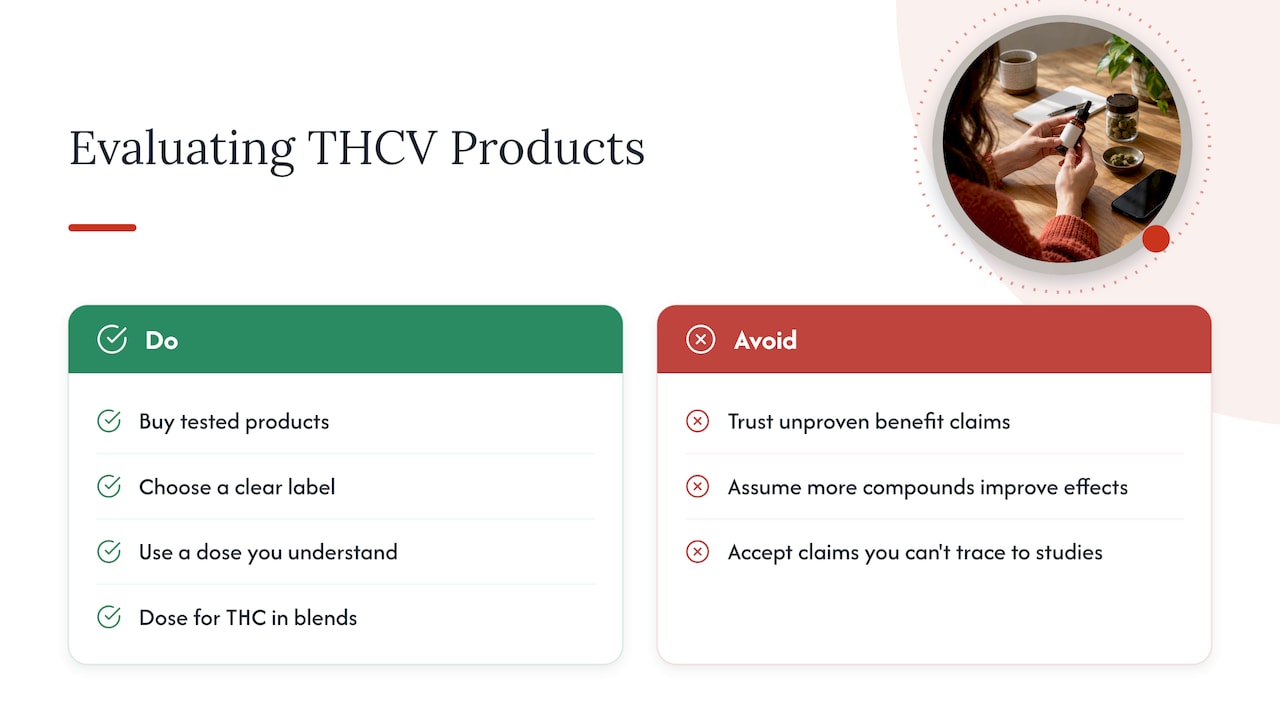
So here is how we read it. A cannabinoid with real pharmacology is interesting. A cannabinoid sold on appetite, energy and focus claims that human trials have not confirmed is a marketing story. We would rather you buy on what you can verify: a tested product, a clear label, a dose you understand. When a product mixes THC with a minor cannabinoid, the THC is what you will feel, and you should dose for that.
We also think the “more compounds, better effect” idea deserves skepticism. We dug into that in our piece on the entourage effect and human trials. Start low, go slow, and ignore any claim you can’t trace to a study.
— Jake
Beta-caryophyllene effects
Beta-caryophyllene (also written B-caryophyllene) is a terpene, an aromatic compound in cannabis and in many non-cannabis plants. It is unusual because it also acts like a cannabinoid. Gertsch and colleagues (2008) identified it as a non-psychoactive, selective CB2 agonist. In cell and mouse models, its anti-inflammatory effects disappeared in mice lacking the CB2 receptor.
A 2013 pain review adds that it is found in foods and spices, is orally bioavailable, and showed CB2-dependent anti-inflammatory and analgesic effects in rodents.
A 2021 review surveys its cardioprotective, hepatoprotective, neuroprotective, gastroprotective, antioxidant and anti-inflammatory potential, and states that human studies are needed. The takeaway: it will not get you high, and it is appealing, but the evidence is mostly mechanistic and preclinical. Do not buy a product expecting a proven medical effect from it.
What is CBC?
CBC (cannabichromene) is another minor phytocannabinoid, generally regarded as non-intoxicating. A 2024 review lists proposed anti-inflammatory, anticonvulsant, antibacterial, pain-related and antidepressant actions, but stresses that commercial CBC products are used with little evidence of safety or efficacy. Human data is sparse: one combination-extract study tolerated up to 26.4 mg of CBC daily, and no standalone therapeutic benefit has been established.
The Sax Institute likewise found no demonstrated therapeutic action for CBC in humans. A 2023 study found CBC reduced inflammatory markers in cultured macrophages and a mouse inflammation model. That is laboratory and animal evidence, not proof of a human treatment effect.
So what are CBC benefits today? Promising questions, not answers.
CBDA vs CBD
CBDA is the raw, acidic form of CBD, in the same way THCA is the raw form of THC. Heat converts the acid to the active compound. We have no controlled human data to cite here on CBDA’s effects, so we won’t promise any. What matters when you shop is the label: it should say which form you are buying and show a lab result. For how the acid-versus-active distinction affects dosing and legal exposure in New York, see our guide to the total THC rule and THCA. Our THC vs CBD article covers the CBD side.
Myrcene effects
Myrcene is one of the most common terpenes in cannabis and a big part of many strains’ aroma. You will often see it credited with sedating effects. We could not find controlled human evidence strong enough to stand behind that claim, so we won’t repeat it as fact. A better habit: use terpene numbers on a lab report to compare aroma and batch consistency, and judge the effect by your own response at a low dose. Our piece on terpene-first low-dose weed for focus explains how we think about that approach.
How to shop for minor-cannabinoid products
Whatever compound caught your eye, the same checks apply:
- Read the certificate of analysis. It should list the milligrams of each cannabinoid, not just “contains THCV.”
- Find the THC content first. It tells you what you will likely feel.
- Compare per-serving doses to the research. If a product has 2 to 5 mg of THCV, the studies above suggest a minimal direct effect.
- Be wary of health claims. Appetite, energy and focus claims on THCV, and disease claims on CBC or myrcene, are not backed by human trials.
- Mind the law. Hemp-derived and cannabis-derived rules differ and change. Our explainer on whether THCA is legal in New York shows how we read the current framework.
If you are comparing formats, flower vs vapes lays out how onset and duration differ by method.
Order tested cannabis in NYC
We are an online dispensary serving New York City, with day and night menus, age verification and delivery windows you can schedule. Flower, vapes, edibles, pre-rolls, concentrates, THC beverages and CBD products all come from tested, verified brands. Delivery fees start at $8 for Queens and $12 for Manhattan and the Bronx. Brooklyn has its own fee, shown at checkout.
If you want to know what a given product contains, check its listing and lab information before you order. For timing, see weed delivery times or scheduled delivery.
Ready to order? Browse the menu and book same-day delivery. Adults 21+ only.
FAQ
Does THCV get you high?
At typical consumer doses, probably not. Oral Δ9-THCV at about 10 mg was not distinguishable from placebo in a small study. Slight THC-like effects appeared only at 100 and 200 mg of Δ8-THCV. Products that blend THCV with THC will still get you high from the THC.
Can THCV help with weight loss?
Not proven. Appetite-suppression findings are mainly preclinical, and only two human studies on obesity-related blood sugar and appetite outcomes have been noted in the 2025 review. Do not use it in place of medical care for weight or blood sugar.
Can THCV cause anxiety?
Controlled studies did not report anxiety as a leading effect. Euphoric mood was the most common adverse event in the Δ8-THCV trial, and most events were mild. If you tend toward anxiety, check how much THC is in the product and start with a very small dose.
Does THCV give you energy or focus?
The evidence does not support it yet. In the Δ8-THCV study, the 25 mg energetic rating did not significantly differ from placebo, and the attention signals were preliminary and not dose-dependent.
Is THCV the same as Δ8-THC?
No. THCV is a different molecule from THC in any of its forms. Δ8-THCV is a form of THCV, not Δ8-THC. See our Delta 8 vs Delta 9 guide for the THC versions.
Sources
- Tetrahydrocannabivarin is Not Tetrahydrocannabinol, PMC (2025)
- Pharmacological actions and associated therapeutic levels of phytocannabinoids, Sax Institute (2021 addendum)
- A Two-Phase, Dose-Ranging, Placebo-Controlled Study of Δ8-THCV, PubMed (2023)
- The effect of five day dosing with THCV on THC-induced effects, PubMed (2016)
- Plant Cannabinoid Working Group report, Advisory Council on the Misuse of Drugs (2016)
- Beta-caryophyllene is a dietary cannabinoid, PMC (2008)
- The Endocannabinoid System, Cannabinoids, and Pain, PMC (2013)
- A focused review on CB2 receptor-selective pharmacological properties of beta-caryophyllene (2021)
- The Potential of Cannabichromene (CBC) as a Therapeutic Agent, PMC (2024)
- In Vitro and In Vivo Anti-Inflammatory Potential of Cannabichromene, PMC (2023)