Read our Google Birdeye Reviews
 Cannabis edibles typically kick in within 30–90 minutes, hit their peak around the 2–3 hour mark, and keep you feeling effects for 4–12 hours total. Some users report mild residual effects the following morning. That range is wide on purpose — your dose, metabolism, and what you ate beforehand all pull the clock in different directions.
Three things to know before you take anything:
- Onset is slow. Most people feel nothing for the first 30–60 minutes, which is exactly when accidental overdosing happens.
- Peak intensity lands around 2–3 hours in, not at the 30-minute mark where many people give up and take more.
- Plan for a full day. If you have to drive, work, or care for someone, edibles are not a same-evening option.
Key Takeaways
Edibles last 4–12 hours for most adults, with onset at 30–90 minutes and peak intensity around 2–3 hours. Plan your full day before you dose.
| Point | Details |
|---|---|
| Onset window | Effects typically begin 30–90 minutes after ingestion; some formats start in 15–45 minutes. |
| Peak and duration | Peak hits around 2–3 hours; total effects commonly last 4–12 hours with residual effects possible to 24 hours. |
| Start low, go slow | Begin at 2.5–5 mg THC; wait at least 2–4 hours before considering any additional dose. |
| Driving and re-dosing | Avoid driving for at least 6–12 hours; wait 24 hours before re-dosing if unsure of your response. |
| Safe storage | Keep edibles in original labeled packaging, locked away from children and pets. |
Table of Contents
- How long do edibles take to kick in?
- What the hour-by-hour timeline actually looks like
- What makes your edible high longer or shorter?
- Dosing guide: what different amounts actually feel like
- Acute effects, risks, and what to do if it’s too intense
- U.S. safety considerations: driving, workplace testing, and pregnancy
- What the research actually says about edible duration
- An editorial perspective on edible safety
- Sources
How long do edibles take to kick in?
The short answer: 30–90 minutes for most products, though some formulations move faster and some slower. Hard candies and lozenges that dissolve in your mouth can start absorbing through the mucous membranes in as little as 15–45 minutes. A dense brownie or a capsule you swallow whole goes through full digestion first, which pushes onset toward the 60–90 minute end — or beyond.
The biology here matters. When you swallow an edible, THC travels through your digestive tract to the liver before it ever reaches your bloodstream. That first-pass liver metabolism converts THC into 11‑hydroxy‑THC, a metabolite that crosses the blood-brain barrier more readily than THC itself and tends to produce stronger, longer-lasting effects. It’s a fundamentally different pharmacological experience than smoking or vaping the same amount.
Your stomach contents change the timeline considerably. An empty stomach speeds absorption; a fatty meal can actually increase THC uptake because cannabinoids are fat-soluble, but it also delays the initial onset window. Physical activity, your metabolic rate, and individual enzyme differences in the liver all add more variability on top of that.
Pro Tip: Set a timer when you take an edible. If you feel nothing at 90 minutes, that’s still within the normal window — wait until the full 2–4 hour mark before deciding the dose wasn’t enough. Keeping a simple log (product name, dose, time taken, time of first effect) pays off quickly.
What the hour-by-hour timeline actually looks like
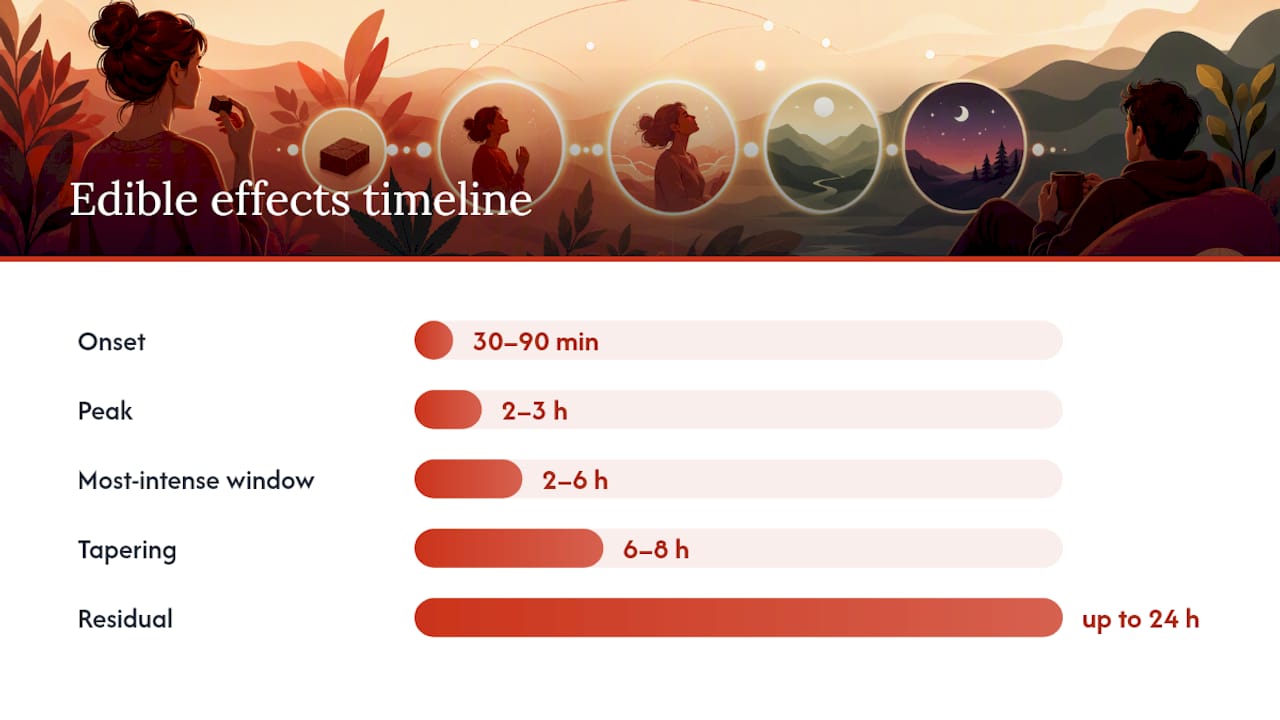
Most adults follow a recognizable arc, though dose and tolerance shift every number in this table.
| Phase | Typical Timing | What Most Users Notice |
|---|---|---|
| Onset | 30–90 minutes | Subtle warmth, mild mood shift, or nothing yet |
| Building | 1–2 hours | Effects becoming noticeable; some anxiety if dose is high |
| Peak | 2–3 hours | Most intense psychoactive effects |
| Most-intense window | 2–6 hours | Sustained impairment; do not drive or operate machinery |
| Tapering | 6–8 hours | Effects declining but still present |
| Residual | Up to 24 hours | Grogginess, mild cognitive fog for some users |
Breaking that down by the clock:
- 0–1 hour: Most people feel little to nothing. This is the danger zone for re-dosing.
- 1–3 hours: Effects build and peak. Euphoria, altered time perception, increased heart rate, and dry mouth are common.
- 3–6 hours: The most intense window for higher doses. Anxiety or paranoia can surface here if the dose was too large.
- 6–12 hours: Gradual taper. Coordination and reaction time remain impaired even as the subjective high fades.
- 12–24 hours: Most effects are gone, but some users notice next-day grogginess or reduced mental sharpness, especially after larger doses.
Sensitive users and those new to edibles sit at the longer end of every range. Experienced, high-tolerance users may move through the timeline faster.
What makes your edible high longer or shorter?
No two people metabolize edibles identically. Several factors stack on top of each other to determine your personal timeline.
Biological factors:
- Dose: The single biggest variable. A 5 mg edible and a 50 mg edible are not on the same scale — the higher dose extends both peak intensity and total duration.
- Tolerance: Regular cannabis users process THC faster and feel effects for a shorter window. Understanding how tolerance builds and resets helps you calibrate your dose accurately.
- Body fat percentage: THC is lipophilic, meaning it stores in fat tissue. Higher body fat can extend the release of THC back into the bloodstream over time.
- Sex and age: Research suggests women may be more sensitive to THC’s effects at equivalent doses. Older adults often experience stronger or longer effects due to slower metabolism.
- Liver enzyme activity: CYP2C9 and CYP3A4 enzymes govern how quickly your liver processes THC. Genetic variation in these enzymes is one reason two people eating the same gummy can have completely different experiences.
- Medications: Drugs that inhibit CYP450 enzymes — including some antidepressants, antifungals, and blood thinners — can slow THC metabolism and intensify or extend effects.
Product factors:
- THC potency: A 10 mg gummy and a 30 mg gummy are not interchangeable. THC numbers don’t tell the whole story, but dose is still the clearest predictor of duration.
- Fat content: High-fat edibles like brownies or chocolates can increase THC absorption. The hemp edibles metabolism process shows that lipid content in the product itself influences how efficiently cannabinoids are absorbed.
- Homemade vs. lab-tested: Homemade edibles are notoriously inconsistent. A batch of cannabis brownies can have hot spots where THC concentration is three times higher than the rest of the batch.
Situational factors:
- Eating on an empty stomach speeds onset but can make effects feel more abrupt.
- Alcohol amplifies THC absorption and intensifies impairment — the combination is unpredictable and genuinely risky.
- Vigorous exercise after consuming may redistribute THC from fat stores back into the bloodstream, briefly intensifying effects.
Analyses of user self-reports consistently show that unpredictable duration is one of the most commonly cited adverse effects of edibles — and the primary reason people accidentally over-consume.
Dosing guide: what different amounts actually feel like
Public-health guidance is consistent on this: start at 2.5 mg THC or less if you’re new to edibles, and wait up to four hours before judging whether you need more. That advice exists because the gap between “not feeling it yet” and “too much” is narrow and easy to cross.

| Dose | Likely Experience for Most Adults |
|---|---|
| 1–2.5 mg | Very mild; threshold effects; good starting point for new users |
| 5 mg | Mild euphoria, relaxation; standard “beginner” dose in legal markets |
| 10 mg | Moderate; noticeable impairment; standard single serving in many regulated products |
| 20 mg | Strong; significant impairment; not recommended for inexperienced users |
| 50 mg+ | Very strong; high risk of anxiety, paranoia, or prolonged impairment |
How strong is 30 mg? For most adults without a high tolerance, 30 mg is a large dose. Expect pronounced psychoactive effects, meaningful cognitive impairment, and a high that can run 8–12 hours or longer. New users who accidentally take 30 mg in one sitting are the most common presentation in cannabis-related emergency visits. If you’re curious about higher doses, work up gradually over multiple sessions — never jump there from a 5 mg baseline in one go. For beginners specifically, low-dose products in the 2.5–5 mg range are the right starting point.
Pro Tip: Split a 10 mg gummy in half for your first session. Take the half, wait three full hours, and only take the other half if effects are minimal. Keep a notes app log with the product name, dose, and how you felt — three sessions of data tells you more than any general guide.
Acute effects, risks, and what to do if it’s too intense
Most edible experiences involve some combination of euphoria, relaxed muscles, altered time perception, dry mouth, increased appetite, and a slower reaction time. At moderate doses, those effects are manageable. At high doses, the picture changes.
Common effects at higher doses:
- Rapid heart rate (tachycardia)
- Anxiety or paranoia, sometimes severe
- Nausea or dizziness
- Disorientation or confusion
- Difficulty concentrating or forming sentences
Signs that warrant emergency care:
- Chest pain or pressure
- Severe difficulty breathing
- Loss of consciousness
- Uncontrollable vomiting
If you or someone near you is having a difficult reaction, here’s what actually helps:
- Stay calm and stay put. Find a quiet, comfortable space. Lying down often helps.
- Hydrate with water. Avoid caffeine, which can amplify heart rate.
- Ground yourself. Focus on slow breathing: inhale for four counts, hold for four, exhale for four.
- Avoid alcohol and other substances. Mixing anything into an already-intense high makes it harder to manage.
- Call for help if needed. If symptoms feel medical — chest pain, breathing trouble, unconsciousness — call 911. Cannabis alone is rarely fatal, but severe reactions can mimic medical emergencies and should be treated as such.
U.S. safety considerations: driving, workplace testing, and pregnancy
Driving: Edible impairment outlasts the subjective high. You may feel “fine” at hour six while your reaction time and judgment remain measurably impaired. Avoid driving for at least 6–12 hours after consuming, and longer after high doses. Cannabis impairment is detectable by law enforcement and is treated as DUI in every U.S. state where cannabis is legal.
Workplace drug testing: THC metabolites stay in your system well beyond the psychoactive window. Urine tests can detect use for days to weeks depending on frequency of use. If your employer has a zero-tolerance policy, edibles carry the same testing risk as any other cannabis product. CBD products with THC content can also trigger positive results.
Pregnancy and breastfeeding:
- The CDC and American College of Obstetricians and Gynecologists both advise against any cannabis use during pregnancy or while breastfeeding.
- THC crosses the placenta and is present in breast milk. No safe level of use has been established for these populations.
Medication interactions: THC is metabolized by the CYP450 enzyme system, the same pathway used by many common medications including warfarin, some SSRIs, and statins. If you take any prescription medication, check with a pharmacist or clinician before using edibles regularly.
What the research actually says about edible duration
The science on edible pharmacokinetics is solid on the broad strokes and murkier on the specifics. Peer-reviewed pharmacokinetic studies consistently place peak blood THC levels around 2–3 hours after oral ingestion, which aligns with patient-reported peak intensity. The NCBI review on cannabinoids confirms that 11‑hydroxy‑THC formation during first-pass metabolism is the primary reason oral THC feels different — and often more intense — than inhaled THC at the same nominal dose.
NIDA’s cannabis research summaries underscore that individual variability in effects is substantial and that conservative dosing guidance is the standard precisely because predicting any individual’s response is difficult. The FDA has noted that variable formulations and limited standardized dosing research make firm universal recommendations difficult — which is why ranges rather than fixed numbers appear in every credible source.
Key research takeaways:
- Peak timing at 2–3 hours is well-supported across multiple study designs.
- Total duration of 6–12 hours is the most commonly cited range, with residual effects to 24 hours documented in some users.
- Sample sizes in most edible studies are small, and most research uses controlled laboratory conditions that don’t fully reflect real-world variability in products and users.
- Future research needs to address dose-response relationships across diverse populations, including older adults and people on common medications.
An editorial perspective on edible safety
The most consistent mistake people make with edibles isn’t ignorance — it’s impatience. Every experienced user I’ve spoken with has a story about the time they “didn’t feel anything” at the 45-minute mark and took more, only to be overwhelmed two hours later. The pharmacology is not subtle: edibles are slow, and the liver’s conversion of THC to 11‑hydroxy‑THC makes the eventual effect stronger than most people expect from the dose on the label.
My practical recommendations are simple. Track every session in a notes app: product name, dose, time consumed, time of first effect, and how intense the peak felt. Three data points from your own body are worth more than any general guide. Plan your day around the edible, not the other way around — block out 12 hours where you have no driving, no caregiving, and no professional obligations. And buy lab-tested products from a source you trust. Homemade edibles and unlabeled products remove the one piece of information you actually need: how much THC you’re taking.
Highfashionsmokesandprints carries lab-tested edibles with accurate labeling, which is the baseline any responsible purchase should start from. The educational resources on the blog cover dosing, tolerance, and product selection in more depth if you want to go further.
Sources
- Edibles: How long do they last? – Medical News Today
- How Long Do Edibles Take to Kick In? Duration, Side Effects – Healthline
- Cannabinoids — NCBI PMC (review article)
- FDA and cannabis research and drug approval process – FDA
This article is general information, not a substitute for advice from a qualified doctor. Consult a qualified healthcare professional about your own circumstances before acting on anything here.