Read our Google Birdeye Reviews

Decarboxylation, or “decarbing,” is gentle heating that converts the inactive acids in raw cannabis, mainly THCA, into active THC. Do it before you cook with flower or infuse butter or oil. In a home oven the usual range is about 220°F for 30 to 45 minutes, and the details below decide whether you get a potent, even result or a wasted eighth. If you would rather skip the kitchen entirely, we deliver lab-tested edibles, vapes and concentrates across New York City.
TL;DR
- Raw flower contains THCA, which is not the compound that produces the high. Heat removes a carboxyl group and creates THC.
- Published guidance for home and licensed processing clusters around 220°F to 280°F for 30 to 60 minutes, and lower and slower is gentler on the plant.
- Spread flower in a thin, even layer, check your oven with a thermometer, and never assume the potency of the finished infusion.
- Smoking or vaping decarbs the flower in the moment, so this step is for edibles, oils and butters.
- Edibles are the most common cause of overconsumption, so start low and wait before taking more.
Table of Contents
- What decarboxylation actually does
- Temperature and time: what the research reports
- How to decarb flower in the oven, step by step
- Common mistakes that cost you potency
- Food safety and dosing when you infuse
- Do you need to decarb if you smoke or vape?
- Skip the oven: ready-made options in NYC
- Our view on decarbing
- FAQ
- Sources
What decarboxylation actually does
In the living plant, cannabinoids are mostly stored as acids. Health Canada’s guidance for health care professionals describes them as inactive monocarboxylic acids, such as THCA, alongside active decarboxylated forms, such as THC. It adds that heating above 120°C (248°F) promotes the conversion. In chemistry terms, heat knocks off a carboxyl group, which is a small cluster of carbon and oxygen atoms, and the molecule changes into its neutral form.
The difference is not subtle. In a 2019 study in Cannabis and Cannabinoid Research, Lewis-Bakker and colleagues measured THCA as roughly three orders of magnitude weaker than THC at the CB1 receptor, the main site in the body through which THC acts. That is why a raw bud tossed into brownie batter does very little. Healthline notes that raw cannabis must be exposed to heat for THCA and CBDA to become THC and CBD, so eating it raw will not give the same effects as heated products.
There is a second benefit. Cannabis Science & Technology’s 2024 explainer on the process says decarboxylation also improves extraction by reducing water content and lowering the polarity of the cannabinoids, which helps them dissolve into fats like butter or oil.
If you are curious how this shows up on a lab label, our guide to THCA versus THC and total THC math explains why a flower can test high in THCA yet be reported as total THC.
Temperature and time: what the research reports
No single setting is perfect, because the reaction depends on both heat and duration. Here is what published sources report.
| Source | Reported conditions | What it tells you |
|---|---|---|
| AJPH review of Colorado edibles | About 220°F for 30 to 45 minutes | The common home-oven benchmark for activating THC |
| Utah state pre-extraction SOP, 2021 | 220°F to 280°F for 30 to 60 minutes | A regulator’s range for cannabis or extract |
| Lewis-Bakker et al., 2019 | Open vessel: 100°C for 60 minutes, or 37°C and 60°C over several hours | Lower heat works, but it takes much longer |
| Das et al., 2022 postharvest review | Conversion is pronounced above 100°C within 60 minutes, still progressing at 80°C over an hour | Even moderate heat starts the conversion |
| Molecules, 2021 | Maximum THC at about 110°C for 60 minutes, with THC loss above 125°C | Too much heat destroys what you are trying to create |
The pattern is consistent. Around 220°F (104°C) for 30 to 45 minutes gets you most of the way, and pushing far above 250°F risks degrading the THC you just made. The Utah procedure also notes that longer decarboxylation converts more THC into CBN, a compound used in sedative-style products, so more time is not simply better.
Why THC and CBD do not want the same recipe
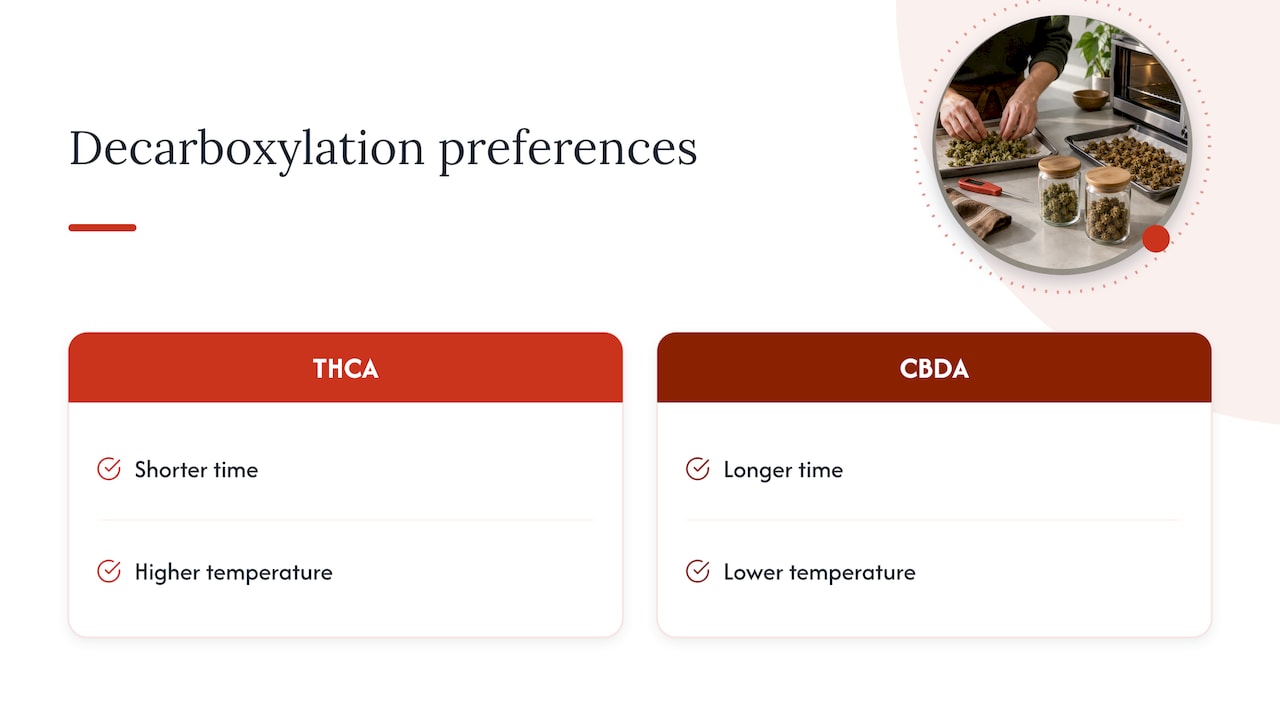
A 2022 review by Filer on acidic cannabinoid decarboxylation explains that the reaction follows first-order kinetics, meaning it proceeds at a rate tied to how much acid remains. It also reports that kinetic modeling found THCA converts best with shorter time and higher temperature, while CBDA converts best with longer time and lower temperature. One “universal” setting cannot be ideal for both. If you are working with a CBD-rich flower, lean toward the lower, longer end of the range.
How to decarb flower in the oven, step by step
This is the method most home cooks use. Each step lists where it tends to go wrong.
- Check your oven. Put an oven thermometer on the rack and preheat to 220°F to 240°F. Home ovens can run well off their dial setting, and a 30°F error changes the outcome. Wait until the thermometer, not the oven light, tells you it is at temperature.
- Break up the flower by hand. Pull buds into pea-sized pieces. Grinding to a powder makes the material scorch easily and can make straining harder later. Skip any stems and seeds.
- Spread it in a thin, even layer. Use a rimmed baking sheet lined with parchment. Piles heat unevenly, so the middle stays raw while the edges overcook. Filer’s review of the literature also reports that oxygen during decarboxylation led to oxidized side products and fewer neutral cannabinoids, so avoid dragging out the time in open air.
- Bake 30 to 45 minutes. Stay at the 220°F end for the full time. If you run closer to 250°F, shorten it and watch closely. Stir gently once at the halfway mark.
- Look and smell. Finished flower is lightly toasted, golden to light brown and dry enough to crumble. Dark brown, blackened or acrid-smelling material has overheated.
- Cool in the pan. Let it come to room temperature before you transfer it. Then infuse it right away into butter, oil or another fat, or store it airtight in a cool, dark place.
Should you cover it?
Many home cooks cover the tray loosely with foil to keep aroma in the oven and reduce drying. A loose cover is a reasonable choice, but keep the layer thin and the thermometer honest. The temperature matters more than the foil.
The jar and boiling methods
Some guides describe sealing flower in a jar and heating it in water. A closed vessel heats faster, and in a closed reactor the Lewis-Bakker study reports the reaction reaching completion at 200°C in just three minutes. That is a laboratory figure, not a kitchen shortcut. Home jars vary in how they transmit heat and in how much pressure they hold, and the oven method is easier to control.
Common mistakes that cost you potency
- Skipping the step. Acid-rich flower stays mostly inactive if it never meets heat above the conversion threshold.
- Trusting the dial. Use a thermometer. Overheating burns off cannabinoids, and underheating leaves THCA behind.
- Scorching. The Molecules study reports THC loss above 125°C, so dark, crispy flower has likely lost some of its potency.
- Heating uneven piles. Thin, uniform layers heat evenly. Thick clumps do not.
- Treating one batch as a known dose. Home times and temperatures are a convention, not a validated potency guarantee. Your finished butter has an unknown strength, so the amount you start with matters more than the recipe.
- Using a hot extract without stirring. The Cannabis Safety Institute’s microbiological safety document notes decarboxylation depends on matrix viscosity and surface area, so thick extracts heated without stirring need much higher temperatures or many more hours.
Food safety and dosing when you infuse
Decarboxylating is a cooking step with consequences for safety, so treat it that way.
Microbes. The same Cannabis Safety Institute document describes decarboxylation as essentially a heat-kill step that kills growing bacteria and fungi but not spores. It explains that spores of C. botulinum are killed at 121°C for three minutes, and that infusions made from cured cannabis extracts do not present a botulinum risk, while raw-cannabis oils that skip decarboxylation must be refrigerated and used soon. For a deeper read on keeping infused oils safe, see this cannabis coconut oil safety guide.
The AJPH Colorado review adds a trade-off for edible makers: the roughly 220°F decarb temperature is below the 240°F to 250°F that USDA recommends for destroying C. botulinum spores in low-acid foods. If you cook infused foods yourself, store them cold, label them and use them quickly.
Potency and dosing. The same review identified 13 edibles-linked public health investigations between 1978 and January 2018, all tied to THC overconsumption, with an average onset of 30 to 120 minutes after eating and effects lasting up to 12 hours. Because you cannot know the strength of a home infusion, start with a very small portion, wait at least two hours before considering more, label everything clearly and keep it out of reach of children and pets. Adults 21 and over only. Our guide to dosing edibles safely walks through milligram math for beginners.
A 2024 review of cannabis-infused foods also reported that an Oregon study found pesticides detectable in 55% of concentrate samples versus 29% of flower samples. That is a good reason to care where your starting material comes from, whether flower or concentrate.
Do you need to decarb if you smoke or vape?
No. Combustion and vaporization supply enough heat to convert THCA as you inhale, so flower you smoke is decarbed in the moment. That is why the step matters for cooking, oils and tinctures, not for a joint or a bowl. If you are weighing the two ways of using flower, our flower versus vapes comparison lays out how each fits different routines.
Can you make edibles without decarboxylating? You can mix raw flower into food, but the result will be far weaker than activated cannabis, because most of the cannabinoids remain in acid form.
Skip the oven: ready-made options in NYC
Decarbing well takes a thermometer, an hour, a thin layer of patience and then a second step to infuse and dose. Many New Yorkers who are busy or new to this would rather start with a product that arrives ready to enjoy.
High Fashion Smokes & Prints delivers lab-tested flower, vapes, edibles, concentrates, THC beverages and CBD products in New York City, with age verification at checkout and day and night menus. Delivery fees start at $8 for Queens and $12 for Manhattan and the Bronx. You can browse our full menu and delivery options, or look at the CBD edibles if you want something gentle to start with.
If you prefer to choose by timing, our same-day delivery schedule guide shows when to order before evening peaks.
Our view on decarbing
Decarboxylation is the step where cooking at home turns from a recipe into a small chemistry project. Temperature, time, layer thickness and even the oxygen in your oven all move the result, and the research says the best settings differ for THC and CBD.
We have been serving New York City since 2011, and what we care about is that you know what you are consuming. That is why we sell products that are tested and verified, and why we publish guides on dosing and on THCA versus THC. If you enjoy the craft, decarb carefully and dose low. If you want a predictable evening, a labeled edible or a vape from our menu gives you a clear starting point and a delivery window that fits your day.
Jake
FAQ
What is the best temperature to decarb cannabis?
Most published guidance points to about 220°F for 30 to 45 minutes, with regulators describing a range of 220°F to 280°F for 30 to 60 minutes. Lower temperatures are gentler on the plant but take longer. Above roughly 257°F (125°C), research reports THC starting to degrade.
Can you smoke decarboxylated cannabis?
Yes, though there is no need to decarb flower you plan to smoke, since the flame supplies the heat. Pre-decarbed flower is mainly used for infusions and cooking.
Can I make edibles without decarboxylation?
You can, but they will be much less potent. Raw cannabis contains mostly THCA, which is far weaker at the CB1 receptor than THC. Decarb first for a noticeable effect, then dose cautiously.
Should I cover cannabis when decarbing?
A loose foil cover is common and keeps odor down. It does not replace an accurate oven temperature and a thin, even layer.
Sources
- Information for Health Care Professionals, Health Canada
- Extractions of Medical Cannabis Cultivars and the Role of Decarboxylation
- Eating Weed: Safety, Benefits, and Side Effects, Healthline
- Decarboxylation: A Multi-Purpose Process Step, Cannabis Science & Technology
- Cannabis-Infused Edible Products in Colorado: Food Safety
- Pre-Extraction Decarboxylation, Utah state SOP
- Postharvest Operations of Cannabis and Their Effect on Cannabinoid Content
- In Situ Decarboxylation-Pressurized Hot Water Extraction, Molecules
- Acidic Cannabinoid Decarboxylation, PMC
- Microbiological Safety Testing of Cannabis, Cannabis Safety Institute
- Cannabis-infused foods: Phytonutrients, health, and safety, Comprehensive Reviews in Food Science and Food Safety