Read our Google Birdeye Reviews

A fake dispensary site looks like a real shop and takes your money, but it never delivers, or it delivers untested product. You can screen out almost all of them in a few minutes. Check the seller against New York’s official license list, look at how it asks you to pay, make sure it demands real ID, and confirm that products carry a lab report. This guide walks through each check with the specifics that matter in New York City.
TL;DR
- Check the seller against the state’s list of licensed dispensaries, using the Office of Cannabis Management (OCM) consumer page. A polished website proves nothing.
- Walk away from Zelle, Cash App, gift cards, or any request for extra “insurance” or “membership” fees after you order.
- A legitimate seller checks government photo ID at the order and at the door. A site that skips ID is ignoring the law.
- Regulated products carry the New York universal symbol and a QR code or link to a Certificate of Analysis (CoA).
- Prices far below the market, no physical address, and only a VoIP number or free email address are classic warning signs.
Table of Contents
- Why fake dispensary sites are so common
- Check 1: Verify the license, not the website
- Check 2: Look at how the site asks you to pay
- Check 3: Expect real ID checks
- Check 4: Look for the contact details of a real business
- Check 5: Open the lab report
- What to do if you already paid a fake site
- Our perspective: transparency is the whole job
- Ordering from us
- A short checklist to keep
- FAQ
- Sources
Why fake dispensary sites are so common
Demand for legal cannabis grew faster than most buyers’ ability to tell a licensed seller from an impostor. Scammers copy the look of a real menu, add stock photos of popular brands, and wait. The Better Business Bureau warned of this pattern when legal markets expanded, and local news coverage of the BBB alert described victims who tried to buy online and never got a delivery.
There are really two kinds of fake:
- The pure scam. You pay, nothing arrives, and the site vanishes or asks for more money.
- The unlicensed seller. Something does arrive, but it comes from outside the regulated system, with no reliable testing, no accountable licensee, and often counterfeit packaging.
Both cost you. The first takes your money. The second can cost you your health, which is why the lab-testing checks below matter as much as the payment checks.
Check 1: Verify the license, not the website
New York gives you an official way to confirm a seller is real. According to the OCM consumer guidance, every licensed dispensary is issued a Dispensary Verification Tool. It is posted in the storefront, or provided with a delivery. Scanning its QR code takes you to OCM’s website and its list of licensed adult-use dispensaries.
In practice:
- Find the seller’s legal business name. A real retailer states it, along with its address and hours.
- Compare it with the state’s list, not with a list the seller links to itself.
- For a delivery, ask for the verification tool at the door, or look for it in your confirmation.
- Be suspicious of a seller that dodges the question or answers with a discount code.
If you want a refresher on how the state’s rules work, our short explainer, Is Cannabis Legal In New York?, covers the basics. Apply this check to every seller you consider, including us.
Check 2: Look at how the site asks you to pay
Payment method is the single fastest filter. Scam sites favor Zelle, Cash App, and similar wallet apps because the transfers are effectively irreversible. Once you send the money, you have almost no chance of getting it back.
The second pattern is the add-on fee. The BBB has described scammers who ask for extra “insurance” or membership fees after an order is placed, promising a refund on delivery. A legitimate licensed dispensary does not do this. If a site says you must pay another $50 to “release” your order, you are being scammed. Stop and do not send anything else.
New York’s rules point the same way. Per OCM, cash payments are prohibited for delivery and orders must be pre-paid, so the payment has to happen through a proper checkout, not through a text-message payment request. The legal limits also apply to a single day’s order: 3 ounces of flower and 24 grams of concentrate per adult customer per day. A site that offers to sell you a pound is not operating under those rules.
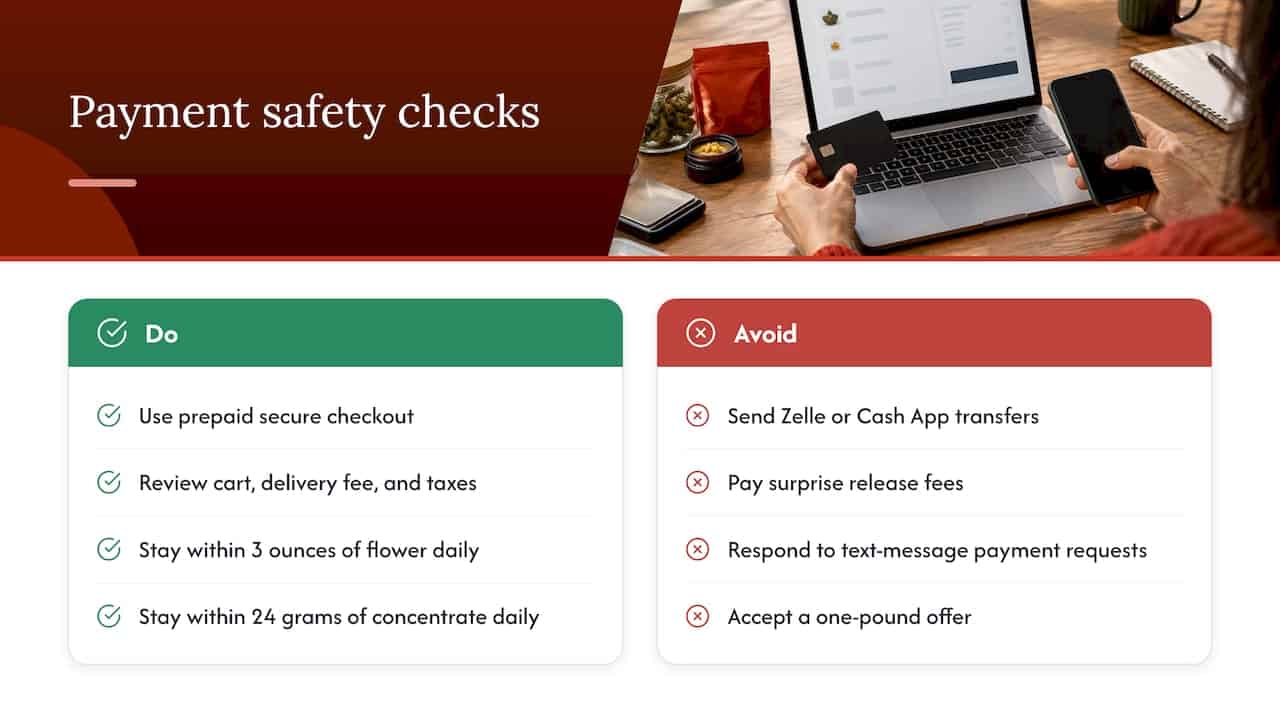
A real checkout page looks boring. It shows your cart, the delivery fee, any taxes, and a standard payment step on a secure page. To see what a clean one looks like, read how to verify a secure cannabis checkout in under a minute.
Check 3: Expect real ID checks
If a site lets you tick a box that says “I am 21” and nothing else, it is not following the law. New Jersey regulators advise that legitimate dispensaries require valid government-issued photo ID to verify age, and that shady operators tend to skip it or use checks that are easy to bypass. The same logic applies in New York: adults 21 and over only, verified.
What a good process looks like for an NYC delivery:
- Age confirmation when you set up the order, not just a pop-up.
- A government photo ID shown at the door, with a name that matches the order.
- A person who can hand off the order to you, the adult, and not to whoever opens the door.
This is also why a refused delivery is not a bug. If the name on the order and the ID do not match, a compliant courier will not hand the package over. We lay out the steps in two-step age verification for NYC and the four ID checks that prevent a refused order. Seeing a seller insist on these steps is a good sign, not an annoyance.
Check 4: Look for the contact details of a real business
Experts quoted in consumer-protection coverage point to too-good-to-be-true deals and generic contact information as major red flags. Real retailers say where they are, when they operate, and what laws they follow. Illicit sites tend to hide behind VoIP numbers and generic email addresses.
A quick audit takes two minutes:
| Signal | Likely real | Likely fake |
|---|---|---|
| Business name and address | Stated, matches the license list | Missing, or a mismatch |
| Hours and delivery windows | Specific, with cutoffs | “24/7 instant,” no detail |
| Contact | Working phone, a business email on its own domain | Only a chat widget, a free email address, or a messaging app |
| Pricing | In line with the market, fees shown up front | Far under market, fees that appear later |
| Payment | Standard checkout | Wallet app, gift cards, crypto |
| ID | Photo ID at the door | “Just click 21+” |
| Lab results | CoA via QR or link | “Lab tested” with nothing to open |
Two more habits help. Search the exact business name plus the word “scam,” and look at when the domain appeared. A site that claims to have served the city for years, but whose domain is a few weeks old, is telling you something.
Check 5: Open the lab report
The lab report is your protection against the second kind of fake: the unlicensed seller that does ship something. OCM says regulated products carry a QR code or link to a Certificate of Analysis, and that all cannabis must pass lab testing before sale at licensed dispensaries. The label also carries the New York universal symbol.
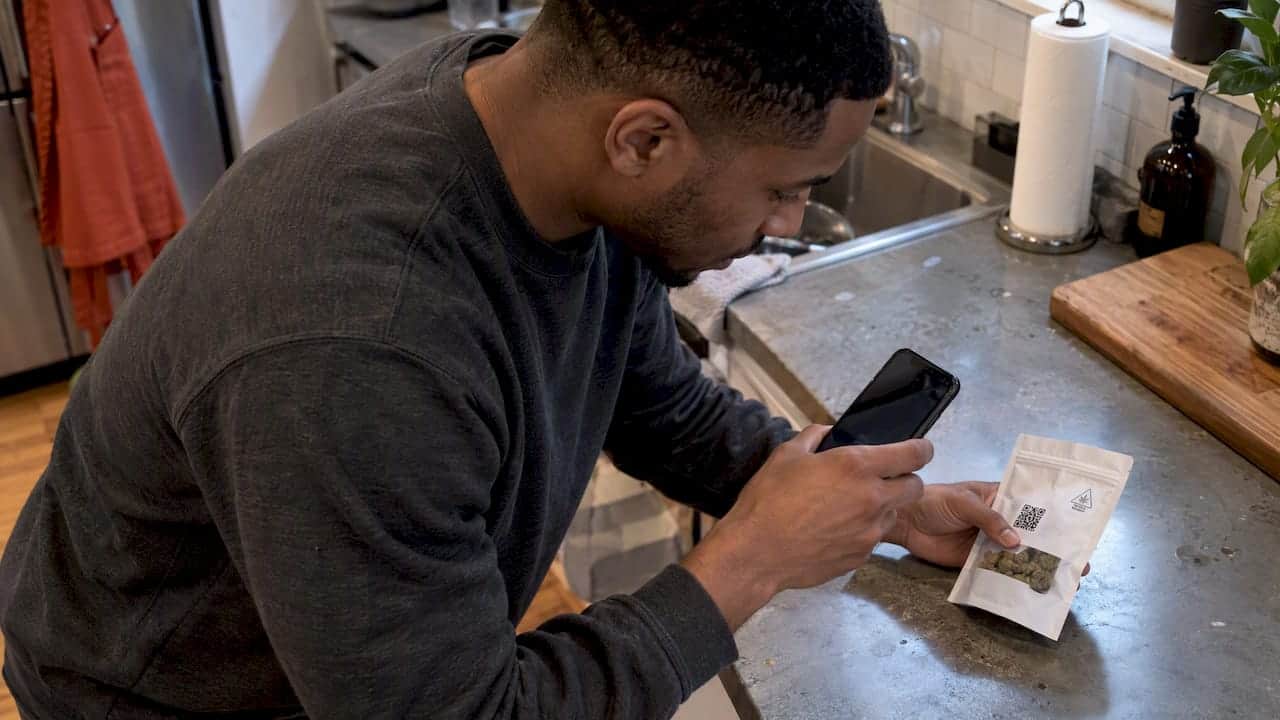
Why it matters is not abstract. A 2026 write-up of a study reported pesticides in 92% of illicit samples, against 6% of licensed products. Illicit vape cartridges are a particular worry. A comment submitted to federal regulators by a cannabis testing lab described Vitamin E acetate and heavy metals such as lead turning up in cartridges from the illicit market.
How to read a CoA in a few minutes:
- Scan the QR code or open the link. It should load a lab report, not a generic image.
- Match the product name and batch or lot number on the report to the one on your package.
- Check the date. An old report on a fresh package is a reason to ask questions.
- Look for the sections: potency (THC and CBD percentages), and contaminant panels such as pesticides, heavy metals, and microbials.
- Compare the potency printed on the label with the report. Small differences happen; large ones do not.
We break the process down further in three quick checks to verify lab results and four label checks every U.S. buyer should do.
Counterfeit vapes and candy lookalikes
Vapes are the most copied category. Fake cartridges borrow the packaging of well-known brands, and the hardware or oil inside is unknown. Check the packaging against what the brand publishes, test the batch code, and be wary of a price that is far below the usual retail price. We keep a comparison of real versus fake Muha Meds 2G disposables as a reference for one popular example.
Edibles carry a different risk. The FDA and FTC have warned companies over copycat food products containing delta-8 THC, noting that products designed to look like familiar snacks can be mistaken for ordinary food, including by children. If a gummy bag looks like a candy brand you know, treat it as a warning, not a bargain. Whatever you buy, store it locked and out of sight.
What to do if you already paid a fake site
Act quickly, and do not send more money.
- Contact your bank or card issuer and report the charge as fraud. Cards offer dispute routes that wallet transfers do not.
- If you used a wallet app, report the transaction to the app. Recovery is unlikely, but the report matters.
- Save the website address, screenshots, emails, texts, and payment receipts.
- File a report with the Better Business Bureau and the Federal Trade Commission.
- Change any password you reused on that site, and watch your accounts for odd charges.
If you gave a copy of your ID to a site you now doubt, keep an eye on your credit reports.
Our perspective: transparency is the whole job
We have been serving adult customers in New York City since 2011, and the fake-site problem is the reason we put verification in plain view. Our ordering flow runs on day and night menus, includes secure age verification, a secure checkout, and delivery tracking. We say that because every one of those steps is something you can test. Ask the questions in this article of us before you order, and ask them of anyone else.
Three habits separate a trusted seller from an impostor. The first is that the seller tells you what it is: where it delivers, when, and what the fee is. Our published fees start from $8 for Queens, and from $12 for Manhattan and the Bronx. The second is that nobody asks you to hurry. The third is that you can check the product itself, from the label to the lab report. We would rather lose an impatient order than fill a doubtful one. If a seller discourages your questions, that is your answer.
— Jake
Ordering from us
If you are 21 or older and in New York City, you can browse our day and night menus at High Fashion Smokes & Prints. We offer same-day delivery of flower, vapes, edibles, pre-rolls, concentrates, THC beverages, CBD products, and accessories. Delivery fees start from $8 in Queens and from $12 in Manhattan and the Bronx. Before you place an order, our five-step checklist for same-day delivery in NYC shows what to have ready. Timing matters too: see delivery times by city to schedule ahead of the evening rush.
A short checklist to keep
Before you pay any cannabis site, run through these questions:
- Is the seller on the official state list of licensed dispensaries?
- Is the payment a standard checkout, with no wallet transfer and no cash?
- Will someone check my government photo ID at the door?
- Does the site show an address, hours, and a way to reach a person?
- Can I open a CoA for the exact batch I am buying?
- Is the price in a believable range?
If any answer is no, close the tab. There is always another order, and there is no refund from a site that disappears.
FAQ
How can I tell if a dispensary website is legitimate?
Start with the license. Use the state’s list of licensed dispensaries from the Office of Cannabis Management to confirm the business name. Then check for a standard checkout, a stated address and hours, ID verification, and lab reports for products. A site that fails any one of these is not worth the risk.
Is it safe to buy edibles online?
It can be, if the seller is verified and the product carries a CoA and the state’s universal symbol. Be cautious with products that copy candy or snack packaging, since the FDA and FTC have warned that they can be mistaken for ordinary food. Start with a low dose, and see our guide to dosing edibles safely.
Do dispensaries keep track of purchases?
Dispensaries collect some data at the point of sale. According to one privacy overview, freestanding dispensaries generally fall outside HIPAA, and recreational purchases typically do not create state-held records the way medical programs do. Ask any seller for its privacy policy, and if you have a specific legal concern, speak with an attorney.
Are dispensary vape carts stronger than regular carts?
Potency varies by product and by the oil inside, so the CoA is the only reliable guide. Concentrate-based carts often list higher THC percentages than flower. Read the number on the report for your batch, and see live resin versus distillate for how the oils differ.
What if the site asks me to pay an extra fee after I order?
Treat it as a scam. The BBB has flagged requests for insurance or membership fees, supposedly refunded on delivery, as a typical scam tactic. Stop paying, contact your bank, and save your records.
Sources
- Consumers | Office of Cannabis Management
- Marijuana dispensary scams reportedly on the rise (CBS Austin)
- BBB alerts of marijuana dispensaries scam (NBC 7 San Diego)
- Legit vs. Shady: How to spot a legal cannabis dispensary in New Jersey
- Study finds pesticides in more than 90% of illicit cannabis samples
- CannaSafe vape report, FDA comment (regulations.gov)
- FDA and FTC warn six companies over copycat food products
- Medical Marijuana Privacy and HIPAA Considerations