Read our Google Birdeye Reviews
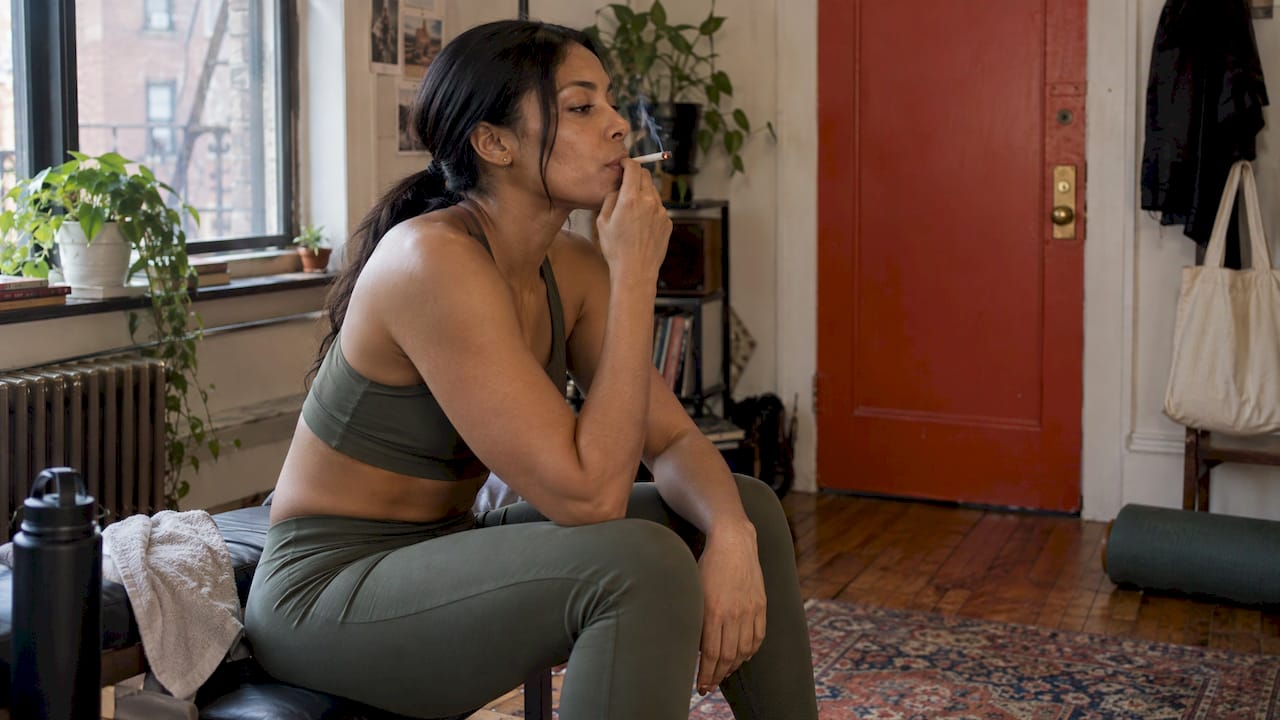
Using weed after a workout is common among people who train regularly, and doing it well comes down to four things: waiting until the session is completely finished, choosing the cannabinoid and format that fit what you want from the evening, keeping the dose modest, and buying products you can trust. We are a New York City dispensary that delivers lab-tested flower, vapes, edibles, concentrates, THC beverages and CBD, so the end of your workout and the start of your wind-down can happen at home. This guide covers what research and exercisers report, how to time it, and how to pick a product.
TL;DR
- Regular exercisers often turn to cannabis after training for relaxation and sleep. In a survey of 111 active users, 93% said CBD helped their recovery and 87% said the same of THC.
- Use it after the session is over, never before or during heavy lifting, running, climbing or anything that needs coordination. THC changes balance, reaction time and heart rate.
- CBD and THC feel different. CBD suits people who want to stay clear-headed, while THC is the choice for deep relaxation at the end of the day.
- Start low, go slow, and buy lab-tested products so you know what is in each dose.
- If you are drug tested or compete in a tested sport, check the rules first.
Table of Contents
- Why gym-goers reach for cannabis after training
- What the research says about THC and muscle recovery
- THC or CBD after the gym?
- Timing: after the session, not during it
- Picking a format that fits your routine
- Why tested products matter more for active people
- If you are tested or compete
- Get it delivered after you train
- Our perspective
- FAQ
- Sources
Why gym-goers reach for cannabis after training
The pattern is easy to understand. A hard session leaves you wired, sore and often too alert to sleep. Cannabis, for many adults, is the way they switch off.
A 2023 survey in the Journal of Cannabis Research asked 111 regularly exercising cannabis users in the United States about their habits. The average age was 31. Some of the results:
- 93% felt CBD assisted their exercise recovery, and 87% felt the same about THC.
- 61% used THC after aerobic exercise, and 60% used it after resistance training, specifically for recovery.
- For CBD, the top motives were sleep and relaxation, both rated 3.89 out of 5. For THC, relaxation came out on top at 4.40 out of 5.
Those are self-reports, and the authors say more data are needed to understand cannabis’s role in recovery. Still, they describe how people actually use it: not as a pre-lift booster, but as a way to unwind, relax tense muscles and fall asleep.
A 2024 position statement from the Association of Ringside Physicians adds that marijuana has been shown to modulate acute and chronic pain in different populations, and that pain-perception effects are supported slightly better than effects on sleep and stress.
What the research says about THC and muscle recovery
Scientists are still catching up with how people really train and recover. A few findings are useful for setting expectations.
Regular users recovered normally in one small study. A pilot study compared 12 chronic cannabis users with 14 non-users after exercise designed to damage muscle. It found no group differences in muscle damage markers or soreness, so cannabis use did not get in the way of short-term recovery. The users also had greater isometric quadriceps strength right after exercise and at 72 hours.
The athlete-specific evidence is early. A 2020 clinical review in sports medicine found that none of the cannabinoid pain trials it examined included athletes, so recommendations have to be extrapolated from other populations. A 2019 systematic review of 37 studies noted that the reported benefits for athletes come mainly from self-reports. In practice, that means your own experience, kept careful and consistent, is the best guide.
CBD research is young. A 2024 systematic review of CBD and exercise screened 901 publications and included seven studies. It reported a beneficial effect on measures such as VO2 and mean power. Blood markers like creatine kinase were higher in CBD groups, which the authors attributed to those participants training harder, not to more damage. Topical CBD has been studied too: a 2025 pilot of about 100 mg of CBD cream in 28 people looked at soreness and strength after a lower-body fatigue protocol, and a 2026 gel study tested application after drop jumps. Both were small pilots, and researchers say dose and design matter a lot.
Sleep is the recovery lever most people mention. Sleep is where muscle repair happens for most of us, and it is the reason people most often give for post-workout use. A 2021 review of cannabis and athletic performance reports that 160 mg of CBD increased sleep duration in people with sleep difficulties, based on subjective reports. We cover this in more depth in our guide on how cannabis affects sleep quality and our look at CBN for sleep.
THC or CBD after the gym?
The choice depends on how you want the evening to go.
| What you want | Common pick | Why people choose it |
|---|---|---|
| Relax and stay clear-headed | CBD | No intoxicating high, so work or family tasks stay on the table |
| Wind down fully, switch off | THC | Survey respondents rated relaxation as their top reason for THC |
| Better sleep after a late session | Evening THC or CBD products | Sleep was the top reason survey respondents gave for CBD |
| Targeted soothing on tired muscles | Topical balm | Applied where you train hardest, with no inhaling |
Our breakdown of THC vs CBD goes through the differences in effects and safety if you are new to either one.
If you are curious about milder, more functional cannabinoids, our write-up of what the human research shows on THCV is worth a few minutes.
Timing: after the session, not during it
The main rule for weed and exercise is about order. Finish the workout, cool down, rehydrate, and only then consume.
The reason is physical. THC can alter coordination, balance and reaction time, and it can raise your heart rate. A 2023 umbrella review of cannabis in healthy athletes found that studies linked cannabis with strength impairments and with reduced exercise duration and work capacity. Because THC raises heart rate by itself, your sense of how hard you are working becomes unreliable. A 2021 review points out that this heart-rate effect confounds submaximal work tests.
The practical version for a safe evening:
- Finish all training first. That includes the cool-down, the stretching and any commute by bike or car.
- Do not drive or ride. If you are heading home on a bike or scooter after training, get home before you consume.
- Skip heavy free weights, climbing, swimming alone and contact sports while under the influence. Those need full coordination and judgment.
- Eat and drink first. A post-workout meal and water make for a more comfortable experience.
- Start with a small dose. Wait before taking more, especially with edibles, which take longer to kick in than inhaled products. If you plan to cook or buy infused oils, a cannabis coconut oil dosing guide explains how dose per serving works.
- Mind the timing of caffeine. If your pre-workout or coffee still has you buzzing, read our piece on weed and caffeine first.
People with heart conditions, a history of panic, anxiety or psychosis, or those who are pregnant should speak with their doctor before using cannabis at all. The umbrella review above lists cardiovascular events, panic, paranoia and psychosis among the adverse effects associated with cannabis consumption. Cannabis is for adults 21 and over, and it should be kept away from children and pets.
We have a longer piece on this topic too: cannabis before a workout for adults covers how people use it ahead of training. Our advice for recovery is simple: keep cannabis for after the work is done.
Picking a format that fits your routine
Different formats suit different post-workout moments.
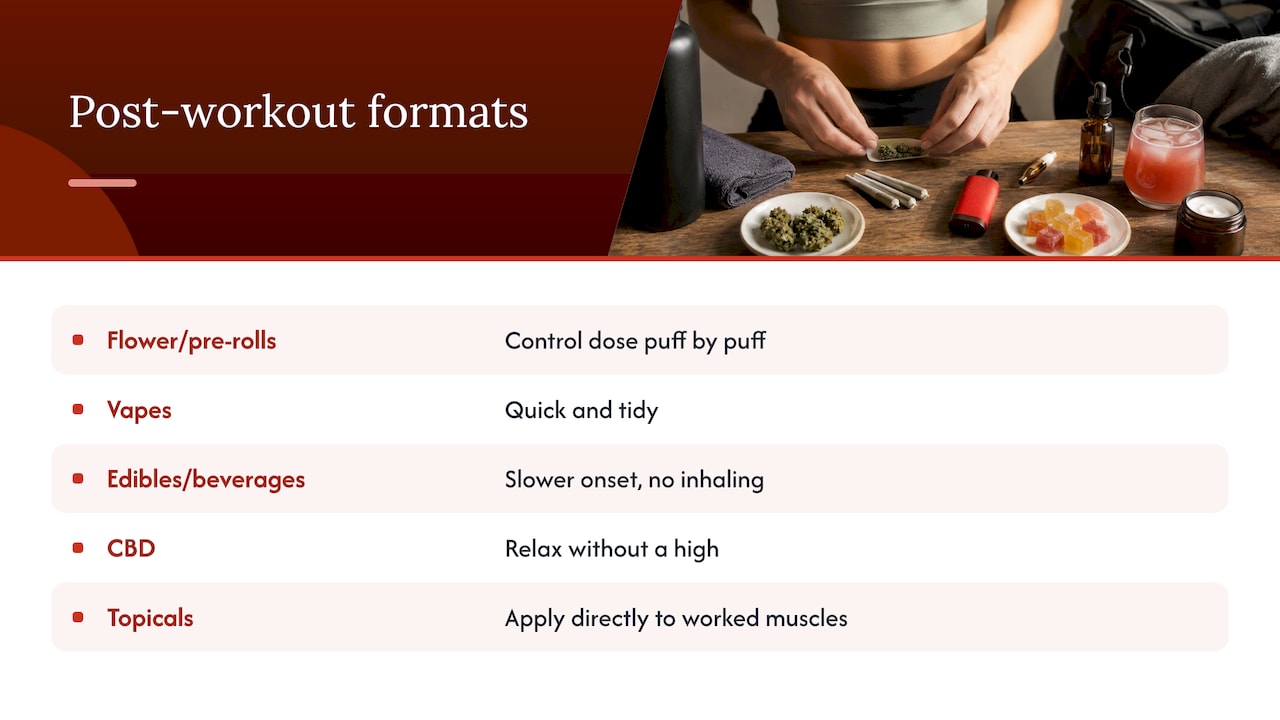
Flower and pre-rolls are the classic wind-down. You control the amount puff by puff, which makes it easy to stop when you feel right. If you are weighing smoking against vaping, our flower vs vapes guide and the vaping vs smoking research summary lay out the trade-offs.
Vapes are quick and tidy, handy when you are showering and getting dinner together after the gym.
Edibles and THC beverages take the inhaling out of it, which some athletes prefer after cardio when their lungs are still working hard. They come on more slowly, so patience matters.
CBD products are the option when you want to relax without a high.
Topicals such as our Body Releaf Balm are applied directly to the muscles you worked, and make a good partner to a stretch routine.
For nights when sleep is the goal, our list of the best indica strains for nighttime in Brooklyn is a place to start browsing.
Why tested products matter more for active people
When you train, you pay attention to what goes into your body: macros, supplements, sleep. Cannabis belongs on that list. The 2020 sports medicine review notes that inconsistent laws and product-purity issues make broad clinical recommendations difficult. That is exactly why the label on your product matters.
We sell lab-tested, verified products, and our positioning is built on honest pricing and transparency. Knowing the potency of what you buy lets you stay on a dose you have chosen on purpose, which is the point of a post-workout routine.
If you are tested or compete
If you are in a tested sport, the rules differ from the rules for a casual gym-goer. Under the 2023 WADA Prohibited List, as summarized in the ringside physicians’ statement, cannabinoids other than cannabidiol are prohibited in-competition only. They are a threshold substance, with a urine threshold of 150 ng/mL. Many employers run their own drug screens as well. If either applies to you, read our guide on how long cannabis stays in your system, and confirm the specific policy with your league, federation or employer.
Get it delivered after you train
The best time to sort out your recovery routine is before you are standing sweaty in a dispensary line. We deliver same-day across New York City, with day and night menus you can browse whenever the workout ends, secure age verification and delivery tracking. You can also schedule delivery for a time you will be home.
Delivery fees are published by borough: from $8 for Queens, and from $12 for Manhattan and The Bronx. Brooklyn has no published fee on our site. Fees are one-off, per order.
Browse the current menu on our site, or see Manhattan weed delivery for that borough. If you want your order waiting after your evening class, our guides to delivery times by city and scheduled delivery for NYC apartments show how to plan around evening peaks.
Our perspective
Most people who write to us about training and cannabis want the same thing: a clean way to come down at the end of a hard day. They are not looking for a shortcut in the gym. They are looking for an evening that lets their body settle.
That is how we think about it, too. Do the work first. Then choose the product that matches the night you want: CBD when you need to stay sharp, THC when you want to switch off, a balm when it is your legs that are talking.
What makes that routine work is knowing what you are getting. We have served New York since 2011, and we built our menu around tested, verified brands and fair pricing because a recovery routine only works when it is repeatable. Same-day delivery and day and night menus are there so the product shows up when you do, without a detour after training.
Pick your format, keep the dose modest, and keep it for after the session.
Jake
FAQ
Does smoking weed ruin gym gains?
The research in healthy athletes does not show it building muscle, and a 2023 review links cannabis with reduced exercise duration and work capacity when it is used before training. That is why we suggest using it after you finish, not before. One small pilot found regular users recovered from muscle-damaging exercise at about the same rate as non-users.
Can I go to the gym and smoke weed?
Keep the order straight: train first, consume after. THC alters coordination, balance and reaction time, so heavy lifting, climbing, swimming alone and contact sports are better left for when you are sober. Our guide to cannabis before a workout explains how adults approach it.
How long after smoking can I work out?
There is no single verified number, because it depends on dose, format, tolerance and the kind of training. A sound rule is to wait until you feel completely clear, and to save high-skill or high-load sessions for a day when you have not used cannabis. Edibles last longer than inhaled products, so plan around that.
Is CBD or THC better for muscle recovery?
In the survey of 111 exercisers, people leaned on CBD for sleep and relaxation and on THC mainly for relaxation. CBD keeps you clear-headed, and THC delivers a fuller wind-down. Our THC vs CBD guide helps you decide which fits your evening.
Will it show up on a drug test?
It can. Tested sports treat THC as a threshold substance in-competition under the WADA list, and employers set their own policies. Read our piece on how long cannabis takes to leave your system and check your own rules.
Sources
- Cannabis use for exercise recovery in trained individuals (Journal of Cannabis Research, 2023)
- Chronic co-use of cannabis and tobacco on short-term recovery from eccentric exercise-induced muscle damage
- The Effect of Cannabidiol on Performance and Post-Load Recovery (Nutrients, 2024)
- Topical Cannabidiol Application and muscle soreness (pilot study, 2025)
- Topical application of cannabidiol for muscle recovery (Journal of Cannabis Research, 2026)
- Cannabis and Athletic Performance (2021 review)
- Understanding Cannabis-Based Therapeutics in Sports Medicine (2020)
- Cannabis Use and Sport: A Systematic Review
- Performance-Enhancing Drugs in Healthy Athletes: An Umbrella Review
- Cannabis in combat sports: position statement of the Association of Ringside Physicians (2024)