Read our Google Birdeye Reviews

Microbial testing is a lab screen that checks cannabis flower, vapes, edibles and concentrates for bacteria, yeast, mold and related organisms that could affect quality or safety. It is described as quality control for both raw materials and finished products, and it is the part of a certificate of analysis (COA) most shoppers skip. This guide explains what the lab looks for, how samples are collected, why limits differ from state to state, and how to read the microbial section before you order.
TL;DR
- Microbial tests look for bacteria, yeast and mold. Some labs go further and test for specific pathogens such as Salmonella and certain Aspergillus species.
- A PASS on a COA means the product met the allowable limits for that test category. It does not mean zero microbes were found.
- Limits are set by each jurisdiction, so the same number can pass in one market and fail in another.
- Some categories are report-only: the lab publishes a number, but there is no pass/fail line.
- Before you order, open the full COA, match the batch number to the label and read the microbial lines, not just the THC percentage.
Table of Contents
- What microbial testing actually checks
- The organisms labs look for
- How samples are collected
- How the lab runs the test
- Limits differ by market
- What PASS means on a COA
- How to read a COA before you order
- Where tested products fit in your order
- Our perspective
- Order tested products for NYC delivery
- FAQ
- Sources
What microbial testing actually checks
Cannabis is a plant, and plants carry microbes. Contamination can happen during growing, drying, curing, processing, storage and handling, which is why testing is applied from raw material to finished product. Research on total yeast and mold links the levels found to the plant’s genotype, the growing environment and pre- and post-harvest handling.
The main reason for the test is consumer safety. Some contaminants can cause illness, and people with weakened immune systems are the group of greatest concern. A professional review of testing methods names aspergillosis, a lung infection linked to inhaling Aspergillus spores, as one of the risks behind the rule.
If you have a compromised immune system, talk to your doctor before using any cannabis product, including tested ones, especially anything you inhale.
The organisms labs look for
Testing programs usually sort the plausible hazards into a few groups.
| Category | What it covers | Why it matters |
|---|---|---|
| Total aerobic bacteria | A broad count of bacteria that grow in air | An indicator of overall hygiene, not of any one pathogen |
| Total yeast and mold | A broad count of fungi | An indicator of how the plant was dried, cured and stored |
| Salmonella and STEC | Specific pathogenic bacteria | Illness-causing organisms, typically required to be not detected in a 1 g sample |
| Aspergillus species | Specific molds such as A. flavus, A. fumigatus, A. niger and A. terreus | Can cause invasive lung disease in susceptible people |
| Coliforms and Listeria | Extra checks on some ingestible products | Relevant to edibles and other products you swallow |
An Arizona health department advisory on microbiological safety testing frames the risks by biological plausibility. It calls out pathogenic bacteria, with Salmonella as the organism of concern among bacteria that survive low water activity, and fungal spores that resist heat and can cause invasive lung disease in susceptible people. Illinois describes its own testing the same way, as screening for harmful bacteria, yeast and mold.
Why total counts are not the whole story
A total count cannot tell a harmless microbe from a harmful one. That is why the professional review above argues for species-specific tests aimed at known human pathogens like Salmonella and the pathogenic Aspergillus group, alongside the indicator counts. When you read a COA, a pathogen line that says “not detected” tells you something different from a total count in colony forming units.
How samples are collected
A test is only as good as the sample. Regulators spell this out in detail because a sample that does not represent the batch produces numbers that mean nothing.
Maryland’s technical authority for cannabis testing requires statistically valid sampling, aseptic collection for antimicrobial testing and, for usable cannabis, at least 0.5% of the batch mass. Increments come from the upper, middle and lower sections of the batch, and the upper sample is taken from at least 10 cm depth. The stated goal is proper collection, labeling, preservation, transport and storage by trained personnel.
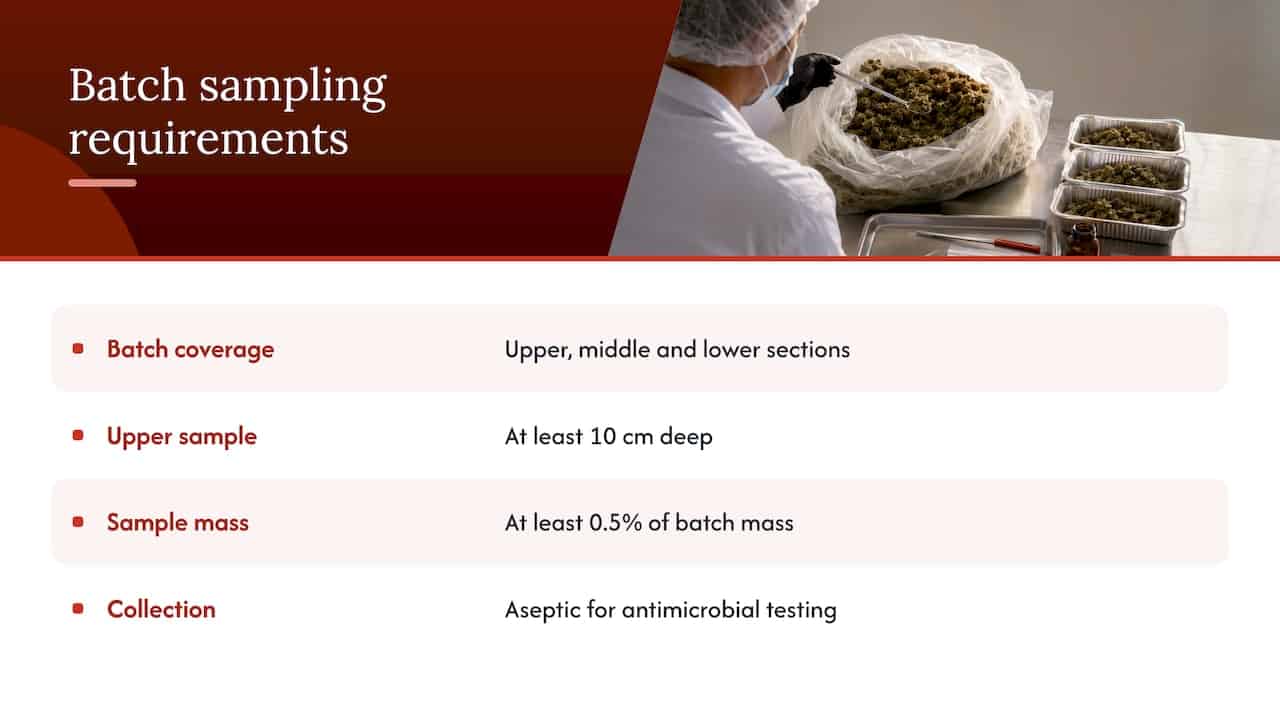
New Jersey’s testing guidance goes the same direction: a testing laboratory employee collects representative samples from each batch using a statistically valid method, including stratified random sampling, with sterile equipment and aseptic technique so the sampling itself does not add contaminants.
For you as a buyer, the takeaway is simple. Lab-collected, batch-level sampling is the standard that serious programs set, and it is why the batch number on your package matters.
How the lab runs the test
Most commercial labs use one or both of two approaches.
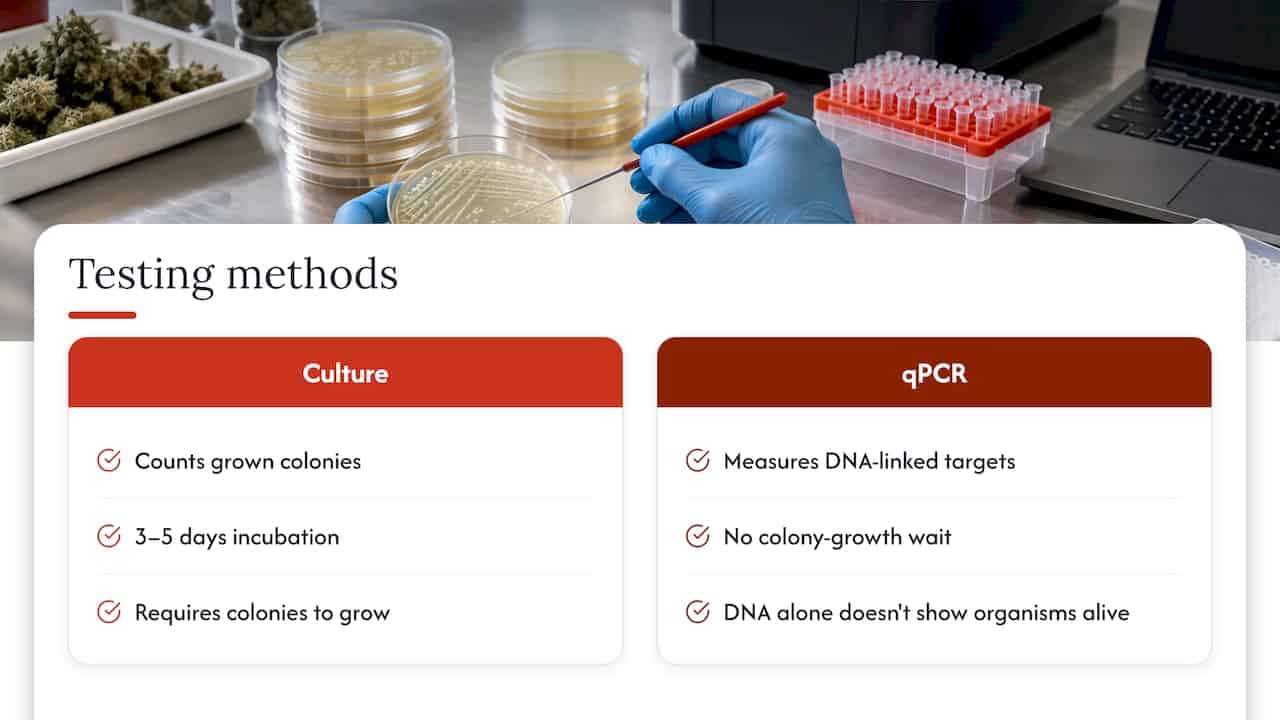
Culture-based methods. A prepared portion of the sample is plated on selective media, incubated, and colonies are counted. A 2023 peer-reviewed review notes that certified commercial labs typically homogenize and plate the sample, then count colonies after 3 to 5 days of incubation. One professional guide lists 3M Petrifilm as a common culture-based format.
Molecular methods. qPCR extracts DNA from the sample and measures targets linked to particular contaminants, without waiting for colonies to grow. Endotext points out the trade-off: qPCR detects genetic material, so by itself it does not show that an organism is alive or capable of harm. That is why many programs keep culture or viability checks in the mix rather than treating qPCR as a universal replacement.
Confirmation and controls
Good labs do not rely on a single presumptive result. Colorado’s reference library says all microbiological methods must include applicable controls and that qualitative pathogen methods must confirm presumptive positives with a proper confirmation step. A state rule adopted in 2020 adds that COAs reporting a failure must show the failed analyte and its concentration, and that microbial failures are confirmed by reanalysis using an equal-sized portion of stored sample.
Limits differ by market
There is no single global microbial limit for cannabis. Here is how a few markets set theirs.
| Market | Example limits | Source |
|---|---|---|
| New Jersey (usable cannabis) | 100,000 CFU/g for total aerobic bacteria and for total yeast and mold; Salmonella and STEC none detected in 1 g; pathogenic Aspergillus none detected in 1 g | NJ-CRC guidance |
| New Jersey (ingestible products) | Adds total coliforms at 1,000 CFU/g and Listeria monocytogenes none detected in 1 g | NJ-CRC guidance |
| Canada | Total yeast and mold at 50,000 CFU/g | Frontiers, 2023 |
| Netherlands (flower, Ph. Eur. spec) | 10 CFU/g for both total counts; absence in 1 g of Staphylococcus aureus, Pseudomonas aeruginosa and bile-tolerant gram-negative bacteria | Dutch cannabis bureau spec sheet |
The spread is wide. A peer-reviewed review reports that total yeast and mold action levels range from 10,000 to 100,000 CFU/g depending on jurisdiction, and the authors note that biological variability and method choices both feed into the differences in what counts as acceptable risk. Europe has also moved toward a common standard: a new flower monograph (3028) took effect on 1 July 2024.
The point for a New York buyer: a number from a COA issued under another state’s rules cannot be compared directly with New York’s limits. Always read a result against the rules of the market it was made for.
What PASS means on a COA
The most common misreading is that PASS equals clean. OpenCOA’s explainer says a PASS in New York means the product met the state’s allowable limits for that test category, not that no contaminants were detected. It also notes that some categories are report-only: total yeast and mold and total aerobic bacteria must be tested and reported, but have no defined pass/fail threshold. In the same explainer, extracted products have a microbial limit of 1,000 CFU/g, and mycotoxins and pesticides have defined thresholds.
That has three practical consequences:
- A PASS is tied to a category. Check which category the product was tested under (flower, extract, edible).
- Report-only numbers still carry information. A lower total count on comparable products usually points to cleaner handling, though the plant, season and method all influence the figure.
- A failure should be specific. If a COA reports a failure, it should name the analyte and the concentration.
How to read a COA before you order
You do not need a lab background. Run through this list on any product page or QR code.
- Match the batch. The batch or lot number on the COA should match your package or listing. Our guide to verifying cannabis lab results shows three quick checks, including how to spot lab-to-lab variability.
- Find the microbial panel. Look for total yeast and mold, total aerobic bacteria and any pathogen lines (Salmonella, STEC, Aspergillus).
- Read units and limits. Results are in CFU/g. “ND” or “not detected” is different from a number.
- Check the category. Flower, concentrate and edible are judged against different limits.
- Confirm the lab and date. A recent test from a licensed lab is what you want to see.
- Read the label too. Our walkthrough of four label checks for U.S. buyers covers what the package should show alongside the COA.
Storage matters after the test
A clean result at the lab does not protect flower from moisture at home. Mold needs water, so how you keep your product affects it after purchase. See how to store cannabis flower so it stays fresh.
Where tested products fit in your order
Microbial limits matter most where the product is inhaled or swallowed. For flower, vapes and pre-rolls, you are inhaling, which is the exposure route behind the fungal spore concern. If you are choosing between formats, our comparison of flower vs vapes helps you weigh the options. For edibles, ingestible-product limits such as coliforms and Listeria apply in some markets, so the COA for a gummy or cookie has its own checklist. You can browse, for example, cannabis-infused gummies made with live resin or CBD edibles.
Our perspective
We have served New York City adults since 2011, and the question we hear most is not “how strong is it?” It is “how do I know it is clean?” That is the right question.
Our approach is built on tested and verified products and on transparency about what you are buying. We want you to look at the COA, not just trust a label, and we publish guides on lab results and labels so you can do exactly that. A buyer who knows that PASS means “within the limits for this category” is a buyer who can compare products on facts.
Delivery shouldn’t change how careful you are. Whether you order from our day menu or our night menu, the same habit applies: match the batch, read the microbial lines, and store the product properly once it arrives. We are here to make that easy, with discreet, professional delivery and fair pricing.
Jake
Order tested products for NYC delivery
If you are ready to put this into practice, we deliver flower, vapes, edibles, pre-rolls, concentrates, THC beverages and CBD across New York City, with age verification, day and night menus and delivery tracking. Delivery fees start from $8 for Queens and from $12 for Manhattan and the Bronx. Browse the menu and order same-day delivery and check the batch details on the products you pick.

Not sure about timing? Our guide to delivery times by city explains how to schedule before the evening peak.
FAQ
Does a PASS mean there were no microbes in the product?
No. In New York, a PASS means the product met the allowable limits for that test category. Microbes can be present below the limit, and some categories are report-only with no pass/fail line.
What is the difference between total yeast and mold and a pathogen test?
Total yeast and mold is a broad count that cannot separate harmless from harmful organisms. Pathogen tests target named organisms such as Salmonella or pathogenic Aspergillus. Programs often use both, because total counts alone cannot identify the harmful ones.
Why do limits differ between states and countries?
Each jurisdiction sets its own action levels. Total yeast and mold limits range from 10,000 to 100,000 CFU/g across markets, and the Netherlands applies a much tighter 10 CFU/g standard to flower. So compare a result only with the rules of the market it was tested under.
Is qPCR better than culture testing?
It is faster and highly specific, but it detects DNA rather than proving an organism is alive or harmful. Endotext cautions against treating it as a universal replacement for culture-based or viability tests.
Who should be most careful about microbial contamination?
People with weakened immune systems face the highest risk from fungal spores, particularly when inhaled. If that applies to you, speak with your doctor before using cannabis in any form.
Sources
- Essential Guide to Cannabis Microbial Testing
- Microbial Testing for Cannabis: Current Perspectives
- Total yeast and mold levels in high-THC cannabis (Frontiers, 2023)
- Microbiological Safety Testing of Cannabis (Arizona DHS)
- Types of Testing (Illinois Cannabis)
- Maryland Technical Authority for Cannabis Testing
- NJ-CRC Testing Guidance, February 2025
- Colorado Cannabis Reference Library: microbial pathogens
- Sample testing rule 64ER20-39
- Endotext: DNA-based testing and microbial identification
- OpenCOA FAQ
- Fungal and mycotoxin contaminants in cannabis and hemp (PMC)
- Ph. Eur. cannabis flower specification sheet
- Tests in the New Ph. Eur. Monograph on Cannabis Flower