Read our Google Birdeye Reviews
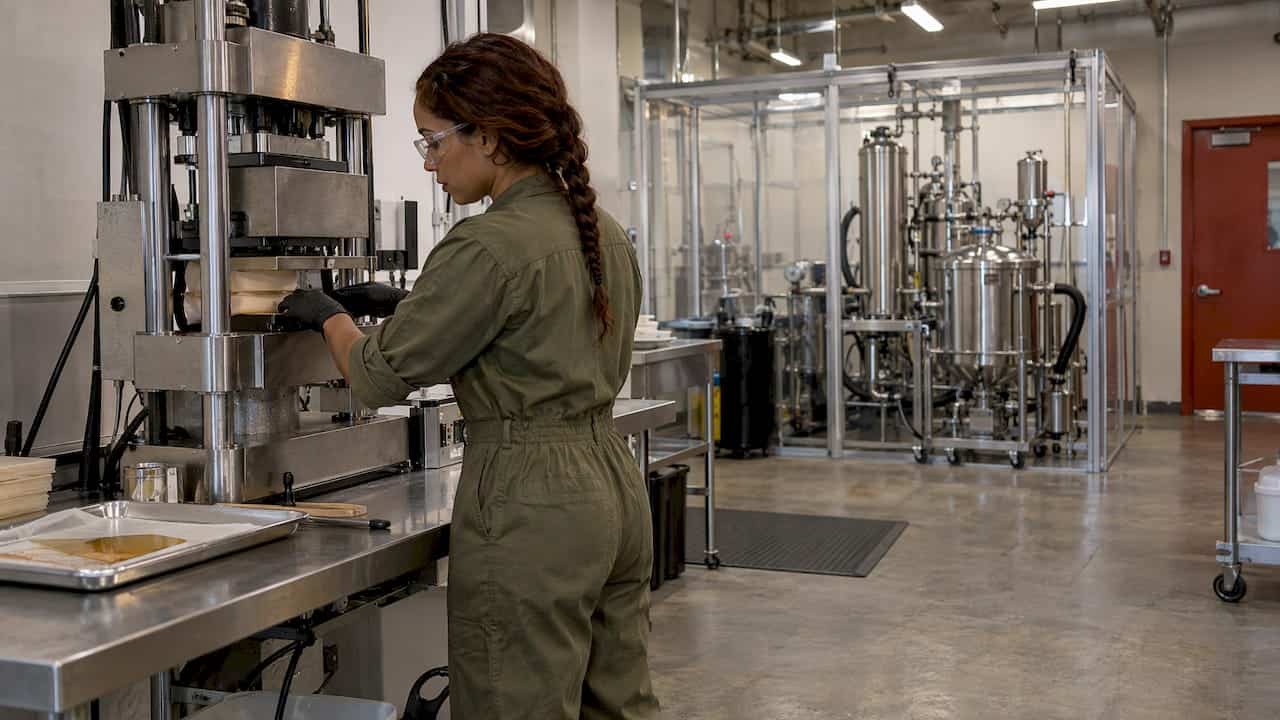
Solventless extracts are separated from the plant with physical force: heat, pressure, ice water or sieving. Solvent-based extracts use a chemical solvent such as butane, ethanol or CO2, which is then removed. Neither is automatically “better.” Solventless is usually chosen for flavor and a plant-like terpene profile. Solvent-based is usually chosen for consistency, range of formats and price. Below is how to pick between them, what testing does and does not tell you, and how full spectrum, broad spectrum and isolate fit in.
TL;DR
- Solventless (rosin, bubble hash, dry-sift) is made with heat, pressure, water or sieving. Solvent-based (butane, ethanol, CO2 extracts) dissolves the plant material into a solution that is purged afterward.
- Solventless tends to be chosen for flavor. Solvent-based tends to be easier to scale and standardize, which is why it fills most vape carts and many edibles.
- “Solventless” does not mean “untested.” Both types still need lab results for contaminants, and the residual-solvent rules differ by state.
- Full spectrum keeps the plant’s wider cannabinoid and terpene mix, broad spectrum removes THC, and isolate is a single purified compound.
- Read the label and the certificate of analysis (COA), then match the product to how you consume it.
Table of Contents
- What solventless and solvent-based actually mean
- How they compare side by side
- Flavor and effect: what to expect
- Safety and testing: what a clean label really tells you
- Full spectrum vs. broad spectrum vs. isolate
- Which one fits you
- Perspective
- Order tested concentrates in NYC
- FAQ
- Sources
What solventless and solvent-based actually mean
The split is about the method, not the final product. In a solvent-based process, a solvent pulls cannabinoids from the plant, and the mixture is later purged to remove the solvent. Solventless methods rely on physical separation instead. Leafly’s glossary gives rosin and bubble hash as the standard solventless examples and butane, ethanol and CO2 as common solvents.
A peer-reviewed review of extraction methods lists ethanol, butane, propane and carbon dioxide among solvent-based options, and dry sieving, water extraction and rosin pressing among solventless ones. It also notes that solvent extraction is the most common method for cannabis, and that pressurizing flammable gases brings real safety hazards in the lab. That last point is why solvent-based extraction belongs in licensed, compliant facilities and never in a kitchen.
The solventless family
- Rosin: heat and pressure squeeze resin out of flower, hash or fresh-frozen material.
- Bubble hash (ice water hash): cold water and agitation knock trichomes off the plant, and screens of different sizes collect them.
- Dry-sift: trichomes are sieved off dried plant material without water.
You may see “live rosin.” That describes the starting material (fresh-frozen plant), and when it is pressed without a solvent it sits in the solventless family. You can browse live rosin and cured hash rosin in our concentrates lineup, and our guide to hash rosin walks through how it is made.
The solvent-based family
- Hydrocarbon extracts (butane, propane): shatter, wax, badder, sauce, live resin and similar textures.
- Ethanol extracts: common as a base for tinctures and many edibles.
- CO2 extracts: CO2 acts as a solvent under pressure. One processor quoted by a cannabis trade outlet describes it as the “solventless solvent” because no CO2 remains once the extract leaves the equipment. Even so, the industry classes it as solvent-based, so you will see it on the solvent side of most menus.
Solventless vs. solvent-free
The terms get mixed up. “Solventless” means no chemical solvent was used in the process. Labels like “solvent-free” often describe a solvent-based product that was purged until little or no solvent remains. They point to the end result, not the method. If the method matters to you, look for the word “solventless” and ask for the COA.
How they compare side by side
| Factor | Solventless | Solvent-based |
|---|---|---|
| How it is made | Heat, pressure, water or sieving | Chemical solvent dissolves the plant, then is purged |
| Typical products | Rosin, bubble hash, dry-sift, rosin-infused pre-rolls | Shatter, wax, live resin, sauce, distillate, many carts and edibles |
| Flavor | Often closer to the source flower | Can be excellent, varies with process and starting material |
| Yield and scale | Lower yield, more labor, harder to scale | Efficient and scalable |
| Consistency | Batch to batch variation is more common | Easier to standardize potency |
| Residual solvent testing | Not relevant in the same way | Required in many states for inhalable concentrates |
| Price | Often higher per gram | Often lower per gram |
The trade-offs in the table follow what extraction-equipment makers and researchers describe. According to Root Sciences, solvent-based extraction is efficient and scalable but needs costly compliant equipment and can affect terpene profiles, while solventless can preserve flavor and terpenes at the cost of lower yields, more labor and difficulty scaling. The same source notes that dry sieving and water extraction offer limited control of potency.
The research base is also thin. The review cited above points out that scientific publications on cannabis extraction are scarce and that solventless methods in particular need more study. So claims about one being “healthier” or “stronger” deserve some skepticism, including from sellers.
Flavor and effect: what to expect
Online discussion among concentrate fans repeats a theme: solventless tends to land closer to the smell and taste of the strain you started with, while solvent-based products can pack a higher potency number or be tuned for a specific profile. That is a preference, not a rule. A well-made hydrocarbon live resin can taste vivid, and a poorly handled rosin can taste flat.
For your own decision, three practical questions help:
- Is flavor the priority? Start with solventless rosin or hash and compare it with a live resin from the same strain.
- Do you want a specific format? Disposable vapes and carts are mostly built on solvent-based oil because it flows consistently through hardware. Solventless options exist, but there is less variety.
- What is your budget? Solventless usually costs more per gram because of lower yields and labor.
Are solventless edibles more potent or solventless vapes healthier?
We found no authoritative source showing that a solventless edible is more potent than another edible, or that a solventless vape is healthier than a solvent-based one. Potency in an edible depends on the dose of THC put into it and your own tolerance, so read the milligrams per piece on the label and start low. Regulators do say that lab testing reduces the risk of consuming pesticides, microbes, heavy metals, toxins and residual solvents. So the safest vape or edible is one that passed testing at a licensed operator, whatever the extraction method.
Safety and testing: what a clean label really tells you
Solventless methods avoid solvent residue by design. That is a real advantage for inhaled products. But solventless concentrates still require testing for pesticides, molds and other contaminants, because contaminants on the starting plant can carry through into the finished product.
Testing rules depend on where the product was made and sold:
- Michigan requires residual-solvent testing for inhalable solvent-based concentrates, with an 800 ppm butane action limit for inhaled products.
- Montana requires potency, mycotoxin, pesticide and heavy-metal tests for both types, residual-solvent testing for solvent-based concentrates, and microbiological testing for non-solvent-based concentrates.
- Minnesota requires concentrates to be tested for contaminants at the point of greatest concentration before they go into other products or are sold in bulk to another manufacturer.
- Maryland states that no health-based residual-solvent limits have been established specifically for cannabis extracts, and that it is uncertain whether the chosen action levels fully protect people who smoke cannabis.
The takeaway: limits vary by state, and the science on inhaled residual solvents is still developing. Leafly’s guidance is to buy from licensed operators so the product has been properly tested.
How to read a COA
- Match the batch or lot number on the package to the one on the certificate.
- Check that a licensed lab issued it and that it covers potency, pesticides, heavy metals and microbials. For solvent-based concentrates, look for a residual-solvent panel too.
- Look at the pass or fail result for each panel, not only the THC percentage.
- If a product has no COA or a mismatched one, skip it.
Full spectrum vs. broad spectrum vs. isolate
These three terms describe what is left in a hemp or cannabis extract, mostly in CBD products. They are a separate question from solventless vs. solvent, since any of the three can be made with or without a solvent.
- Full spectrum keeps the plant’s profile: cannabinoids such as THC, THCa, CBD, CBDa, CBG and CBN, plus terpenes and other compounds.
- Broad spectrum keeps a variety of cannabinoids and terpenes but is processed to remove THC. A published U.S. analysis of CBD products defined it as CBD plus at least one other cannabinoid with no detectable THC.
- Isolate is a single purified compound, in practice CBD. The same analysis defined isolate products as containing more than 95% CBD.
| Full spectrum | Broad spectrum | Isolate | |
|---|---|---|---|
| Cannabinoids | Many, including THC | Several, no detectable THC | CBD only |
| Terpenes | Yes | Yes | No |
| Trace THC | Yes | Not detectable | No |
| “Entourage effect” | Possible | Possible | Not applicable |
The entourage effect is the idea that cannabis compounds work better together. It is a popular theory but the evidence is mixed: some research suggests full-spectrum extracts can work better than other CBD types, while the mechanisms and even the existence of the effect are disputed.
One practical point matters if you are drug tested. Full-spectrum products can contain trace THC, so they carry more risk than isolate. Our article on CBD and military drug tests goes through that in detail. If you need to avoid THC entirely, check the COA for “non-detect” rather than trusting a front-of-pack word.
Which one fits you
Choose solventless if you care most about flavor and aroma, want a minimally processed concentrate, and do not mind paying more per gram. Rosin is the easiest place to start. Rosin-infused pre-rolls are a gentler entry point, like the solventless infused rosin pre-roll pack we carry.
Choose solvent-based if you want a wider range of textures, a very consistent vape, or a lower price per gram. Just confirm the batch passed residual-solvent testing where required.
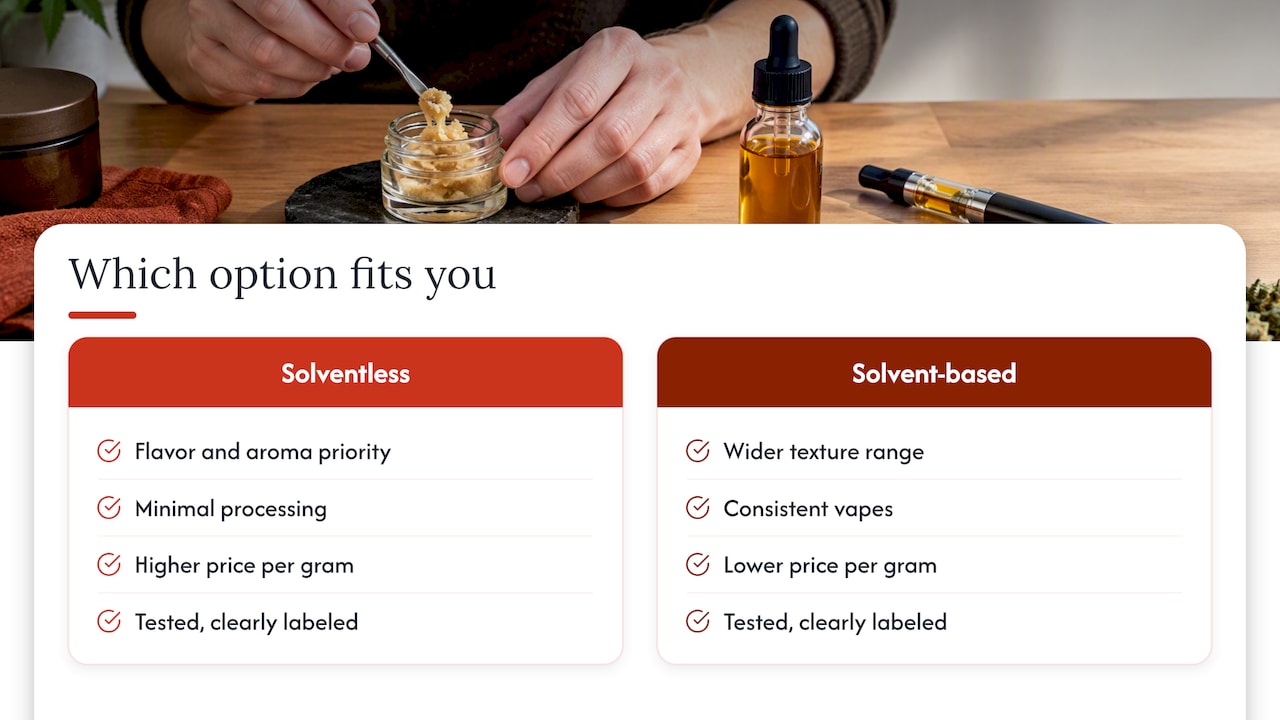
Choose either if the product is tested, labeled clearly and made by a licensed operator. A fresh, well-handled product from a trusted source beats any extraction label.
For new consumers: start with a low dose in whatever format you choose. Concentrates are far more potent than flower, so a small amount goes a long way. If you are comparing formats generally, our piece on flower vs. vapes lays out the differences.
Perspective
We have been serving New York City since 2011, and the question we hear most from customers is not which method is best but which product is honest. Our view is simple. Solventless rosin and hash are what we point people to when flavor comes first, and a clean solventless pen like the solventless live rosin pen is an easy way to try it without a dab rig.
We also carry solvent-based concentrates and vapes, because they serve real needs: consistency, variety and price. Our standard is the same for both. We stock tested and verified brands, we want you to be able to check the label, and we think fair pricing and discreet delivery should come with it.
If you are unsure, tell us what you like to smoke or vape and what you want out of it. Pick one product, learn what you enjoy, then compare.
Jake
Order tested concentrates in NYC
If you are an adult 21 or older in New York City, you can browse our day and night menus for rosin, hash, vapes, pre-rolls, edibles and more, with age verification at checkout and same-day delivery in set windows. Delivery fees are listed from $8 in Queens and from $12 in Manhattan and the Bronx, and you can see the full details on our ordering page. Start with live rosin if flavor is your priority.
New customers can also ask about our first-time customer incentive and referral program when they order.
FAQ
Is solventless better for you?
Not proven. Solventless methods avoid solvent residue, which is a real point in their favor for inhaled products. But published research on extraction methods is limited, and solventless products still need testing for pesticides, molds and other contaminants. A tested product from a licensed operator matters more than the label.
Are solventless vapes healthier than solvent-based vapes?
We found no authoritative source that says so. Solventless vapes avoid residual solvents by design, but regulators stress lab testing for all products to reduce exposure to pesticides, heavy metals and other contaminants. Check the COA for the batch you are buying, and be aware that hardware quality also plays a role.
Are solventless edibles more potent?
Potency in an edible comes from how much THC is infused per piece, not from the method alone. Read the milligrams on the label, start with a low dose and wait before taking more, since edibles take longer to take effect than inhaled products.
What is the difference between broad spectrum and isolate?
Broad spectrum contains CBD plus other cannabinoids and terpenes, with THC removed. Isolate is purified to mostly CBD alone, over 95% in the definition used by one U.S. product analysis. Isolate lacks the other plant compounds that the entourage effect theory relies on.
Is full spectrum better than isolate?
It depends on your goal. Full spectrum keeps the wider plant profile, and some evidence suggests it may work better, though the entourage effect is disputed. Isolate is a better fit if you want to avoid THC, and you should confirm the result on the COA.
Sources
- What is extraction? Cannabis Glossary, Leafly
- Processing and extraction methods of medicinal cannabis (PMC)
- Solvent vs. Solventless Extraction: Pros, Cons, and Key Differences, Root Sciences
- BHO, CO2, Solvent vs Solventless Concentrates, Trichly
- Cannabis extraction debate: solvents versus solventless, MJBizDaily
- Michigan CRA Sampling and Testing Technical Guidance
- Montana CCD Quality Assurance Testing Requirements Appendix
- Maryland Cannabis Administration, Authority for Cannabis Testing
- Minnesota OCM Cannabis Technical Authority
- What are full-spectrum cannabis extracts and how are they made, Leafly
- Product labeling accuracy and contamination analysis of CBD products (PMC)
- What are the different types of CBD, Medical News Today