Read our Google Birdeye Reviews
THCA is the non-intoxicating acidic compound cannabis plants actually produce; it only becomes the intoxicating delta-9 THC you’re thinking of once heat strips away a carboxyl group. Smoke it, vape it, or bake it into an edible and you get high. Eat it raw in a salad or tincture and you mostly don’t. That single mechanism also drives drug-test risk and the messy 2026 legal reclassification reshaping how THCA products get sold.
TL;DR:
- Raw THCA products typically contain high levels of THCA without producing a psychoactive effect unless heated or cooked, which converts it into THC.
- Decarboxylation through heat is required to convert THCA into THC, with combustion and vaping happening instantly, while oven decarboxylation takes 30 to 45 minutes.
- The upcoming 2026 change to total THC calculations will generally reclassify products with high THCA as illegal if their combined THC exceeds legal limits, affecting legality and drug testing results.
- THC effects vary significantly based on consumption method, with inhalation causing quick onset and edibles producing longer, more intense experiences due to different metabolism pathways.
- Laboratory reports must separately list THCA and THC percentages; trusting the COA is essential for accurate dosing and avoiding unexpected intoxication.
Table of Contents
- THCA vs THC: What Is THCA and Why Doesn’t It Get You High?
- THCA vs THC: How Does Delta-9 THC Actually Work in the Body?
- How THCA Turns Into THC: The Chemistry of Decarboxylation
- How Do Effects Compare Across THCA Flower, THC Vapes, and Edibles?
- What Does the Research Actually Show About THCA and THC Benefits?
- Is THCA Legal? How the 2026 Total-THC Rule Changes Things
- How to Store and Use THCA Products Without Losing Control of the Outcome
- Why COAs Matter More Than the Label
- Ready to Buy Lab-Tested THCA and THC Products in NYC?
- Sources
- FAQ
THCA vs THC: What Is THCA and Why Doesn’t It Get You High?
THCA, or tetrahydrocannabinolic acid, is what a living cannabis plant actually manufactures inside its trichomes, the tiny resin glands coating the flower. Delta-9 THC doesn’t exist in the plant in any meaningful quantity until something heats it. That’s the part most people get backward: the “THC” everyone talks about is technically a byproduct of processing, not the plant’s native chemistry.
The reason THCA doesn’t produce a high comes down to one extra piece of molecular baggage: a carboxyl group (-COOH) attached to the molecule. That group changes the compound’s shape just enough that it can’t slot efficiently into CB1 receptors, the brain’s cannabinoid docking sites responsible for the euphoria and altered perception people associate with cannabis. Cenikor’s breakdown of THCA explains this bulky group essentially blocks the fit, so THCA passes through the body without triggering the same psychoactive cascade.
That’s why a handful of raw-THCA products exist specifically for people who want cannabinoid exposure without the high:
- Raw THCA flower kept unheated (rare outside a garnish or topical use, since most flower gets smoked or vaped anyway).
- Raw cannabis tinctures made through cold extraction methods that avoid heat entirely.
- Juiced cannabis leaves or fresh buds, a practice some wellness-focused users adopt for the plant’s raw cannabinoid and terpene content.
None of these routes reliably produce intoxication, but “reliably” is doing real work in that sentence. THCA is chemically unstable, and even gentle heat or prolonged light exposure will slowly convert a portion into delta-9 THC over time. If you’re buying flower labeled as high-THCA, the lab report is the only way to know what you’re actually getting. A certificate of analysis (COA) should list both the THCA percentage and the delta-9 THC percentage separately. If a product’s COA only shows one number, that’s a red flag, not a shortcut.
THCA vs THC: How Does Delta-9 THC Actually Work in the Body?
Delta-9 THC is the molecule responsible for the effects most people associate with cannabis, and it works because its shape fits CB1 receptors cleanly, without the steric interference THCA’s carboxyl group causes. Once THC binds, it triggers the release of dopamine and alters activity across brain regions tied to memory, coordination, and time perception.
The National Institute on Drug Abuse documents the common acute effects clearly: euphoria, relaxation, altered sensory perception, increased appetite, and slowed reaction time. Higher doses can tip into anxiety, paranoia, or short-term memory disruption, particularly in people with lower tolerance or younger users whose brains are still developing.
How you take it changes the ride:
- Inhalation (smoking or vaping) delivers THC to the bloodstream in minutes, peaks fast, and tends to fade within two to four hours.
- Oral consumption (edibles) takes 30 minutes to two hours to kick in because THC has to pass through the digestive system and liver first, but the resulting high often runs six to eight hours.
- Sublingual or tincture use lands somewhere between the two, with faster onset than edibles but a gentler curve than smoking.
The safety concerns here aren’t abstract. The CDC’s public health guidance on marijuana flags impaired driving as a leading real-world risk, since THC slows reaction time and disrupts spatial judgment even when someone feels fine. Mixing THC with alcohol or sedatives amplifies impairment unpredictably, and heavy, frequent use in adolescence has been linked to cognitive effects that researchers are still working to fully map out.
How THCA Turns Into THC: The Chemistry of Decarboxylation
Decarboxylation is the process that converts THCA into delta-9 THC, and it’s simpler than the name suggests: heat knocks off the carboxyl group as carbon dioxide, leaving behind the leaner, CB1-friendly THC molecule. This is the entire reason lighting a joint gets you high while chewing a raw bud does almost nothing.
The conversion isn’t a clean one-to-one swap. Because THCA is a heavier molecule, losing that carboxyl group also sheds mass, so chemists use a conversion factor to estimate how much delta-9 THC a given amount of THCA will actually yield. A flower testing at 20% THCA doesn’t become 20% THC after full decarboxylation. It becomes closer to 17.5%.
Rough conversion timelines by method:
- Combustion (smoking): Near-instant. The flame’s heat, often exceeding 400°F, decarboxylates THCA the moment it burns.
- Vaping: Also close to instant, though efficiency depends on the device hitting the plant material’s ideal temperature range, generally 315 to 350°F for flower vapes.
- Baking/cooking for edibles: Slower and less complete unless done deliberately. Oven decarboxylation at around 240°F for 30 to 45 minutes is the standard home method, and skipping this step is the single most common reason homemade edibles turn out weaker than expected.
- Room-temperature storage: Extremely slow but nonzero. THCA degrades gradually into THC over weeks or months even without intentional heating, which is why old flower tests differently than fresh flower.
Quick math for dosing: A gram of flower testing at 25% THCA contains 250 mg of THCA. Multiply by 0.877 and full decarboxylation yields roughly 219 mg of available delta-9 THC in that gram, assuming complete conversion, which combustion and vaping generally approach but rarely hit at 100%.
That gap between “what’s on the label” and “what actually gets absorbed” is where a lot of dosing mistakes happen, especially for anyone converting a THCA percentage into a mental estimate of how strong an edible or dab will feel.
How Do Effects Compare Across THCA Flower, THC Vapes, and Edibles?
The same THCA percentage on two different labels can produce two completely different highs depending on how you consume it, and that catches a lot of people off guard. Smoking or vaping heated THCA flower delivers a fast, sharp onset, typically within 10 minutes, peaking around 30 minutes, and tapering off over two to three hours. Edibles made from the same flower feel slower to start but hit harder and longer, because the liver metabolizes THC into 11-hydroxy-THC, a compound that crosses the blood-brain barrier more efficiently and produces a more intense, sometimes disorienting effect than inhaled THC alone.
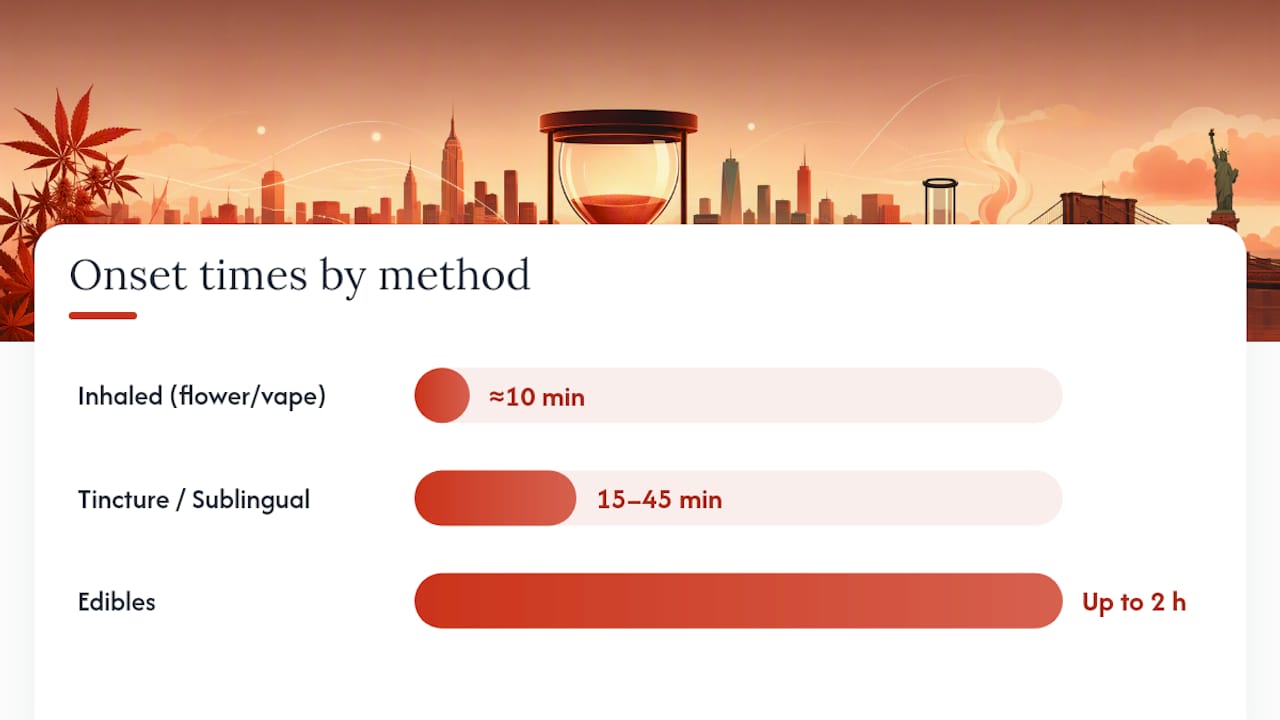
This pharmacokinetic difference is well documented in reviews of cannabis pharmacokinetics, and it’s the biological reason “start low and go slow” isn’t just cautious marketing language. It’s a real dosing safeguard.
A practical breakdown of what to expect:
- Inhaled (flower or vape): Onset in minutes, easier to self-titrate because you feel effects before you’ve consumed too much.
- Edibles: Onset delayed up to two hours, effects often described as more of a body high, and duration can stretch past six hours.
- Tinctures/sublingual: Onset around 15 to 45 minutes, a middle ground between the two extremes.
Terpene content also shifts the subjective experience even when two products list identical THC percentages. A high-myrcene flower can feel sedating while a limonene-heavy strain feels brighter and more energizing, independent of raw potency. If you want to understand why two “20% THC” products feel nothing alike, that terpene profile is usually the answer.
Pro Tip: If you’re trying an edible for the first time, wait a full two hours before considering more, even if you feel nothing at the 45-minute mark. The 11-hydroxy-THC delay is the number one reason people overconsume edibles and end up with a rough night instead of a pleasant one.
A basic safety checklist worth keeping in mind regardless of method: never drive after using THC in any form, avoid combining it with alcohol or sedatives, and recognize early signs of overconsumption as a cue to stop, hydrate, and wait it out.
What Does the Research Actually Show About THCA and THC Benefits?
THC has real clinical backing for a handful of specific uses. THCA does not, at least not yet in humans, and that distinction matters more than most marketing copy lets on.
Delta-9 THC has recognized clinical evidence supporting its use in pain management, chemotherapy-induced nausea, and appetite stimulation, particularly in specific patient populations. The National Center for Complementary and Integrative Health lays out what current evidence actually supports, and it’s narrower than popular claims suggest. THC’s therapeutic profile is real but bounded, effective for specific symptoms in specific populations, not a general-purpose remedy.
THCA’s story is different. Most current knowledge comes from preclinical research, including cell studies and animal models, suggesting potential anti-inflammatory and neuroprotective properties. That’s a meaningfully weaker evidence tier than human clinical trials.
Systematic reviews of cannabis and cannabinoid research consistently note that while THC has documented clinical utility for certain conditions, the broader evidence base, and especially data specific to THCA, remains limited by small sample sizes, short study durations, and a shortage of large randomized controlled trials.
That’s the core finding from NCBI’s systematic review literature on cannabis and cannabinoids, and it’s worth sitting with. Preclinical signals are real starting points, not proof of human benefit.
A few practical distinctions worth keeping straight:
- THC: clinical evidence for pain, nausea/vomiting from chemotherapy, and appetite stimulation.
- THCA: mostly lab and animal-model signals for anti-inflammatory activity, not yet confirmed in human trials at scale.
- Both: still under active research for a wider range of conditions, with results that vary by dose, delivery method, and individual physiology.
None of this replaces a conversation with a healthcare provider, especially for anyone considering cannabis alongside prescribed medication or as a substitute for an existing treatment plan. Self-directed substitution without medical supervision is where most of the real risk lives, not in the compounds themselves.
Is THCA Legal? How the 2026 Total-THC Rule Changes Things
The 2018 Farm Bill legalized hemp federally by defining it as cannabis containing no more than a low concentration of delta-9 THC by dry weight, measuring only that one compound. That narrow wording created what’s often called the THCA loophole: flower could carry sky-high THCA percentages, convert to well over 0.3% THC the moment someone smoked it, and still technically qualify as legal hemp on paper.
That loophole is closing. Regulatory movement toward a “total THC” calculation, which adds delta-9 THC and decarboxylated THCA together rather than counting delta-9 alone, has been building through 2026, and the Congressional Research Service’s analysis of the 2018 Farm Bill walks through exactly how that shift reclassifies products that used to skate under the old 0.3% line. Practically, a lot of “hemp-derived THCA flower” that was legal under the old measurement standard no longer clears the threshold once THCA gets counted toward total THC. Enforcement and exact thresholds still vary by jurisdiction, so anyone buying across state lines needs to check local law rather than assume federal hemp status travels with the product.
Drug testing doesn’t care about any of this nuance anyway. Standard urine tests detect THC-COOH, a metabolite your body produces after THC is processed, regardless of whether that THC came from a dispensary flower, a THCA product you smoked, or an edible. Heat any THCA product and you’ve created the same metabolite a standard THC flower would.
A few things worth knowing before you buy or travel:
- If you’re in a job category subject to drug testing, smoking or vaping any THCA product carries the same detection risk as smoking regular THC flower.
- Crossing state lines with THCA products, even ones marketed as “hemp-legal,” carries real legal exposure depending on the destination state’s total-THC rules.
- Reading a COA before you buy tells you what a product will become once heated, not just what it measures raw.
For New York shoppers specifically, local THCA legality has its own wrinkles worth understanding before you order.
How to Store and Use THCA Products Without Losing Control of the Outcome
Whether a THCA product stays non-intoxicating or slowly turns into something stronger depends almost entirely on how you store and consume it. Here’s how to keep that outcome intentional instead of accidental.
- Match the method to the goal. Smoking, vaping, or baking THCA flower will decarboxylate it, full stop. If you want to avoid intoxication, raw tinctures or cold-extracted products are the only reliable route.
- Store it cool, dark, and airtight. THCA degrades gradually into THC through ordinary heat and light exposure over time, even sitting in a drawer. An airtight container kept away from windows and heat sources slows that drift significantly.
- Check the COA before buying, not after. A legitimate lab report lists THCA percentage and delta-9 THC percentage as separate line items. If a seller can’t produce that split, treat the product’s actual potency as unknown.
- Assume older flower is stronger than the label suggests. Flower that’s sat around for months has likely converted more THCA to THC than a fresh batch tested at harvest.
Pro Tip: If you’re new to cannabis and specifically want to avoid getting high, don’t rely on “low THCA” flower alone. Ask specifically for the delta-9 THC percentage on the COA. That number, not the THCA number, tells you what you’ll actually feel once heat is involved.
Why COAs Matter More Than the Label
We’ve been doing this since 2011, and if there’s one lesson that’s held steady the entire time, it’s that the label on the jar tells you a lot less than the certificate of analysis behind it. THCA and THC percentages need to be verified separately, every time, especially now that total-THC calculations are reshaping what counts as compliant. Buyers who check both numbers, match the product type to the effect they actually want, and use resources on responsible dosing consistently have better experiences than those who buy on branding alone.
— Jake
Ready to Buy Lab-Tested THCA and THC Products in NYC?
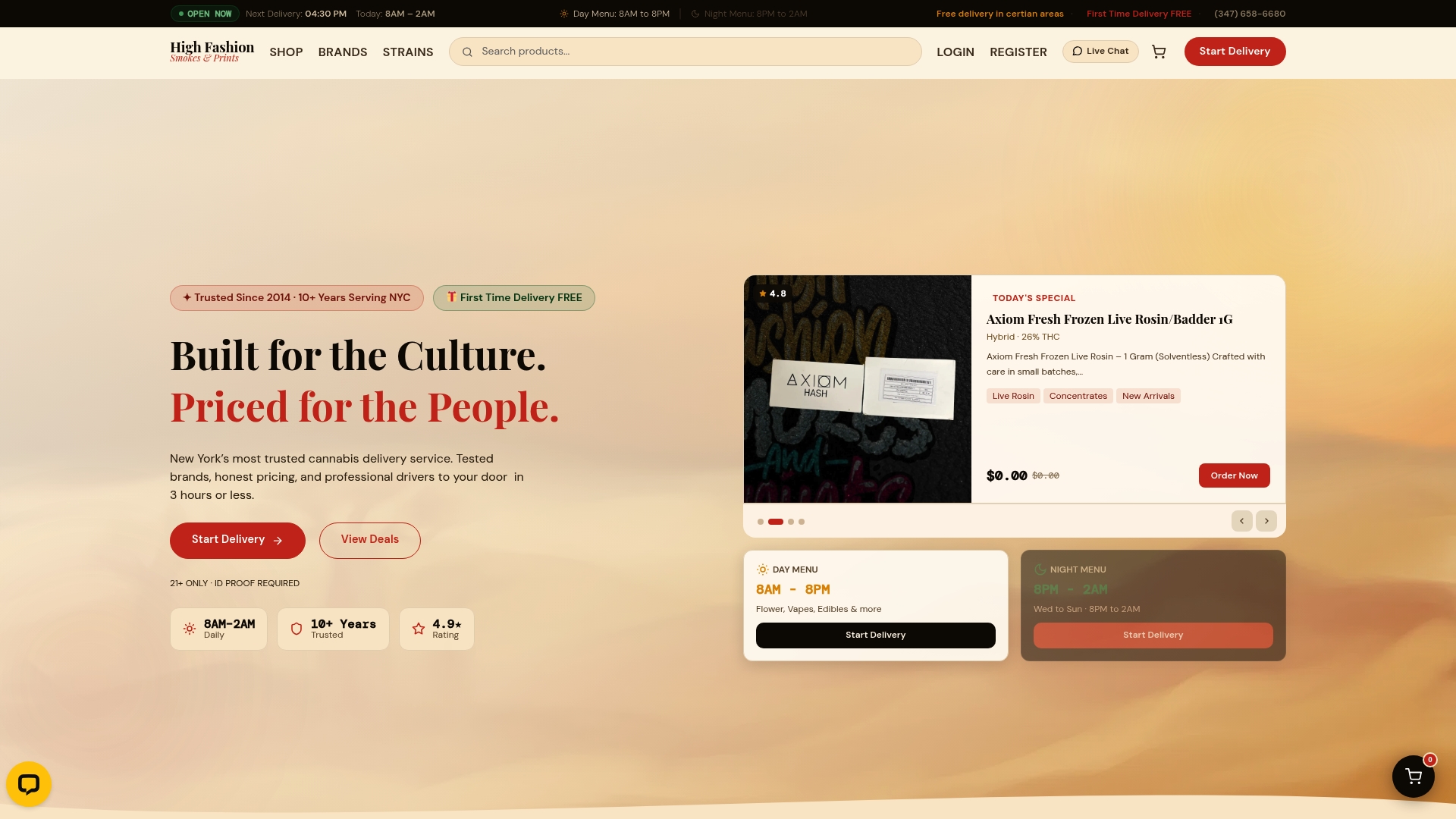
Skipping the guesswork on THCA versus THC starts with buying from a menu where every product already lists both numbers, not chasing down a COA yourself after the fact. An established online dispensary offers same-day delivery of lab-tested flower, vapes, concentrates, edibles, and THC beverages in New York City, emphasizing honest pricing and verified lab results rather than vague potency claims.
Before you order, it’s worth reading through our safe cannabis use guide, which walks through the same start-low, wait, buy-tested principles covered above, applied to real dosing decisions. If you’re weighing whether cannabis fits your situation at all, our breakdown of the pros and cons of cannabis is a reasonable place to start. Browse the current day and night menus, verify your age, and place an order for delivery within a scheduled window built around your evening, not a warehouse’s convenience.
This article is general information, not a substitute for advice from a qualified doctor. Consult a qualified healthcare professional about your own circumstances before acting on anything here.
Sources
FAQ
Does Raw THCA Get You High?
No. Raw THCA doesn’t bind CB1 receptors efficiently because of its carboxyl group, so consuming it unheated, in a tincture or juiced, produces little to no intoxication. Smoking, vaping, or cooking it converts THCA into delta-9 THC, which does get you high.
Will THCA Flower Show Up on a Drug Test?
Yes, if you heat it. Heating THCA converts it into delta-9 THC, and your body metabolizes that into THC-COOH, the same compound standard drug tests screen for, regardless of whether the product started as “THCA flower” or dispensary THC flower.
Is THCA Legal Everywhere THC Is Illegal?
Not reliably anymore. The 2018 Farm Bill only measured delta-9 THC at 0.3%, letting high-THCA hemp flower slip through legally, but the 2026 shift toward total-THC calculations closes that gap in many jurisdictions. Check local law before assuming a THCA product is legal where you’re buying or traveling.
How Much Delta-9 THC Does THCA Flower Actually Produce When Smoked?
Multiply the THCA percentage by roughly 0.877 to estimate the delta-9 THC yield after full decarboxylation.
Where Can I Buy Lab-Tested THCA and THC Products in NYC?
Same-day delivery of lab-tested flower, vapes, concentrates, and edibles is available across New York City, with COAs provided for listed products. Check the safe cannabis use guide before your first order to understand dosing basics.