Read our Google Birdeye Reviews
The entourage effect claims that cannabis compounds work better together than any single compound works alone, and the mechanism has real preclinical backing, but no human clinical trial has proven it delivers reliably better outcomes than isolated cannabinoids. The practical bottom line: choose products based on verified lab testing and full compound profiles rather than “entourage” marketing language, and talk to a clinician before using cannabis for a specific medical condition.
TL;DR:
- The entourage effect lacks definitive human clinical evidence and is often misused in marketing to suggest whole-plant products outperform isolated cannabinoids.
- Preclinical studies demonstrate plausible mechanisms like synergy, bioenhancement, and receptor interactions, but human trials remain small, inconsistent, and inconclusive.
- Laboratory testing of cannabis products should focus on verified cannabinoid and terpene profiles, contaminant testing, and batch-specific COAs rather than marketing claims.
- Variations in chemotypes, delivery methods, and individual metabolism make it difficult to reliably attribute clinical benefits to entourage effects.
- Reliable cannabis use for medical purposes requires consulting clinicians and choosing products verified through current lab testing standards.
Table of Contents
- What Does “Entourage Effect” Actually Mean?
- The Compounds Behind Cannabis Synergy: Cannabinoids, Terpenes, and Flavonoids
- Preclinical Promise vs. Human Clinical Proof: Where the Evidence Actually Stands
- How Cannabinoids and Terpenes Might Interact in the Body
- What the Evidence Says About Pain, Anxiety, Epilepsy, and Inflammation
- How to Read Lab Results and Avoid Marketing Hype
- Why the Research Still Falls Short (and What Would Fix It)
- How Highfashionsmokesandprints Applies the Evidence
- Where to Find Lab-Tested Cannabis with Verified Compound Profiles
- Sources
What Does “Entourage Effect” Actually Mean?
The term comes from a 1998 paper by Raphael Mechoulam and Shimon Ben-Shabat, the researchers who first isolated THC decades earlier. They observed that 2-arachidonoyl glycerol, an endocannabinoid produced naturally in the body, became more active when accompanied by related but inactive fatty acid compounds. Mechoulam and Ben-Shabat called this an “entourage effect,” a narrow observation about the endocannabinoid system itself, not a claim about smoking flower with lots of terpenes in it.
That distinction got lost somewhere between the lab and the dispensary shelf. Cannabis marketing adopted “entourage effect” as a catchall for any claim that whole-plant products outperform isolated cannabinoids, often with no supporting data specific to the product in question. A scoping review published in PMC makes this point directly: the phrase gets used so loosely across industry and academic writing that it has become almost meaningless without more precise pharmacological language attached to it.
Pharmacologists actually have better words for what might be happening, and using them helps you evaluate claims more critically:
- Synergy describes compounds producing a combined effect greater than the sum of their individual effects.
- Antagonism describes one compound blunting or blocking another’s effect, which is arguably just as important as synergy and gets far less marketing attention.
- Bioenhancement describes one compound improving the absorption, metabolism, or bioavailability of another without changing its core mechanism.
- Polypharmacy is the broader term for using multiple active compounds together, borrowed from conventional medicine and applicable to any multi-drug regimen.
Within this framework, researchers distinguish two types of interaction. Intra-entourage effects happen within a single cannabinoid class, such as THC and its own minor cannabinoid relatives modulating each other’s activity at the same receptor family. Inter-entourage effects cross categories entirely, like a terpene changing how THC crosses the blood brain barrier or binds a receptor. Most consumer marketing conflates the two, which is exactly the kind of imprecision the PMC review warns against.
The Compounds Behind Cannabis Synergy: Cannabinoids, Terpenes, and Flavonoids
Cannabis produces more than 100 cannabinoids, over 150 terpenes, and a smaller set of flavonoids, but only a handful of each show up in concentrations high enough to plausibly matter for effect. Understanding what each class actually does helps you read a lab report instead of a marketing headline.
Major cannabinoids carry the most direct pharmacological weight:
- THC binds CB1 receptors directly and drives the psychoactive effects most people associate with cannabis.
- CBD doesn’t bind CB1 strongly at all; instead it acts as a negative allosteric modulator, changing how THC interacts with the receptor without occupying the same binding site.
- CBG, often called the “mother cannabinoid” because other cannabinoids derive from its acidic precursor, shows some non-psychoactive receptor activity in early research.
- CBN forms as THC degrades with age and light exposure, and is associated anecdotally with sedation, though rigorous human data is thin.
- THCV is structurally similar to THC but binds differently at CB1, with some preclinical work suggesting appetite-suppressing rather than appetite-stimulating effects.
Terpenes are the aromatic compounds responsible for a strain’s smell, and they’re not just decoration. Preclinical research on phytocannabinoid-terpenoid interactions has found several with plausible bioactivity even at low concentrations:
- Limonene, common in citrus-forward strains, has shown mood-modulating activity in animal models.
- Myrcene, found in high concentrations in many indica-leaning varieties, is associated with sedating effects, though the popular “couch lock” claim outruns the current evidence.
- Pinene may support alertness and has documented bronchodilating properties in non-cannabis research contexts.
- Linalool, also present in lavender, shows anxiolytic activity in rodent studies.
- Caryophyllene is unusual among terpenes because it binds directly to CB2 receptors, giving it a cannabinoid-like mechanism most terpenes lack.
Flavonoids are the least studied of the three classes. Cannabis-specific flavonoids called cannflavins have shown anti-inflammatory activity in cell studies, but human data is essentially absent, and most flavonoid claims you’ll see online extrapolate from flavonoid research in other plants entirely.
Chemotype matters more than most product labels suggest. Cannabinoids and terpenes aren’t randomly combined in a plant; they’re produced through linked biosynthetic pathways, so a strain naturally high in myrcene often correlates with a specific cannabinoid ratio. A terpene added back into a product after processing doesn’t necessarily recreate the pharmacological relationship that existed in the original plant, which is one reason lab-verified full spectrum profiles matter more than a terpene percentage alone.
Preclinical Promise vs. Human Clinical Proof: Where the Evidence Actually Stands
Preclinical work has produced some genuinely interesting findings. Research on THC and CBD together has documented that CBD can inhibit hepatic CYP enzymes responsible for metabolizing THC, which alters how quickly THC converts to its more potent metabolite, 11-hydroxy-THC. Animal studies have also shown terpenes acting on behavior at surprisingly low serum concentrations, suggesting they don’t need to be present in large amounts to matter pharmacologically. A Drexel University research highlight on d-limonene found it appeared to mitigate THC-induced anxiety when the two compounds were administered together, one of the more specific and encouraging data points in this space.
The problem is scaling that up to reliable human outcomes. A scoping review on the entourage effect concludes that while preclinical signals are real, the human clinical evidence remains contradictory and insufficient to confirm synergy as a dependable therapeutic mechanism. A separate review focused on terpenes and mood disorders reaches a similar conclusion: exploratory preclinical data looks promising, but additive or synergistic enhancement hasn’t been demonstrated in controlled clinical trials to a standard that would satisfy a regulator or a skeptical clinician.
“The current clinical evidence is not sufficiently robust to confirm the existence of a therapeutically meaningful entourage effect, despite reasonable pharmacological plausibility from preclinical research.” This is the core tension running through nearly every serious review of the topic: plausible mechanism, unconfirmed clinical magnitude.
Where human studies do exist, they tend to be small, use inconsistent products, and measure different outcomes, which makes cross-study comparison difficult. A handful of trials comparing whole-plant extracts to isolated cannabinoids for conditions like seizure frequency have shown suggestive dose-sparing effects, meaning patients needed less of the extract to achieve a comparable result. But sample sizes in the dozens to low hundreds, combined with wide product variability between study sites, keep these findings in the “encouraging signal” category rather than “settled science.”
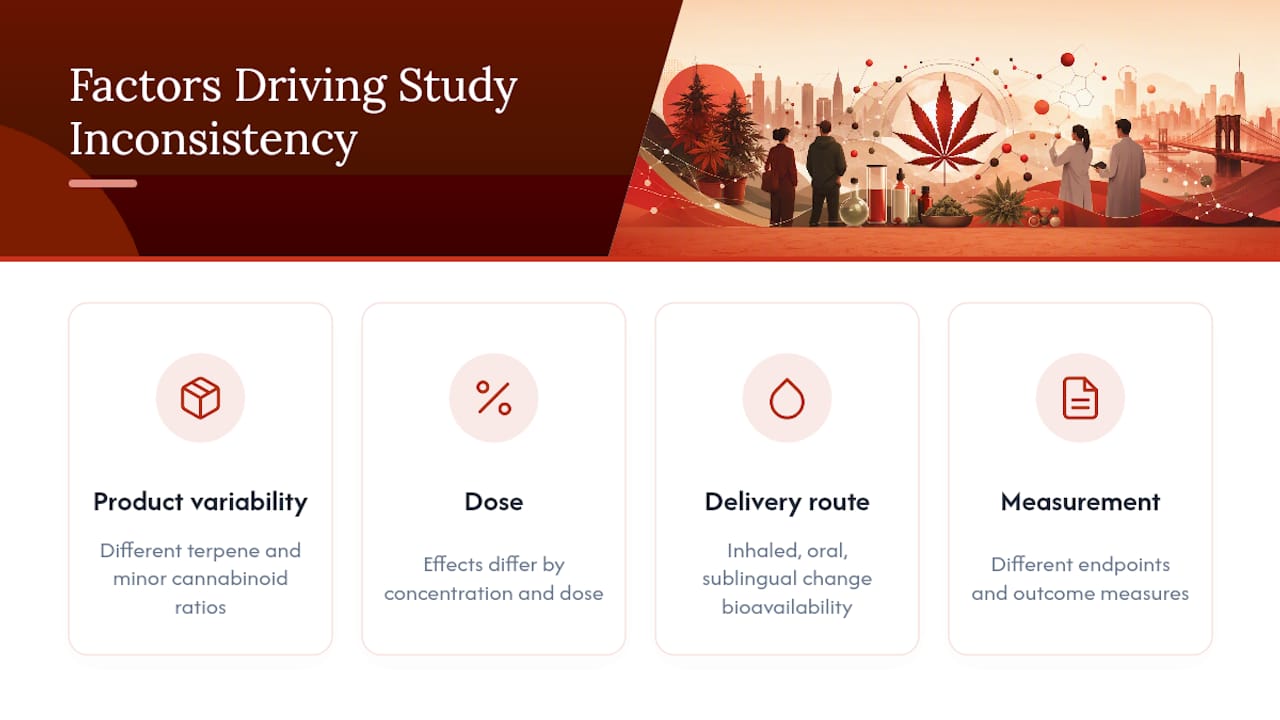
Several factors explain why studies keep contradicting each other. Product variability is a major one: two “full spectrum” products from different growers can have wildly different terpene and minor cannabinoid ratios, so calling them the same intervention is scientifically shaky. Dose matters too, since a terpene that shows an effect at one concentration may do nothing or something different at another. Delivery method changes bioavailability substantially between inhaled, oral, and sublingual routes. And measurement inconsistency, different studies tracking different endpoints like self-reported anxiety versus seizure counts versus blood biomarkers, makes it nearly impossible to build a clean meta-analysis across the existing literature.
How Cannabinoids and Terpenes Might Interact in the Body
The mechanisms proposed for entourage-style interactions fall into a few distinct categories, and understanding them helps explain why some claims are more credible than others.
Receptor-level interactions are the most studied pathway. THC binds directly to CB1 receptors concentrated in the central nervous system and CB2 receptors more common in immune tissue. CBD doesn’t compete for the same binding site; research described in the phytocannabinoid-terpenoid synergy review describes it acting as a negative allosteric modulator, changing the receptor’s shape or responsiveness rather than blocking THC outright. Beyond the classic cannabinoid receptors, several cannabis compounds also act on serotonin receptors and TRP (transient receptor potential) channels, which are involved in pain and temperature sensation, opening additional pathways beyond the endocannabinoid system.
Pharmacokinetic interactions affect how the body processes cannabinoids rather than how they act at the receptor. The CBD-THC CYP enzyme interaction mentioned earlier is the clearest documented example: CBD’s inhibition of certain liver enzymes can slow THC’s conversion to 11-hydroxy-THC, potentially altering the intensity and duration of the high. Blood brain barrier permeability is another consideration, since a compound’s ability to reach central nervous system receptors at all depends on its lipid solubility and interactions with efflux transporters at the barrier.
Terpene pharmacology deserves its own mention because terpenes were long dismissed as merely aromatic. Caryophyllene’s direct CB2 binding gives it a mechanism that looks genuinely cannabimimetic, meaning it may act somewhat like a cannabinoid itself rather than just modulating one. Other terpenes appear to work through entirely separate receptor systems, which means their contribution to a product’s overall effect could be additive to cannabinoid activity rather than a true pharmacological synergy in the strict sense.
A few practical mechanisms worth keeping in mind:
- Concentration thresholds matter: a compound inactive at typical product concentrations may become relevant at higher doses, and vice versa.
- Formulation changes exposure: an inhaled vape delivers compounds to the bloodstream in seconds, while an edible delays and extends exposure over hours.
- Co-occurring compounds from the same chemotype are more likely to interact meaningfully than terpenes and cannabinoids combined artificially after extraction.
- Individual variation in liver enzyme activity, body composition, and cannabinoid receptor density means the same product can produce different subjective effects across users.
What the Evidence Says About Pain, Anxiety, Epilepsy, and Inflammation
Cannabis marketing loves to cite the entourage effect for nearly every condition imaginable. The actual evidence is far more selective, and epilepsy is where it’s strongest.
Human data is thinner and often confounded by the fact that pain trials frequently combine cannabis with other pain management approaches, making it hard to isolate the plant’s specific contribution. The theoretical mechanism, terpenes like caryophyllene acting on CB2 receptors involved in inflammatory pain pathways alongside THC’s central action, is plausible but not yet confirmed in well-controlled human trials.
Anxiety and mood is where terpene-specific data is most interesting right now. The Drexel University finding on limonene and THC is one of the more concrete data points in the entire entourage literature: limonene appeared to reduce THC-induced anxiety when combined with THC in controlled conditions. Linalool has shown similar anxiolytic activity in animal models. CBD’s own interaction with THC, tempering some of THC’s anxiogenic potential in certain users, adds another layer, though individual response varies enough that this can’t be treated as a guarantee.
Epilepsy offers the field’s most cited, and most misunderstood, data point. A 2018 meta-analysis pooling data from 11 studies covering 670 people found that lower doses of CBD-dominant extract reduced seizure frequency in some datasets compared to purified CBD, suggesting a dose-sparing effect from the accompanying plant compounds. That’s a genuinely notable finding. It’s also a single meta-analysis built on heterogeneous underlying studies, not a large standalone randomized controlled trial, so treating it as proof of a broad entourage effect overstates what it actually shows.
Inflammation and other frequently cited claims, immune modulation, appetite regulation, sleep support, sit at the earliest and weakest end of the evidence spectrum. Most of what’s published is cell-culture or animal work with no human trials directly testing whole-plant versus isolated compound outcomes for these specific claims. If a product description leans heavily on inflammation-fighting entourage language, that’s a marketing claim running well ahead of the data supporting it.
How to Read Lab Results and Avoid Marketing Hype
A certificate of analysis, or COA, is the single most useful document for separating real product information from entourage marketing copy. Here’s how to actually use one.
- Check the potency panel first. It should list individual cannabinoid percentages, not just a single “total THC” number, so you can see the actual ratio of THC to CBD, CBG, and other minor cannabinoids.
- Look for a full terpene panel, not just a total. A report showing individual terpenes like myrcene, limonene, and caryophyllene by percentage tells you far more than a vague “terpene rich” label. If you’re specifically hunting for a myrcene-forward strain, comparing panels across strains with documented myrcene content is a more reliable approach than trusting a product name.
- Confirm contaminant testing. Pesticides, heavy metals, residual solvents, and microbial contaminants should all appear with pass or fail results, not just be mentioned as “tested.”
- Check the testing date and lab accreditation. A COA older than a few months, or one from an unaccredited lab, tells you less about what’s currently in the package than a recent report from a certified facility.
- Match the batch number on the COA to the batch number on the product. A COA that doesn’t correspond to the specific batch you’re holding is essentially meaningless.
On dosing, the safest approach for any format is to start low and go slow, and to understand that format changes the timeline dramatically. Inhaled products act within minutes and fade within a couple of hours, while edibles can take 45 minutes to two hours to take effect and last considerably longer, which is why beginner-friendly edible dosing guidance matters more than most people assume before their first experience. Tinctures sit in between, offering faster onset than edibles through sublingual absorption while still allowing more precise dose control than smoking or vaping.
The FDA’s consumer guidance on cannabis-derived products specifically warns against relying on unproven medical claims and recommends verifying products through legitimate lab testing rather than marketing language. Red flags worth watching for include COAs that look inconsistent from batch to batch with no explanation, terpene percentages that seem implausibly high for the product type, and any claim that a product “cures” or “treats” a specific medical condition, language no legitimately tested consumer cannabis product should be using.
Pro Tip: Ask whoever is fulfilling your order to show you the COA before you buy, not after. A legitimate product should have that documentation ready and current, and hesitation to produce it is itself useful information.
Why the Research Still Falls Short (and What Would Fix It)
Most entourage effect studies share the same structural weaknesses, and recognizing them helps explain why headlines about the topic keep contradicting each other.
The biggest issue is product heterogeneity. When two research teams both test “full spectrum cannabis extract” but their extracts come from different cultivars, processed differently, with different terpene retention, they’re not really testing the same intervention. Add small sample sizes, frequently in the dozens rather than hundreds of participants, and a near-total absence of pharmacokinetic data tracking what’s actually happening in participants’ bloodstreams, and it becomes clear why systematic reviews keep landing on “insufficient evidence” rather than a firm conclusion either way.
A study design capable of actually settling the question would need several features current research mostly lacks:
- Standardized, chemically verified extracts used identically across all study sites, with full compound panels published alongside results.
- Randomized, double-blind, crossover designs comparing isolated cannabinoids against matched whole-plant extracts in the same participants.
- Pharmacokinetic and pharmacodynamic endpoints measured directly, blood concentration curves alongside subjective and physiological outcomes, not just self-reported symptom scores.
- Dose-response mapping across multiple concentrations rather than a single fixed dose, since several proposed entourage mechanisms appear to be concentration-dependent.
Regulatory and manufacturing hurdles make this harder than it sounds. Federal restrictions in the United States have historically limited researcher access to diverse, well-characterized cannabis products, and the natural variability of a plant-derived medicine makes the kind of batch-to-batch consistency pharmaceutical trials usually demand genuinely difficult to achieve at scale.
How Highfashionsmokesandprints Applies the Evidence
Highfashionsmokesandprints has served New York City with same-day cannabis delivery since 2011, and every product in the day and night menus comes with lab testing behind it. That’s a deliberate choice given how much entourage marketing outruns the actual science.
Rather than leaning on vague synergy claims, the educational content across the site focuses on what’s verifiable: cannabinoid ratios, terpene content, and how to read a COA before you buy. If you’re weighing a product for a specific therapeutic goal, whether that’s easing anxiety with a limonene-forward strain or exploring lower-THC formats, that’s a conversation worth having with a clinician first, not a marketing page.
— Jake
Where to Find Lab-Tested Cannabis with Verified Compound Profiles
Reading a COA is only useful if the product behind it is actually consistent, batch after batch, and that’s the standard Highfashionsmokesandprints holds itself to for every item on its day and night menus. Every listing ties back to real lab documentation, so you’re never guessing at a terpene percentage or a THC-to-CBD ratio based on a strain name alone.

If you’re in Brooklyn wondering about the basics of legal weed delivery or checking out the newly expanded Brooklyn delivery service, the process works the same way it does across the rest of New York City: browse verified lab profiles, ask a budtender directly if a COA raises questions, and start with a lower-dose format if you’re newer to a particular product type. First-time customers exploring lower-dose options can start with the best THC edibles for beginners menu, and anyone further out on Long Island can check how delivery works in that area before placing a first order. Place your order through the day or night menu and get same-day delivery without the marketing noise.
Sources
The PMC scoping review on the entourage effect offers the clearest terminology breakdown available. The phytocannabinoid-terpenoid synergy review covers mechanism in depth. The mood disorder terpene review and Medical News Today’s evidence summary both translate clinical findings for general readers, while the FDA’s consumer update grounds product-safety guidance in regulatory language.
This article is general information, not a substitute for advice from a qualified doctor. Consult a qualified healthcare professional about your own circumstances before acting on anything here.
- Decoding the postulated entourage effect of medicinal cannabis: What it is and what it isn’t
- What is the entourage effect and is it beneficial? – Medical News Today
- FDA consumer update: what you need to know about products containing cannabis or cannabis-derived compounds