Read our Google Birdeye Reviews
Limonene is a citrus-scented terpene that can lift mood and, in at least one controlled human study, reduce THC-induced anxiety without changing how much THC reaches your bloodstream. It shows up in lemon peels, cannabis flower, and a surprising number of cleaning products. The evidence behind its health claims ranges from solid (for the THC-anxiety interaction) to purely preclinical (for most other benefits). Knowing which is which matters before you buy a supplement or chase a specific strain.
Quick summary of limonene effects by evidence strength:
- Mood elevation / energizing feel — reported by users; limited controlled human data
- Anxiolytic (anti-anxiety) potential with THC — supported by one controlled human lab trial
- Anti-inflammatory and antioxidant activity — demonstrated in preclinical work; human evidence limited
- Antimicrobial properties — in vitro only
- Digestive / GERD relief — small clinical reports show symptom improvement in some patients
- Anticancer / chemopreventive signals — preclinical and one open-label human tissue study; not proven in clinical trials
The strongest human finding is the vaporized d-limonene + THC study: a controlled dose of d-limonene selectively reduced anxiety and paranoia ratings caused by THC. On the safety side, skin sensitization from topical use and potential drug interactions via liver enzymes (CYP2C9/CYP2C19) are the two flags worth knowing before you go heavy on supplements.
Key Takeaways
Limonene’s most credible human evidence is its selective reduction of THC-induced anxiety in a controlled trial, while most other claimed benefits remain preclinical or supported only by small clinical reports.
| Point | Details |
|---|---|
| Strongest human evidence | One controlled trial showed vaporized d-limonene reduced THC-induced anxiety without altering THC blood levels. |
| Most benefits are preclinical | Anti-inflammatory, antioxidant, and anticancer signals come mainly from animal and cell studies, not human trials. |
| Dose gap is significant | Clinical trials used 1,000–2,000 mg/day; typical cannabis sessions deliver far less limonene. |
| Safety flag for supplements | CYP2C9/CYP2C19 interactions mean limonene supplements can affect prescription drug metabolism. |
| COA is your best tool | Terpene panels on lab reports are the only reliable way to confirm limonene content in a cannabis product. |
Table of Contents
- What is limonene and where does it come from?
- What are the reported limonene effects and benefits?
- What does the science actually show?
- How does limonene behave inside cannabis products?
- What are the side effects and safety concerns?
- How do you find and use limonene-rich products?
- What does research still need to answer?
- The evidence on limonene deserves more nuance than it usually gets
- Sources
What is limonene and where does it come from?
Limonene is a monocyclic monoterpene, meaning it is built from two isoprene units arranged in a single ring. The form you encounter in nature, food, and cannabis is almost always d-limonene (the right-handed isomer). Its mirror image, l-limonene, occurs in smaller amounts in some plants like spearmint and pine needles. When a product label or COA just says “limonene,” it almost certainly means d-limonene.
Common natural sources include:
- Citrus peel oils — lemon, orange, grapefruit, lime (limonene makes up the majority of cold-pressed citrus peel oil by weight)
- Cannabis flower — one of the most abundant terpenes across many chemovars
- Herbs and spices — dill, caraway, celery seed, juniper
- Cleaning and fragrance products — widely used as a solvent and scent agent
Limonene is also an FDA-approved food flavoring (GRAS status), which is why you encounter it in beverages, candies, and baked goods without a second thought. That food-safe status is relevant context when evaluating supplement claims, though the doses in food are far lower than those used in clinical trials.
What are the reported limonene effects and benefits?
The list of claimed benefits is long. The honest version comes with evidence labels attached.
- Mood elevation / mild energizing effect (reported; limited human data) — Users consistently describe citrus-dominant cannabis as uplifting. Preclinical rodent studies support an anxiolytic and antidepressant-like profile, but controlled human data outside the THC context is thin.
- Anxiolytic effect alongside THC (human: controlled trial) — The clearest human signal. In a randomized crossover study, vaporized d-limonene reduced THC-induced anxiety in a dose-orderly pattern without altering THC blood levels or other THC effects.
- Anti-inflammatory activity (preclinical) — Multiple animal and cell studies document reduced inflammatory markers. A broad preclinical review compiles this evidence, though no large randomized human trial has confirmed it.
- Antioxidant activity (preclinical; in vitro) — Limonene and its metabolites scavenge free radicals in test-tube models. Healthline’s summary correctly notes that most of this evidence does not yet translate to proven human benefit.
- Antimicrobial properties (in vitro) — Active against several bacterial and fungal strains in lab conditions; no clinical application established.
- Digestive / GERD relief (small clinical reports) — Alternate-day 1,000 mg regimens produced symptom improvement in a subset of patients over two-week and longer courses, per small clinical reports.
- Anticancer / chemopreventive signals (preclinical + one open-label human tissue study) — An open-label pilot in 43 women with early-stage breast cancer found that 2 g/day oral limonene concentrated in breast tissue and reduced cyclin D1 expression by 22% (P = 0.002), though proliferation and apoptosis markers showed minimal change. Promising, not proven.
Dose matters more than most marketing copy admits. The GERD studies used 1,000 mg doses. The breast-tissue study used 2,000 mg/day. A typical cannabis product delivers limonene in the low milligram range at most. Extrapolating clinical trial results to what you inhale from a vape cart is a stretch.
Pro Tip: If a product page lists “limonene” as a benefit without specifying the percentage on a COA or the dose per serving, treat the claim as marketing, not medicine.
What does the science actually show?
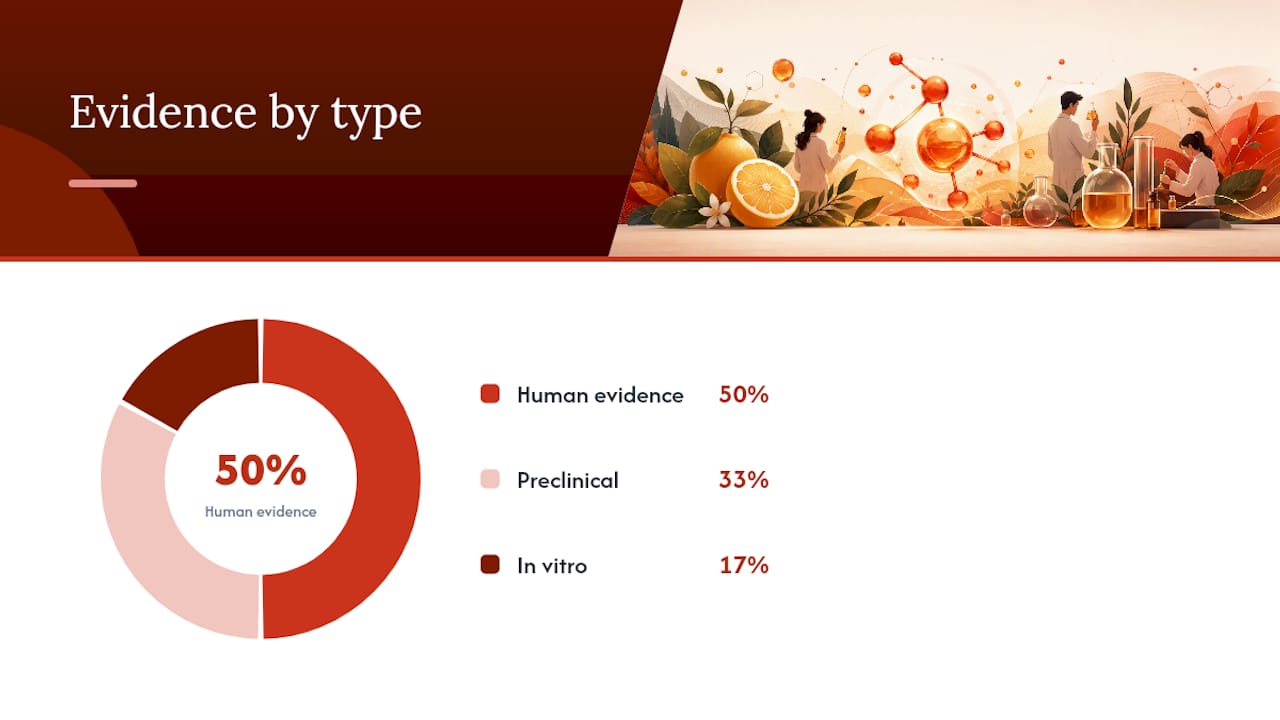
The evidence base for limonene spans several study types, and they are not equally convincing.
The controlled THC study stands apart from everything else in this list. It was designed specifically to test whether limonene modulates THC’s subjective effects, and it found a selective, dose-orderly reduction in anxiety and paranoia ratings.
Key finding: In a controlled crossover trial, concurrent vaporization of 15 mg d-limonene with 30 mg THC reduced ratings of anxious and paranoid feelings compared to THC alone, without altering THC blood concentrations or other THC-related effects. D-limonene administered alone produced no discernible effects versus placebo. This suggests limonene acts through its own neuromodulatory pathways rather than by blocking THC at CB1 or CB2 receptors. Read the full study.
The breast-tissue pilot is worth reading carefully before citing it as anticancer evidence. Limonene did concentrate in breast tissue (mean ~41.3 μg/g) and did reduce cyclin D1 expression, a cell-cycle regulator. But proliferation marker Ki67 and apoptosis marker cleaved caspase 3 showed minimal change. Tissue bioaccumulation and a single biomarker shift are not the same as demonstrated clinical benefit.
Preclinical work, compiled in a systematic review of limonene’s biological activities, documents anti-inflammatory, antioxidant, gastroprotective, and immunomodulatory effects across cell and animal models. The breadth is real. The translation to humans is incomplete.
Proposed mechanisms for the anxiolytic and mood effects include GABAergic, serotonergic, dopaminergic, and adenosine A2A receptor pathways. These come from preclinical behavioral and receptor-binding work and have not been confirmed in human mechanistic studies.
How does limonene behave inside cannabis products?
Terpenes are produced in the same resin glands as cannabinoids, but their concentrations vary far more than most consumers realize. Two products sold under the same strain name can have completely different terpene profiles depending on the grower, harvest, curing method, and storage conditions. Strain names are not a reliable proxy for limonene content.
Practical implications for cannabis users:
- Aroma is a rough signal, not a guarantee. A strong citrus smell suggests limonene, but the only way to confirm the amount is a terpene panel on the COA.
- Processing strips terpenes. Distillate loses most of its original terpene content during extraction. Live resin and live rosin preserve far more. Full-spectrum products sit in between.
- The entourage effect is real but not fully mapped. The controlled d-limonene + THC study is the clearest human evidence that a specific terpene can selectively modify a specific cannabinoid effect. That is meaningful. It does not mean every terpene combination produces predictable results.
- Inhaled dose is much lower than clinical trial doses. Even a limonene-rich flower at 1% terpene content delivers only a few milligrams per session, well below the gram-scale doses used in GERD or breast-tissue studies.
For broader context on why THC percentage alone does not determine your experience, the entourage effect and terpene interaction discussion is worth reading alongside this.
Pro Tip: *On a COA terpene panel, look for limonene listed as a percentage by weight.
For a deeper look at how terpenes contribute to anxiety relief specifically, see the role of terpenes in anxiety relief.
What are the side effects and safety concerns?
Limonene has a solid safety record at food-level exposure. The picture gets more complicated at medicinal doses.
Key safety points:
- Generally safe in food amounts — GRAS status from the FDA; dietary exposure through citrus and flavored foods carries no known risk for most people.
- Skin sensitization — Topical application, especially from essential oils, can cause allergic contact dermatitis. Oxidized limonene (from air exposure) is a more potent sensitizer than fresh limonene.
- Medicinal-dose safety is less certain — WebMD’s safety summary notes that limonene appears possibly safe in medicinal doses for up to one year based on available studies, but long-term high-dose data is limited.
- Pregnancy and breastfeeding — Insufficient safety data; avoid medicinal doses.
- Drug interactions via CYP enzymes — Limonene is metabolized by and may inhibit CYP2C9 and CYP2C19. Medications in those pathways include warfarin, certain antidepressants, proton pump inhibitors, and some antifungals. If you take prescription medications, check with a clinician before adding a limonene supplement.
Dosing context matters. Dietary exposure from food is measured in micrograms to low milligrams. The GERD clinical reports used 1,000 mg doses on alternating days. The breast-tissue study ran 2,000 mg/day for 2–6 weeks. These are not comparable to what you get from a cannabis session or a flavored beverage.
Pro Tip: If you are pregnant, breastfeeding, managing a chronic condition, or taking prescription medications, talk to a clinician before using limonene supplements. The food-safe label does not automatically extend to gram-scale daily doses.
How do you find and use limonene-rich products?
Reading a COA for terpene content
A Certificate of Analysis from an accredited lab is the only reliable source of terpene data for cannabis products. When you pull one up:
- Look for a terpene panel — not all COAs include one, and its absence means you have no data on limonene content.
- Find limonene listed by percentage (% by weight or mg/g). Above 0.5% in flower is a meaningful level.
- Check the testing lab’s accreditation — ISO/IEC 17025 is the standard for cannabis testing labs in the U.S.
- Note the harvest or lot date — terpenes are volatile and degrade over time. A product tested six months ago may have lost a significant portion of its terpene content by now.
- Confirm whether the label says d-limonene specifically or just “limonene” — for cannabis and supplements, this distinction matters for matching to study data.
Choosing the right product format
How a product is made determines how much limonene survives to the final form. Live resin preserves far more terpenes than distillate because it uses fresh-frozen plant material and lower-temperature extraction. Distillate is nearly terpene-free unless terpenes are added back after processing. Full-spectrum tinctures retain more of the original plant profile than isolate-based products.
For edibles, onset and bioavailability differ substantially from inhalation. Dosing edibles safely covers the timing and dose differences that matter when you switch formats.
Supplement shopping tips
- Verify the dose per capsule — products vary from 250 mg to 1,000 mg per serving.
- Look for third-party testing and a COA from the supplement manufacturer.
- Prefer products that specify d-limonene rather than generic “citrus extract.”
- Store supplements and cannabis products away from heat and light. Terpenes oxidize faster than most people expect, and oxidized limonene is both less effective and more likely to cause skin sensitization.
What does research still need to answer?
The current evidence base has real gaps, and honest consumer guidance has to acknowledge them.
Priority questions the research has not yet answered:
- Replication of the THC + d-limonene finding across different formulations, doses, and populations. One controlled trial is a strong start, not a settled conclusion.
- Oral dosing trials for anxiety and mood — the human anxiolytic data comes from vaporized delivery. Whether oral limonene produces the same effect at comparable doses is unknown.
- Dose-response relationships in diverse populations — most studies used narrow participant groups; age, sex, metabolic differences, and cannabis use history all plausibly affect outcomes.
- Long-term safety data for high-dose supplementation — the available human safety window is roughly one year at medicinal doses, and that comes from a small evidence base.
- Mechanistic receptor mapping in humans — the GABAergic, serotonergic, and adenosine A2A proposals come from preclinical work. Human receptor studies have not confirmed which pathways drive the observed effects.
- Clinical endpoints for GERD and anti-inflammatory claims — small symptom reports need replication in randomized, placebo-controlled trials with validated clinical endpoints.
No FDA-approved therapeutic use of limonene currently exists for any of the indications discussed here, including anxiety, GERD, or cancer prevention. Regulatory status could change as clinical evidence accumulates, but as of now, limonene is a food additive and fragrance ingredient, not an approved drug or supplement for these purposes.
The evidence on limonene deserves more nuance than it usually gets
Most coverage of limonene falls into one of two failure modes: either breathless enthusiasm that treats preclinical findings as proven human benefits, or reflexive dismissal that ignores the one genuinely interesting controlled human trial in the literature.
The THC + d-limonene study is worth taking seriously precisely because it was designed well. Randomized crossover, controlled doses, measured pharmacokinetics. The finding that limonene selectively reduced anxiety without touching THC blood levels or other THC effects is not what you would expect if limonene were just a placebo or a simple CB1 modulator. That specificity is the signal.
What it does not tell you is whether the same effect occurs with oral limonene, at lower inhaled doses, or in people who use cannabis daily rather than intermittently. Those are real unknowns, and any product claiming to “harness limonene’s anxiolytic power” without acknowledging them is selling you a story, not a result.
The breast-tissue data is the other case where nuance gets lost. Limonene concentrated in breast tissue and shifted a biomarker. That is biologically interesting. It is not evidence that limonene treats or prevents breast cancer. The study was open-label, had no control arm, and the proliferation markers did not move. Reporting it as an anticancer finding without those caveats is misleading.
For cannabis users specifically, the practical takeaway is simpler than the science: if you want limonene in your product, read the COA terpene panel. Strain names tell you almost nothing. A citrus smell is a hint. The percentage on a lab report is the only number that actually matters.
Sources
- Vaporized D-Limonene Selectively Mitigates the Acute Anxiogenic Effects of Δ9-Tetrahydrocannabinol in Healthy Adults Who Intermittently Use Cannabis – PMC
- Limonene: Uses, Benefits, Side Effects, and Dosage – Healthline
- Limonene: Overview, Uses, Side Effects, Precautions, Interactions, Dosing and Reviews – WebMD
- Clinical and preclinical reports on limonene’s gastroprotective effects – PMC
This article is general information, not a substitute for advice from a qualified doctor. Consult a qualified healthcare professional about your own circumstances before acting on anything here.