Read our Google Birdeye Reviews
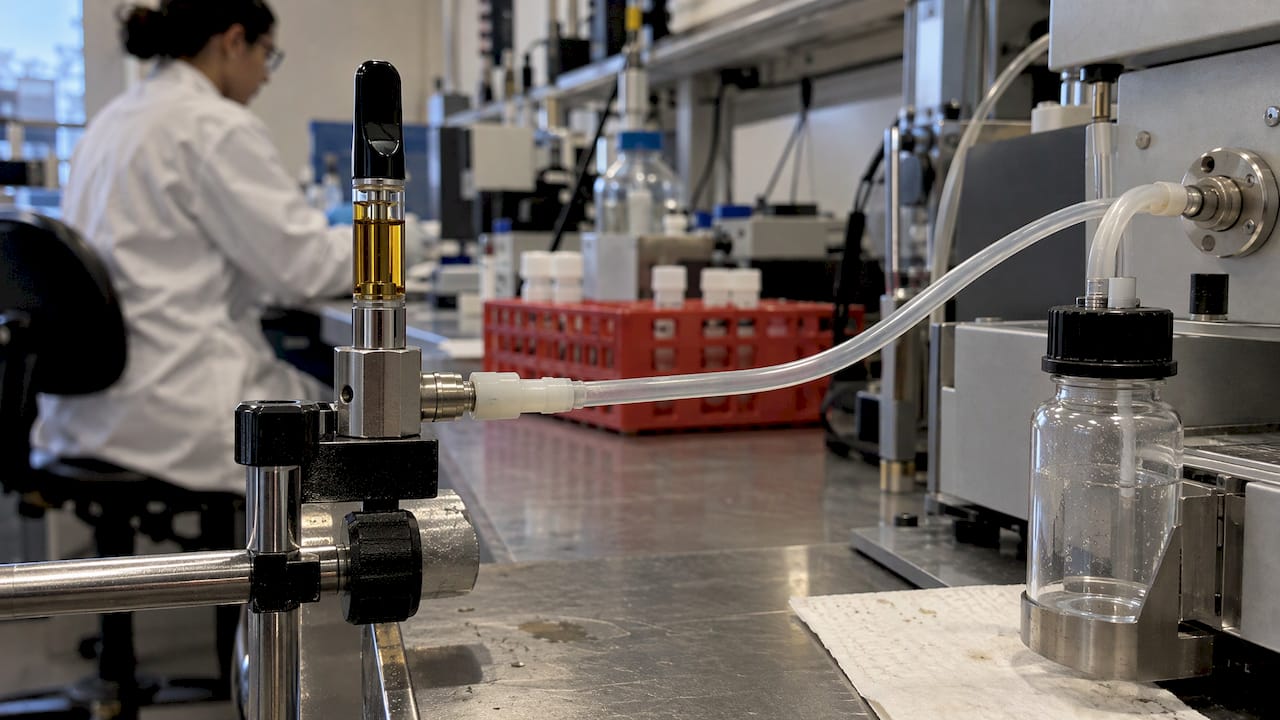
Traces of metals such as chromium, nickel, copper and lead have been measured in cannabis vape oil and aerosol, and most of them come from the cartridge hardware, not the plant. That makes your choice of tested, verifiable carts and the way you store and use them the practical levers. We sell lab-tested vapes with same-day delivery across New York City, so this guide covers what researchers found, what is still unknown, and what you can do on your next order.
TL;DR
- Studies of cannabis carts have detected chromium, copper, nickel, lead, tin and zinc, and the pattern points to the device’s own metal parts as the main source.
- Heat and time matter: hotter coils and long, warm storage were linked to higher metal levels in a lab test.
- Standard cannabis lab panels usually cover only arsenic, cadmium, mercury and lead, so a clean certificate of analysis does not cover every metal that matters in a cart.
- Verify the brand and the lab results, store carts cool, and avoid dry hits to keep exposure as low as you can.
- Researchers have not yet established the direct health effect of these metals from cannabis vaping.
Table of Contents
- Where metals in a vape cart come from
- Which metals researchers have found
- How heat and storage change the numbers
- What the health evidence does and does not say
- Why a clean lab report is only part of the answer
- A practical checklist for buying carts
- How to use and store carts to keep exposure low
- Vapes, flower and what suits you
- What we do at High Fashion Smokes & Prints
- Our perspective
- FAQ
- Sources
Where metals in a vape cart come from
A cart is a small machine. Oil sits in a tank, flows to a heating coil, and the aerosol travels through a mouthpiece and connector. Those parts are made of metal alloys, and the oil touches them for weeks or months before you use it.
A 2025 scoping review of nine studies describes two routes into your inhale: metals can be vaporized directly, or they can leach from components into the oil and then travel in oil droplets or the aerosol mixture.
A 2025 Scientific Reports study explains the droplet part. Even at the 5 to 10 watts typical of cannabis vape devices, the oil at the coil surface boils in tiny bubbles. They burst within milliseconds and throw off airborne droplets that can carry metal particles.
This matters for how you shop. If the plant and the extraction were the only concern, a strain or brand name would tell you most of what you need. Because hardware is a major source, the cartridge itself deserves as much attention as the oil.
Which metals researchers have found
The table below summarizes the main studies. These are laboratory results on specific products, not a verdict on every cart.
| Study | What was tested | Metals detected |
|---|---|---|
| 2021, Washington State, Chemical Research in Toxicology | 13 cannabis cartridges | Chromium, copper, nickel, with smaller amounts of lead, manganese and tin moving into the oil and inhaled vapor |
| 2022, Canada | 20 legal and 21 illegal vape liquids | Lead up to 50 µg/g, nickel up to 677 µg/g and zinc up to 426 µg/g in illegal samples; copper up to 485 µg/g in legal samples |
| 2025, Scientific Reports, Canada | Six legal vape liquid products, machine-vaped | Cobalt, chromium, nickel, lead, tin and zinc in the aerosol |
Two details are worth keeping.
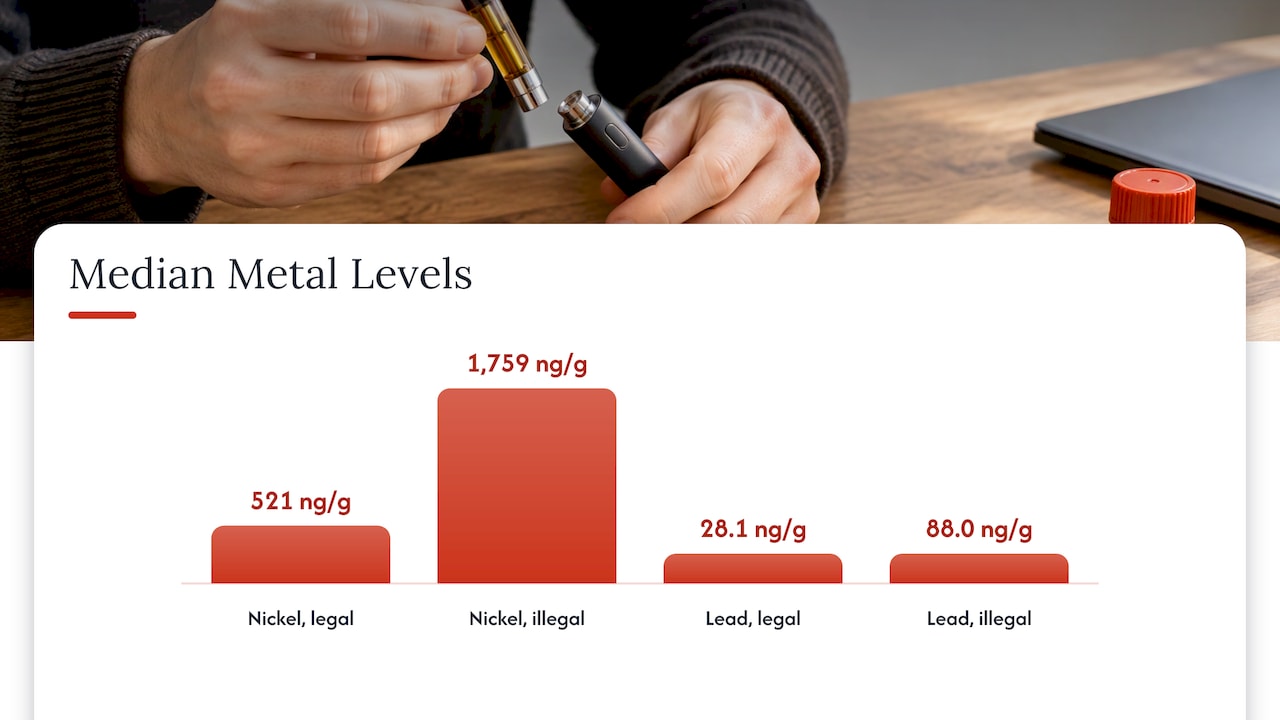
First, the 2022 work found metal-bearing particles in vape liquids from unused legal pens, and median levels were far lower in legal products than in illegal ones. For nickel the median was 521 ng/g in legal samples against 1759 ng/g in illegal ones, and for lead 28.1 against 88.0 ng/g. Where a cart comes from clearly changes the picture.
Second, results varied even between two identical devices from the same production lot. One clean result on one cart is not a guarantee about the next.
In the 2025 study, the elements found in the aerosol matched the metals in the cartridge components, which is the strongest sign so far that the hardware is the source.
How heat and storage change the numbers
The scoping review pulled together temperature data that is easy to act on.
- Cannabis oil vaporizes at roughly 200°C to 350°C, and the review reports up to 600°C in a fully loaded tank.
- A dry coil, meaning a coil with no oil reaching it, can reach about 1000°C.
- Heating to higher temperatures for longer increases leaching.
- Identical cartridges stored for 3 weeks versus 7 months at 25°C and 42°C showed significantly higher copper, chromium, nickel and lead at 7 months.
- Repeated heating and cooling cycles can chip metal particles from damaged coil surfaces.
All of this is in the 2025 scoping review. It also notes that continued use concentrates metals in the later sections of a cartridge.
In plain terms: time and warmth work against you inside a cart. That is why buying from a source that moves product quickly and storing it well beat stocking up and leaving carts in a hot car or a sunny window.
What the health evidence does and does not say
You should know the actual state of knowledge, without hype in either direction.
The scoping review reports that the leached metals were associated with EVALI, the lung injury linked to vaping, and may help form a harmful compound called ketene from vitamin E acetate at high temperatures. Vitamin E acetate is an additive tied to the 2019 outbreak and is not something a reputable cart should contain. The same review states that none of the nine studies evaluated the direct health impact of the metals.
A January 2026 risk assessment in Frontiers in Toxicology used Health Canada data on regulated products. Even assuming every bit of metal reached the lungs, none of the four most-regulated metals (arsenic, cadmium, mercury and lead) exceeded permitted daily exposure limits for typical daily use of legal vape liquids. Heavy use at the highest observed levels did exceed limits for chromium, copper and nickel. The authors also point out that these pharmaceutical limits were built for unheated products, so cannabis needs its own toxicology review.
What this means for you: exposure depends on the cart, how it was stored, and how much and how hard you vape. People with asthma, other lung conditions or pregnancy, and anyone with symptoms such as persistent cough, chest pain or shortness of breath, should talk to their doctor about vaping.
Why a clean lab report is only part of the answer
New York requires lab testing of each lot of adult-use cannabis. The Office of Cannabis Management publishes its testing limits under 9 NYCRR Part 130, and metals are among the required contaminant categories. That is the baseline for licensed products.
There is a subtlety, though. The 2026 Frontiers paper notes that the industry commonly tests the four Class 1 metals: arsenic (0.2 µg/g), cadmium (0.3 µg/g), mercury (0.1 µg/g) and lead (0.5 µg/g). The pharmacopoeia standard lists 24. And the 2021 Washington State authors stress that chromium, copper and nickel from hardware are the metals actually migrating into inhaled vapor, so they argue the regulated list should grow.
That gap is the reason to read a lab report with some care rather than just looking for a green check. Also remember that a certificate describes the oil as tested on a given date and lot, not what happens after months in a warm cart. Our guide to three quick checks on cannabis lab results shows how to read a report and how to spot variability between labs.
A practical checklist for buying carts
- Confirm the product is real. Counterfeit carts are a known problem in New York, and a fake has no traceable hardware or oil. Our six phone checks for fake vape carts take 30 to 90 seconds.
- Match the lot to a lab report. Look for the lot or batch number on the package and the same number on the report, with a lab name and date.
- Check which analytes the report covers. If metals are listed, note whether it is only the four Class 1 metals. That is common, so treat it as a minimum, not a full hardware screen.
- Prefer fresher product. Because the storage tests tied higher metal levels to longer storage, buy what you will finish in a reasonable time rather than building a stockpile.
- Look at build quality. A 2020 systematic review found that open-system devices with kanthal and stainless steel coils had consistently higher iron and nickel levels, and recommends high-quality metals with few defects, minimal soldered parts and timely coil replacement. Those findings concern open-system nicotine devices, but the principle carries over: well-made hardware is less likely to shed metal under repeated heating.
- Use a compatible, well-made battery. Our vape battery safety rules cover voltage and charging, and a battery that runs the coil too hot raises the temperatures discussed above.
How to use and store carts to keep exposure low
These habits follow directly from the temperature and storage findings.
- Keep carts cool and out of sunlight. The 42°C storage condition produced the highest readings in the lab, and a parked car in a New York summer can get there. Our guide on keeping vape carts potent for six months covers storage in detail.
- Take short, gentle draws. Long, hard pulls drive the coil hotter, and the review links higher temperatures held for longer to more leaching.
- Stop when the cart runs low. A tank near empty risks a dry coil, which can reach about 1000°C. Metals also concentrate in the final sections of a cartridge.
- Pause between sessions. Constant back-to-back use means constant heating and cooling cycles, which the review connects with metal particles chipping off coil surfaces.
- Retire a cart that tastes burnt or looks damaged. A harsh or metallic taste is a signal to put it down.
- Keep spare gear in one place. Our vape accessories category has batteries and extras so you do not improvise with a mismatched charger.
None of this can promise zero exposure. It lowers the factors the studies tie to higher metal levels, which is the realistic goal.
Vapes, flower and what suits you
If your main concern is hardware, it is fair to ask whether another format suits you better. Flower and vapes deliver differently, and our flower vs vapes comparison and vaping vs smoking research summary walk through onset, discretion, dosing and what the evidence says about each. Many customers keep both on hand: carts for quick, discreet sessions and flower for evenings at home.
What we do at High Fashion Smokes & Prints
We have served New York City since 2011, and we deliver same-day lab-tested flower, vapes, edibles, concentrates, pre-rolls, THC beverages and CBD, with age verification at checkout and delivery tracking. Our vape range includes disposables and carts, such as the Mad Labs 2 gram disposable.
Delivery fees start from $8 in Queens and from $12 in Manhattan and the Bronx. Our day and night menus let you order when it suits you, and you can check delivery hours in NYC before you book a window. Order straight from our menu.

Because carts spend less time in storage when you order what you will use soon, same-day delivery fits the advice above.
Our perspective
We have been delivering in New York since 2011, and the question we hear most about vapes is simple: is this cart legit and clean? The research gives a useful answer. Metals in a cart come largely from the hardware, so the product you choose, the lab report behind it and how you keep it afterward all count.
That is why we put tested brands and honest pricing at the center of what we do. We encourage customers to check lot numbers, read the report, and use our guides on fake carts and lab results before they vape. A cart you can verify is a cart you can trust more.
Our advice for most adults is the same: buy what you will use in the next few weeks, keep it cool, take easy draws, and let us bring it to your door in a discreet delivery window. We built our menu and our delivery around that kind of informed, no-pressure shopping.
Jake
FAQ
Is there metal in my vape?
Vape devices contain metal parts such as coils, connectors and solder points, and studies of cannabis carts have detected trace metals including chromium, nickel, copper and lead in the oil or aerosol. Levels vary widely between products and even between two carts from the same lot. Choosing verified, lab-tested carts and storing them well are the steps within your control.
Do hotter vapes release more metals?
In the research, higher temperatures held for longer increased leaching. Oil vaporizes at about 200°C to 350°C, while a dry coil can reach about 1000°C. Short draws and not vaping a nearly empty cart help keep the coil in its normal range.
Does a lab report tell me if a cart has heavy metals?
It tells you the results for the metals the lab tested on that lot. Many panels cover arsenic, cadmium, mercury and lead, while hardware-derived metals such as chromium, copper and nickel are not always included. Read which analytes are listed and match the lot number to your package.
How should I store my carts?
Keep them upright, cool and out of sunlight and hot cars. In one lab test, carts stored seven months at 42°C had significantly more copper, chromium, nickel and lead than ones stored three weeks. Buying what you will finish soon reduces storage time.
Are the health effects of metals from cannabis vapes known?
Not yet in full. A 2025 review found that none of nine studies measured direct health impact, and a 2026 risk assessment concluded risk is low for most non-daily users of regulated products. If you have a lung condition, are pregnant or have symptoms such as chest pain or lasting cough, speak with your doctor.
Sources
- Heavy Metals in Cannabis Vapes and Their Health Implications (Scientific World Journal, 2025)
- Tracking metal presence in cannabis vaping products (Scientific Reports, 2025)
- Metals in Cannabis Vaporizer Aerosols (Chemical Research in Toxicology, 2021)
- Evidence That Metal Particles in Cannabis Vape Liquids (2022)
- Risk assessment of metals measured in regulated Canadian products (Frontiers in Toxicology, 2026)
- Risk assessment of metals, full text (PMC)
- Electronic nicotine delivery system design and aerosol metals (2020 systematic review)
- New York Office of Cannabis Management: Cannabis Testing Limits