Read our Google Birdeye Reviews

Vaping heats cannabis instead of burning it, so it avoids smoke and most combustion byproducts. That is why many researchers consider it the lower-risk way to inhale. But “lower risk” is not “safe”. Vaping can deliver more THC per session, concentrate cartridges bring their own contaminant concerns, and the CDC says there isn’t enough evidence to call any one method safer than another. Below is what separates the two methods and how to choose between them.
TL;DR
- Smoking burns flower at far higher temperatures than vaping, which produces smoke, tar and carbon monoxide. Vaping heats at lower temperatures and produces less of these.
- Vaping lowers some respiratory complaints, but the evidence is thin and the CDC says it can’t rank methods as safer or less safe.
- In a controlled trial, vaporized cannabis produced higher blood THC and stronger effects than the same dose smoked. Start low with a vape.
- Dry-herb vaporizers are generally favored in harm-reduction reviews over smoking, e-liquids or concentrates. Product quality matters as much as method.
- Smoking wins on flavor, aroma and ritual. Vaping wins on convenience and discretion.
Table of Contents
- How smoking and vaping actually differ
- Is vaping weed safer than smoking it?
- Does vaping get you higher?
- How long effects last
- Flavor, aroma and convenience
- Pros and cons at a glance
- Which method fits you?
- Harm-reduction habits that work for either method
- Perspective: why we steer people toward tested vapes and flower
- Get tested vapes and flower delivered in NYC
- FAQ
- Sources
How smoking and vaping actually differ
The difference comes down to combustion. Smoking cannabis, whether in a joint, pipe or bong, takes the plant to roughly 600 to 900°C. A 2023 academic review puts vaporization at about 160 to 230°C, which is hot enough to release cannabinoids and terpenes as vapor but well below the point where plant matter burns. Lower heat means significantly lower levels of carbon monoxide and other toxins.
That is the whole logic of vaping. You are still inhaling an aerosol, but you skip most of what comes from fire.
There are two quite different kinds of vaping, and people often lump them together:
- Dry-herb vaporizers heat ground flower in a small chamber. You inhale vapor from the plant itself, and the leftover material turns toasted brown rather than to ash.
- Cartridge and disposable vapes heat an oil, usually a distillate or a live-resin style extract. These tend to be far more potent than flower. Our guide on flower vs. vapes goes deeper on how to match each format to your goals.
Dabbing is a third inhalation route, using a hot surface to vaporize a concentrate. It sits closer to the vape end of the spectrum in terms of potency, and temperature control matters. We cover that in our dab temperature guide.
Is vaping weed safer than smoking it?
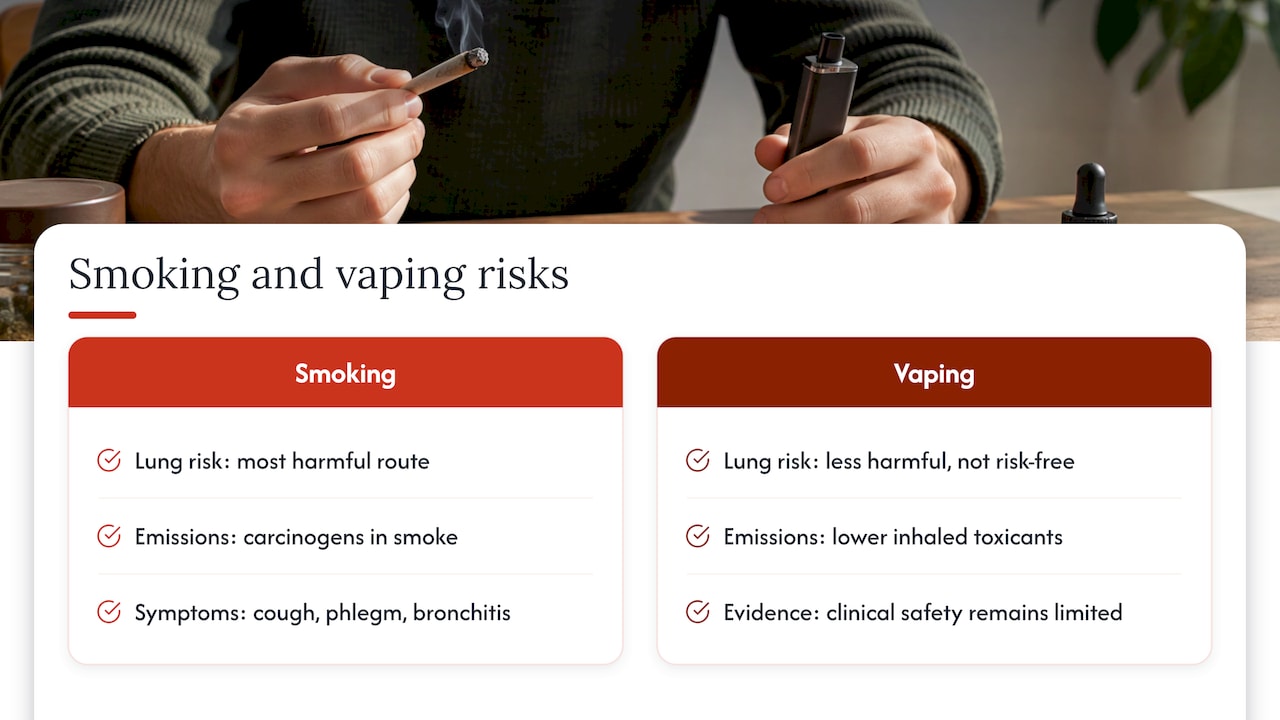
Vaping is likely gentler on your lungs than smoking, but nobody has proven it is safe, and the honest summary is that the evidence is limited.
Here is what the major sources say.
The case for vaping being lower risk. Health Canada’s accessories guidance says smoking is the most common way to consume cannabis and the most harmful one for your lungs. It notes that cannabis smoke contains many of the same harmful chemicals as tobacco smoke, including carcinogens, and that vaping is less harmful to the lungs, though not risk free. A Swiss-led toxicological assessment reviewed emissions studies and found lower exposure to inhaled toxicants from vaporizers than from joints.
Smoking is also linked to everyday respiratory trouble. A 2025 SAGE review associates cannabis smoking with worsening chronic cough, phlegm and more frequent bouts of bronchitis. A 2025 review in PMC adds that these symptoms often resemble chronic bronchitis and may ease after people stop smoking, which suggests inflammation rather than permanent structural damage. The same review does not find that cannabis smoking consistently causes emphysema the way tobacco does, though heavy, prolonged use may cause airflow obstruction.
A review in Canadian Family Physician is not needed here: the 2023 academic review above also reports that dried-flower vaporizers are preferred from a harm-reduction standpoint because of a lower risk to lung health than smoking or vaping e-liquids and concentrates.
The caution. The CDC’s cannabis FAQ says scientists don’t have enough evidence to say using cannabis one way is safer than another. It points out that smoking exposes you and people nearby to harmful chemicals, while oils and concentrates used in vaping may contain additives or contaminants, and vaping has been linked to lung injury.
An editorial in JAMA Network Open makes a similar point: heating rather than burning should avoid pyrolytic toxins, yet there is little robust clinical or epidemiological evidence that vaporization is safer in practice. And the authors of the 2023 review concede their own recommendations are weak in strength because the literature is limited.
Put together: the mechanism favors vaping, the measured emissions favor vaping, and the respiratory symptom data lean the same way. The outcome data are not strong enough to promise anything. Treat vaping as the lower-exposure option, not a free pass.
What worries researchers about vape products
The risk in vaping is mostly in the product, not the principle:
- Formulations using propylene glycol and vegetable glycerin can form formaldehyde, a group 1 carcinogen, when heated, according to the 2023 review.
- The same paper notes that vitamin E acetate, found in many unregulated e-liquid products, has been associated with EVALI, the 2019 lung injury outbreak.
- Health Canada’s guide adds that heavy metals can leach from hardware into the extract and be inhaled.
This is why where you buy matters. Sourcing lab-tested products from a seller who verifies brands is the practical answer to most of those concerns, and we explain our approach below.
Does vaping get you higher?
Often, yes, at the same amount of flower or the same nominal dose.
In a crossover trial of 17 healthy adults, vaporized cannabis produced greater effects and higher blood THC than equal doses smoked. At 25 mg, peak blood THC was 10.2 ng/mL after smoking and 14.4 ng/mL after vaporizing. Blood THC and heart rate peaked within 30 minutes and returned to baseline within 3 to 4 hours.
Johns Hopkins Medicine, reporting on the same work, found people who vaped 25 mg rated the overall strength of the drug’s effect at an average of 77.5, against 66.4 for those who smoked the same dose. They also reported about a 7 percent higher score for anxiety and paranoia.
Why would a gentler method hit harder? A few reasons:
- Delivery efficiency varies widely. The Swiss assessment found THC delivery ranged from 12% to 32% for joints but from 3% to 84% for vaporizers. Smoke wastes THC through side-stream burning between puffs. A good vaporizer wastes less.
- Potency of the material. Dried flower usually sits below 30% THC, while e-liquids and solid concentrates commonly contain 40 to 95% THC and often exceed 80%. The same paper notes most adverse events with cannabis are THC-dose dependent.
- Less friction. A vape asks nothing of you but a press and a pull, so it is easy to take more than you planned.
One more finding is worth knowing. A 2025 study of consumption modes found dabbing was associated with higher acute plasma THC than joint-like modes, and that vaping and dabbing showed quicker drops in subjective intoxication. The authors suggest this faster comedown may encourage more frequent redosing, which could raise overall consumption.
The takeaway for dosing: with a vape, take one small puff, wait, and reassess before another. That is especially true if you are newer to cannabis.
How long effects last
Both methods are fast. Health Canada says that with smoking or vaping you start to feel effects within seconds or minutes, the strongest effects can arrive around 10 to 30 minutes in, and effects can last 2 to 4 hours. It also says some impairment can linger for up to 24 hours. Plan around that: don’t drive, and schedule your session for when you have nowhere to be.
Flavor, aroma and convenience
This is where the two methods feel different day to day.
Flavor. Because vaping happens at lower heat, it tends to preserve more of the terpenes that give flower its citrus, pine or gas character. Smoking gives the toastier, heavier taste many people associate with weed. Neither is objectively better. It is a matter of preference.
Smell. A qualitative study of recreational users found vaporization usually produces fewer olfactory cues than smoking. For apartment living, that is a real plus.
Convenience. The same study found users saw vaporizers as more convenient and needing less preparation. No grinding, rolling or lighter required.
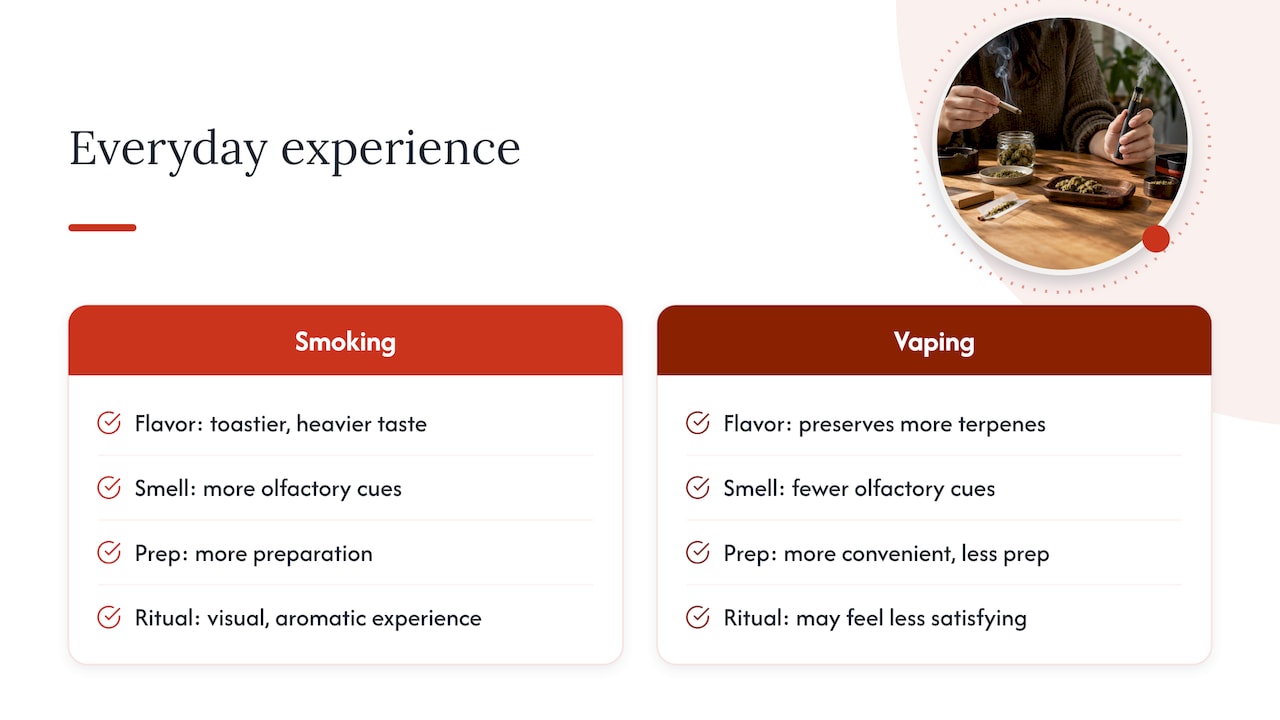
Ritual. Some participants missed the visual and aromatic experience of smoking and felt less satisfied by vaping. If sharing a joint with friends is half the point, a vape pen won’t replace it.
Pros and cons at a glance
| Smoking (joint, pipe, bong) | Vaping (dry-herb or cartridge) | |
|---|---|---|
| Combustion | Yes, with smoke, tar and carbon monoxide | No combustion, aerosol or vapor only |
| Lung exposure | Higher; linked to cough, phlegm and bronchitis | Lower for toxicants; product quality is the main concern |
| Potency per session | Generally lower delivery to the blood | Often higher; concentrates can be very strong |
| Flavor | Robust, toasty | Cleaner, more terpene-forward |
| Smell | Strong and lingering | Milder |
| Convenience | Needs rolling or packing, a flame | Charge and press |
| Ritual and sharing | Strong | Weaker |
| Main watch-outs | Smoke inhalation, mixing with tobacco | Additives, hardware quality, overdoing it |
Which method fits you?
Use your situation, not a blanket rule.
- You want the lowest-exposure inhaled option. A dry-herb vaporizer with lab-tested flower lines up with what harm-reduction researchers prefer. Browse our flower selection if you want to start there.
- You want zero prep and discretion. A cartridge or disposable is easiest. Our vapes, disposables and carts page shows what is on the menu, and we cover charging and handling in our vape battery safety guide.
- You love the ritual and flavor of flower. Smoking is fine as a preference. Keep sessions modest and skip the tobacco.
- You’d rather not inhale at all. Edibles avoid the lungs entirely, with a slower onset. See our edibles vs. smoking harm-reduction rules.
- You’re new. Choose a lower-THC product and the method you can dose most slowly.
Harm-reduction habits that work for either method
- Don’t mix cannabis with tobacco. The professional drug-information service The Level advises avoiding this because tobacco is highly addictive and can do more damage to your lungs.
- Prefer dry-herb vaporizing over concentrates if lung health is your main concern, per the 2023 review cited above.
- Buy tested, verified products. The review calls for strict testing and quality assurance in cannabis products, which is the best argument for buying from a seller that vets brands rather than an unlabeled cart from a stranger.
- Go slow. If you’re trying edibles, wait an hour before taking more. With smoke or vapor, effects hit quickly, so a pause of several minutes is enough to judge.
- Respect the hardware. Use the charger that came with the device and don’t leave it charging overnight.
- Know your own limits. If you have asthma, a chronic lung condition, heart disease, or you’re pregnant, talk to your doctor before inhaling anything. Don’t drive or work with machinery while impaired.
Perspective: why we steer people toward tested vapes and flower
We’ve been delivering in New York City since 2011, and the question we hear most is whether to smoke or vape. Our honest answer is that the method matters less than what is in it.
The people who walk into trouble are rarely the ones choosing between a joint and a dry-herb vape. They’re the ones who grab an unmarked cartridge, get a much stronger hit than expected, and have a rough night. That’s why we focus on lab-tested, verified products, and why we put education next to the menu.
If you want the cleaner-tasting, lower-smoke experience, a vape is a great fit and we carry a full range of flower, carts, disposables and accessories. If you want flower, we’ll happily help you pick something you’ll enjoy. Either way, we’d rather you start low and enjoy it than overdo it.
Jake
Get tested vapes and flower delivered in NYC
If you’re 21 or older and ready to try either method, we deliver same-day across New York City, with age verification at checkout and day and night menus so you can order when it suits you. Our site currently lists delivery fees from $8 in Queens and from $12 in Manhattan and the Bronx. Check the delivery times page for windows, or place an order on our site.

If you’d rather not be home for a handoff, you can look at scheduled delivery instead.
FAQ
Is vaping weed safer than smoking it?
It is likely lower risk for your lungs, because it avoids combustion and exposes you to fewer toxicants. Health Canada calls vaping less harmful than smoking for the lungs. The CDC, however, says there isn’t enough evidence to declare either method safer, and vape products can contain additives or contaminants. Buy tested products and keep doses modest.
Is a vape stronger than a joint?
Often, yes. In a controlled trial, the same dose vaporized produced higher blood THC and stronger reported effects than when smoked. Cartridges and concentrates also contain much more THC than flower. Take a single small puff and wait before another.
Does vaping weed smell less than smoking?
Generally. Research with recreational users found vaporization gives off fewer odor cues than smoked cannabis. It isn’t odorless, though, so don’t assume it is invisible indoors.
What are the main pros and cons of vaping weed?
Pros: less smoke, cleaner flavor, milder odor and easy use. Cons: it can hit harder than expected, concentrate and cartridge quality varies, and some people miss the ritual of smoking. Dry-herb vaporizers with tested flower avoid most of the potency and additive concerns.
Sources
- Cannabis vaporisation: Understanding products, devices and risks (2023)
- CDC: Cannabis Frequently Asked Questions
- Health Canada: Using a cannabis product
- Health Canada: Cannabis accessories for inhalation
- Acute Effects of Smoked and Vaporized Cannabis in Healthy Adults, JAMA Network Open
- Peering Through the Haze of Smoked vs Vaporized Cannabis, JAMA Network Open
- Johns Hopkins Medicine: Vaping cannabis produces stronger effects than smoking
- Mode matters: how modes of cannabis consumption differ (2025)
- Clinical Application of Cannabis Vaporization
- Cannabis use and its impact on respiratory physiology (2025)
- Toxicological assessment of aerosols emitted by cannabis joints and vaporizers
- Vaporization of Marijuana Among Recreational Users
- The Level: Cannabis